Come along with us as we visit Antarctica, The Falkland Islands, and South Georgia Island on our trip with Oceanwide Expeditions!
For the best viewing of this page on a tablet or phone, turn your device sideways.
We took this 22 day trip January 16 through February 6, 2026. There are lots of different opinions on the best time to visit Antarctica. Trips are only available from October to March, as this is summer in the southern hemisphere. January and February are generally the warmest months. The scenery and wildlife will vary from November to March, with November having pristine snow and mating and nesting penguins, December bringing penguin chicks, and February being prime season for molting penguins and whale sightings. We decided on January/February based on other commitments and Steve’s work schedule, so we were prepared to see whatever the season brought us. If you have a preference, there are lots of resources available to help you decide which month is right for you. This article is a complete review of our trip with advice and recommendations based on our experiences. For the blog posts I wrote each day while traveling, with more detailed information of the day’s activities, please see the blog page. For our detailed Antarctica packing list, click here. I have also linked each day’s blog post in this article.
How to Choose a Trip and Tour Operator
There are many different itineraries to choose from when visiting Antarctica, and several tour companies that offer them. Some trips only do a “drive by” of the Antarctic peninsula, while on others you can visit the Falkland Islands and South Georgia Island, as well as step foot on the Antarctic continent itself. Some sail deep into the Weddle Sea beyond the Antarctic Circle, and some trips from Australia and New Zealand visit the Ross Sea and McMurdo Sound. Some trips skip the Drake Passage by flying over, and some trips offer activities such as helicopters, mountaineering, kayaking, diving, camping, and photography workshops. The choices are overwhelming.
In addition to all the choices listed above, your choice of ship also matters. Ships larger than 500 passengers are not allowed to take passengers to shore per IAATO regulations (International Association of Antarctic Tour Operators). This is considered a drive by cruise. Many of these ships offer luxury cruising experiences and can be a great choice, depending on your preferences. Ships that carry 500 passengers or under (not including crew) are allowed to take passengers to shore via Zodiac, but only 100 passengers can be ashore at any given location at any given time, so it may limit your time on shore if you are on a larger ship.
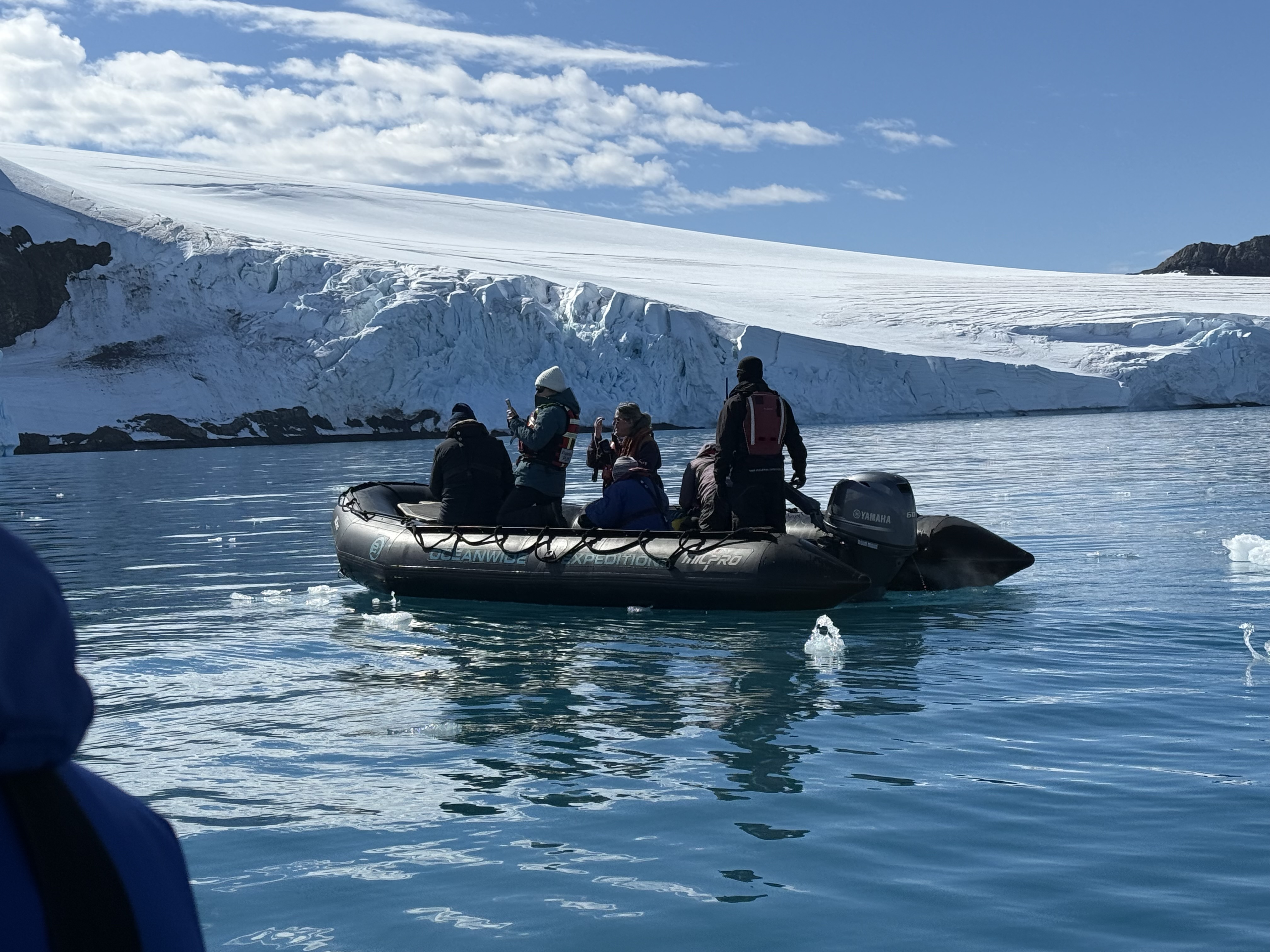
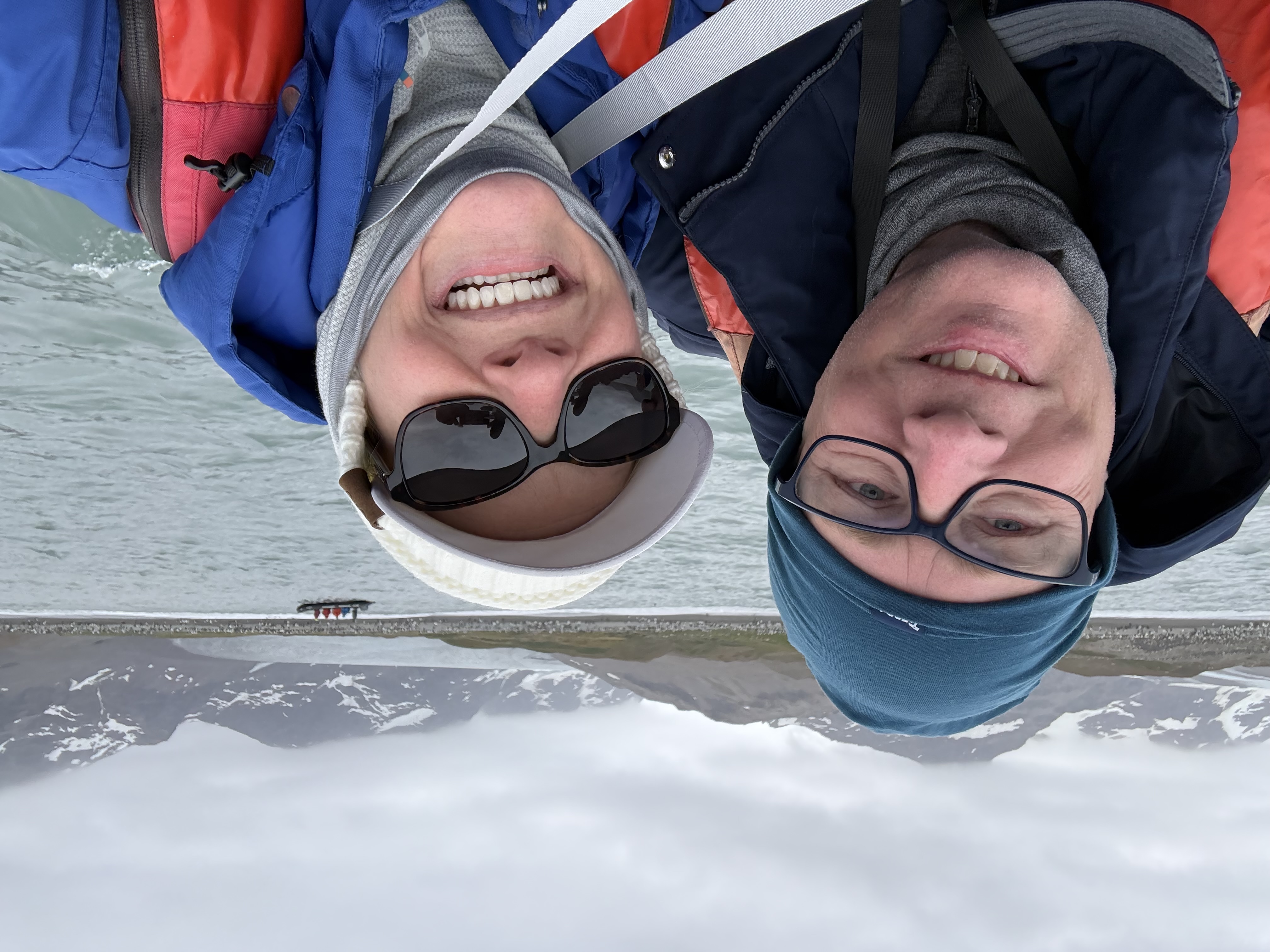
If maximizing the time on shore is important to you, you need to consider a ship that has under 200 passengers. Half the passengers can be ashore, while the other half is cruising in the Zodiacs, then they switch. Ships with only 100 passengers can take everyone to shore at the same time and offer an extended stay for hiking, wildlife viewing, and photography. These ships often offer twice per day landings and can spend three or more hours ashore each time. Prices for a trip to Antarctica can vary widely, based on ship size, itinerary, and the activities that are offered, from $5000 per person to upwards of $40,000 per person. Plan to spend more for a smaller expedition ship than a larger drive by cruise.
There is no right answer to which ship and company is the best. This is a personal decision and that answer will be different for every person, depending on age or physical ability, budget, time, and interests. We started out by contacting Polar Tracks Expeditions. Their agents are all either current or former polar guides and are very knowledgeable with all the inside information. This is how we discovered all the above information about ship size, etc. They will offer you a questionnaire to fill out. This will help them match you to an operator and ship based on your preferences. (We found Polar Tracks through their affiliated Facebook group “The Antarctic Experience: From Bucket List to Booked.” It is full of valuable information if you want to start by nosing around there.) Polar Tracks only offers trips on ships with 200 passengers or less, as they will tell you this is the best way to truly experience Antarctica. If you are interested in a larger ship, they can direct you to the best choices in that category, but you cannot book those ships through Polar Tracks. (We are not affiliated with Polar Tracks in any way.)
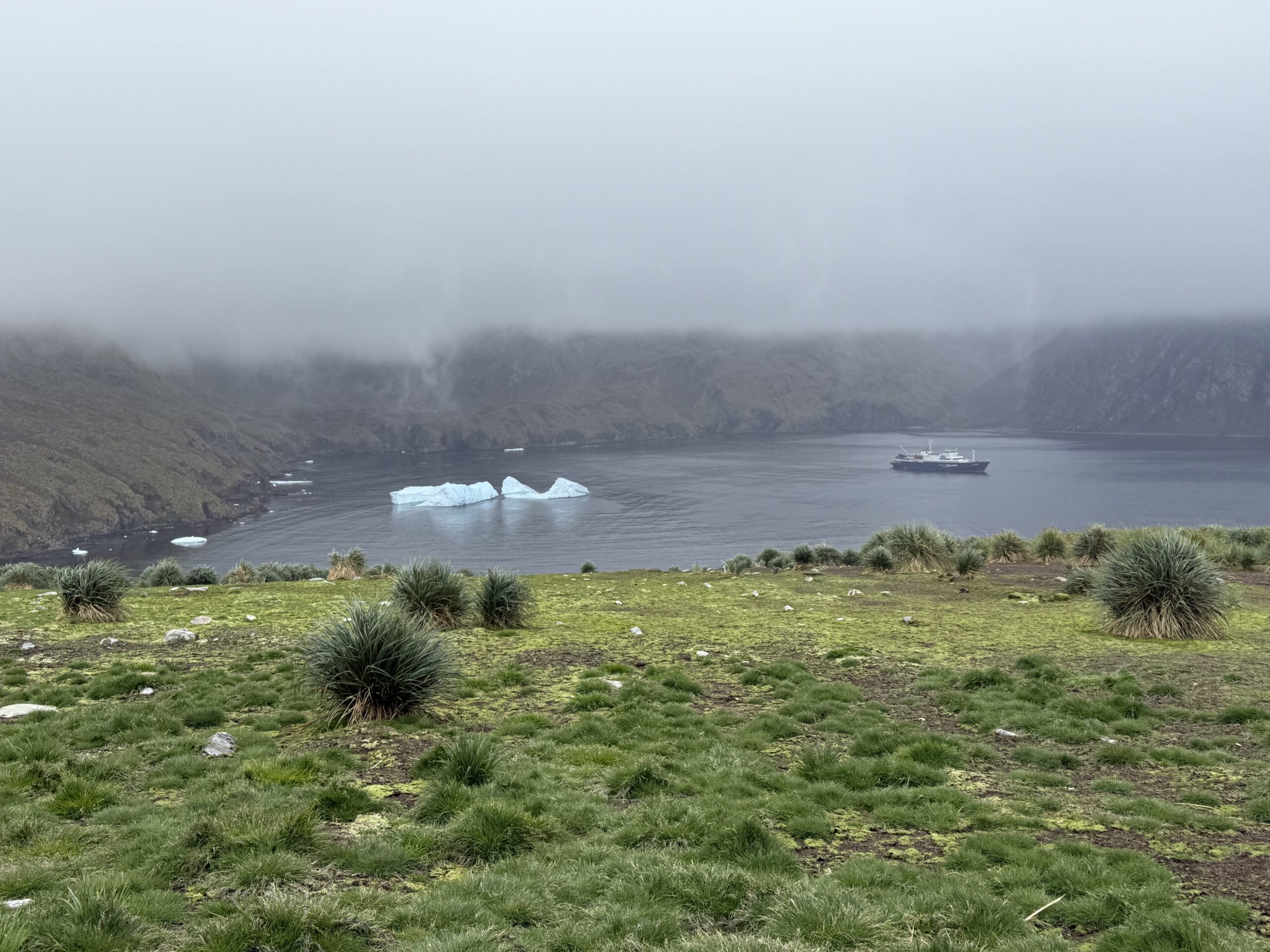
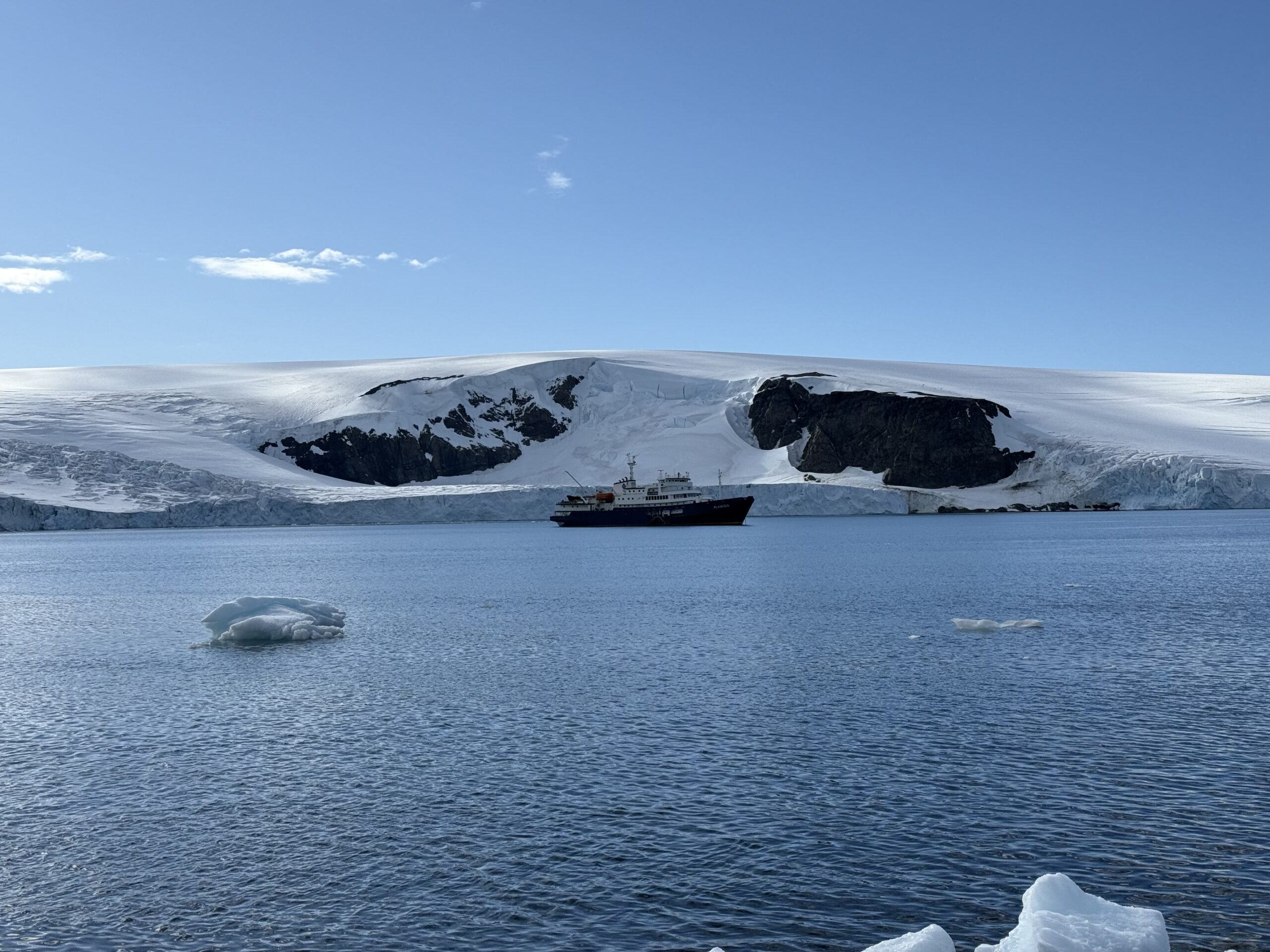
Our Ship and Itinerary
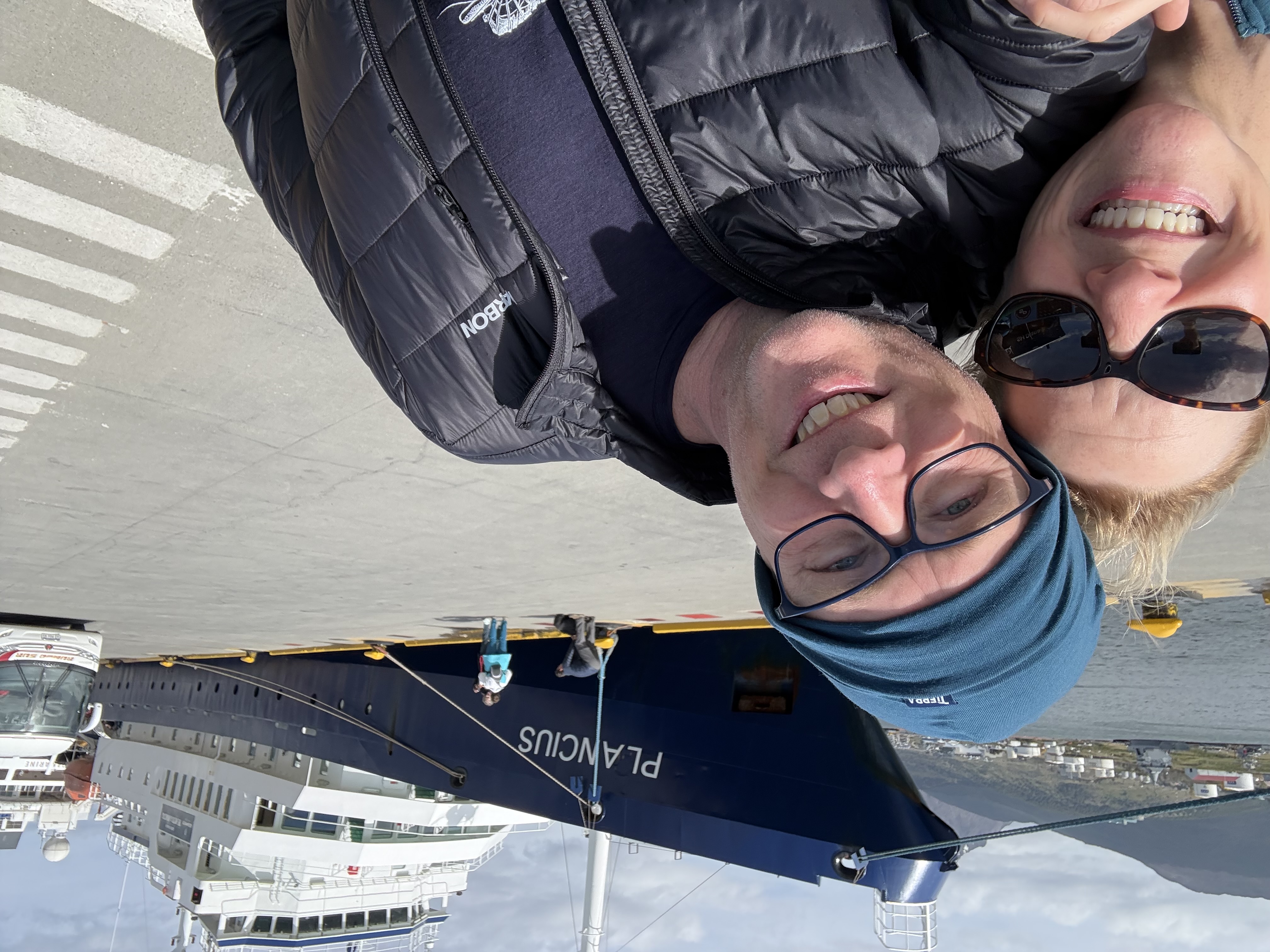
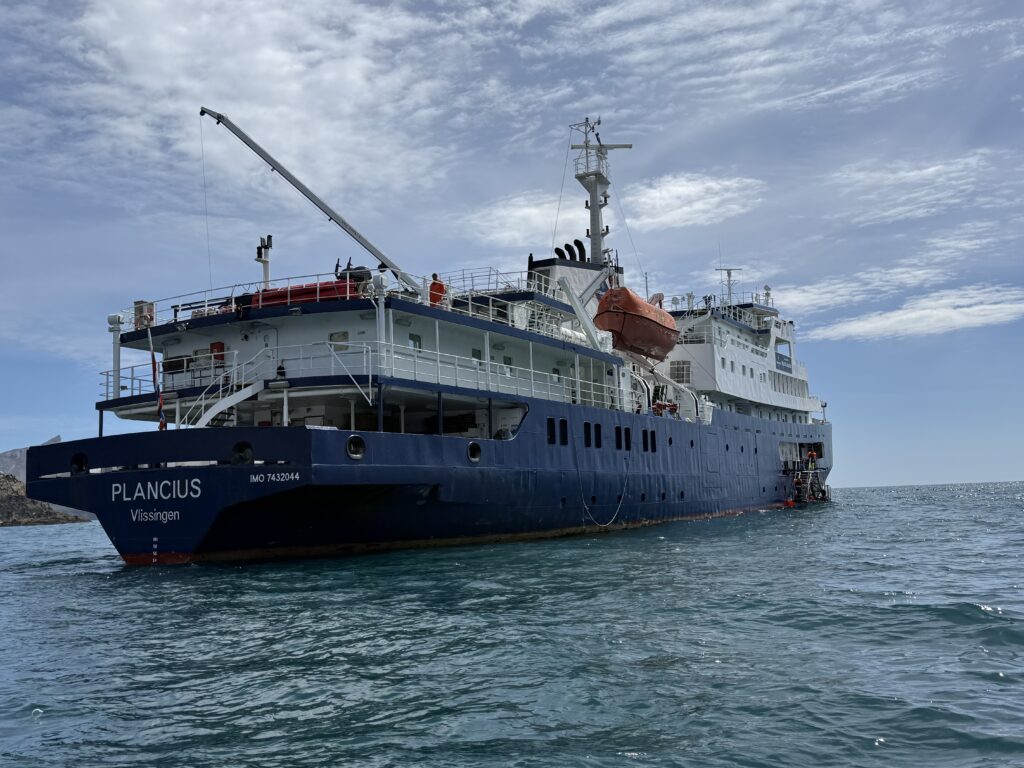
After looking at all the options, we decided we wanted a small ship under 200 passengers, and we also wanted to visit the Falklands, South Georgia, and step foot on the continent. This narrowed down our choices, which were further narrowed by Steve’s work schedule. Through our Polar Tracks agent Jon Furhmann, we booked a 19 day trip with Oceanwide Expeditions on the m/v Hondius, which holds 170 passengers. Long story short, we then had to change our sailing date and ended up on the same itinerary on OE’s ship m/v Plancius, which holds 108 passengers. And let me tell you, we sure made the right decision here, as you will see in the rest of the article. We ended up with 95 passengers on board, and 44 crew members, so all of us could go ashore at the same time and spend two to three hours exploring each time.
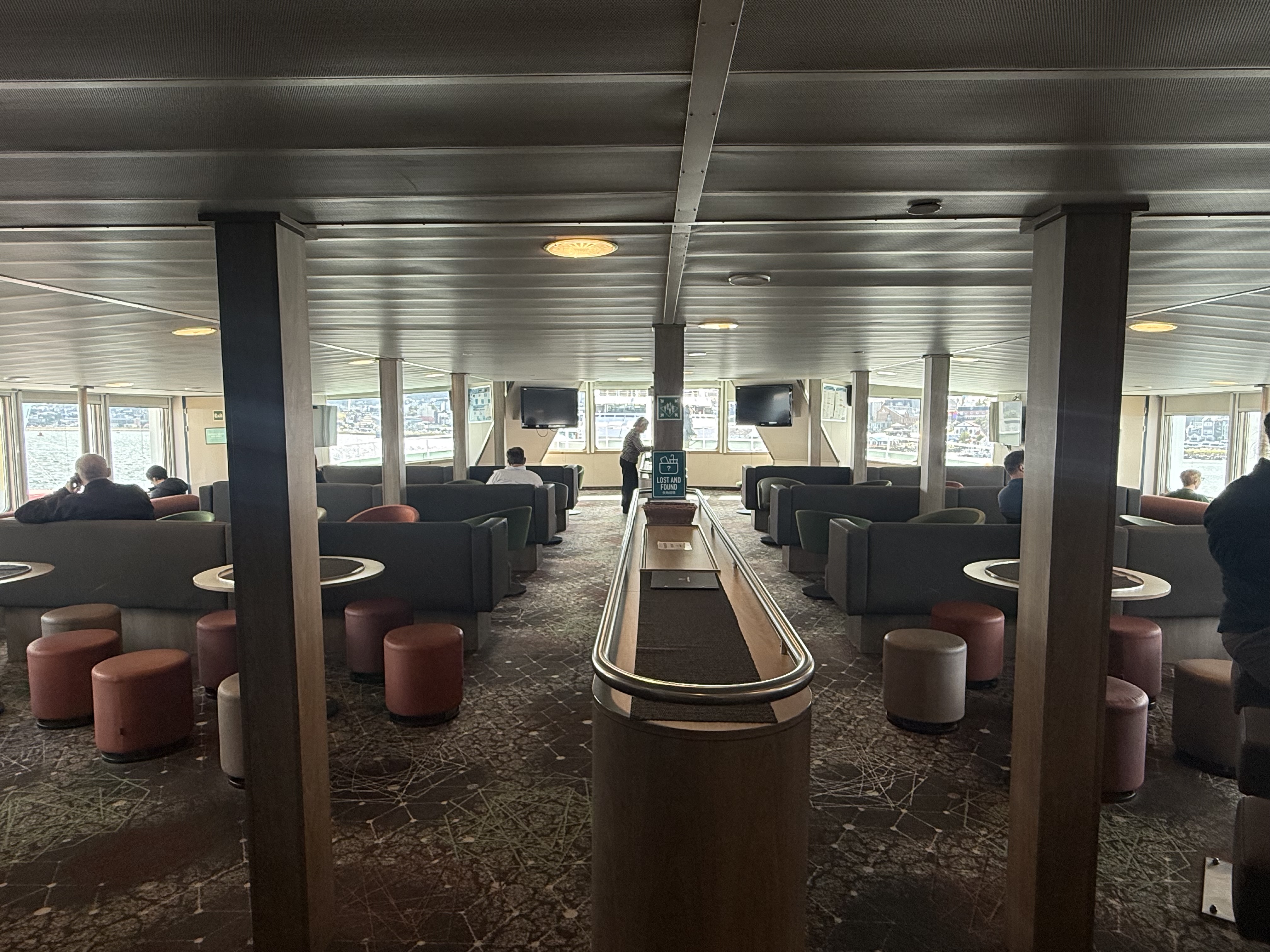
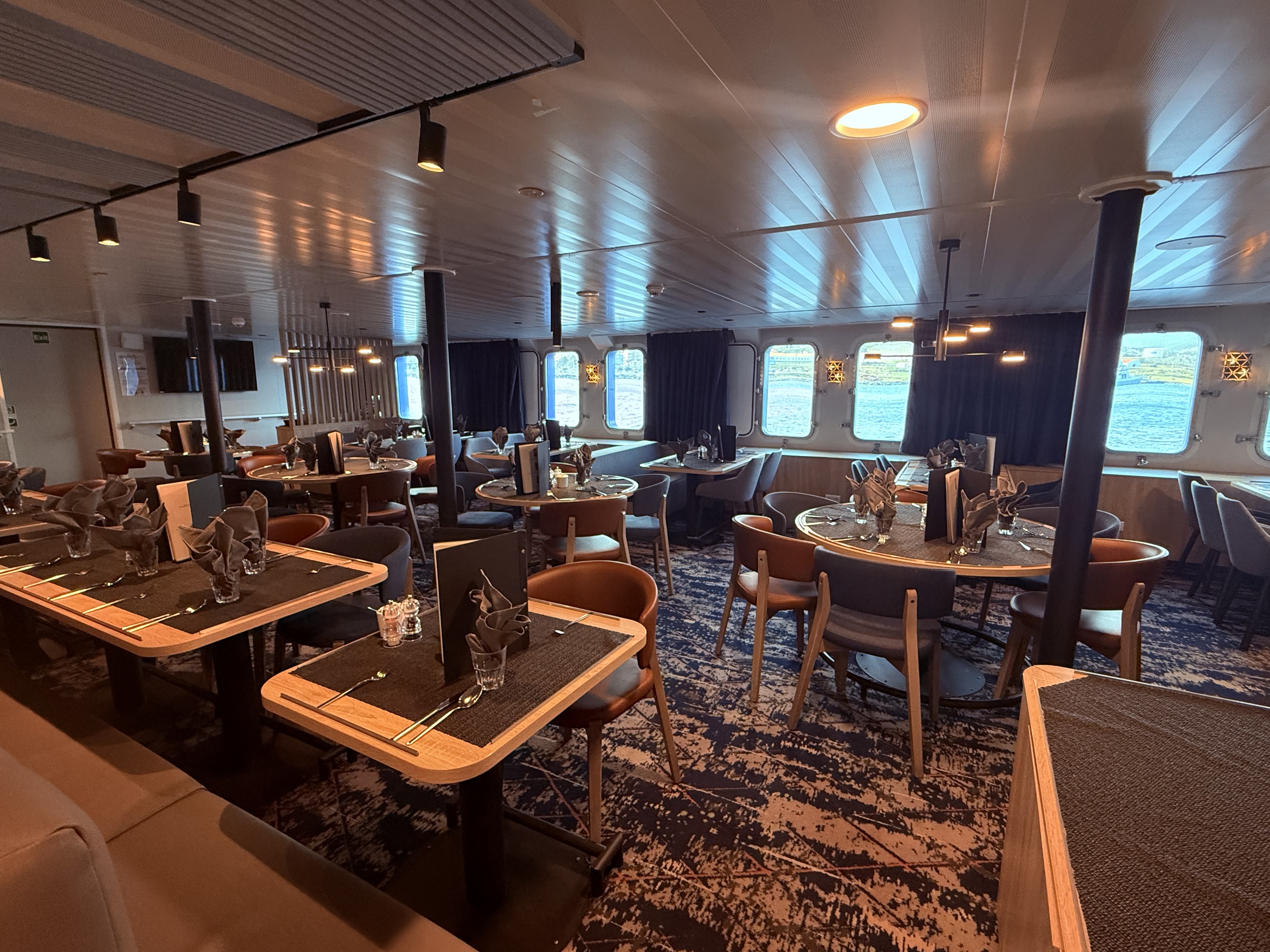
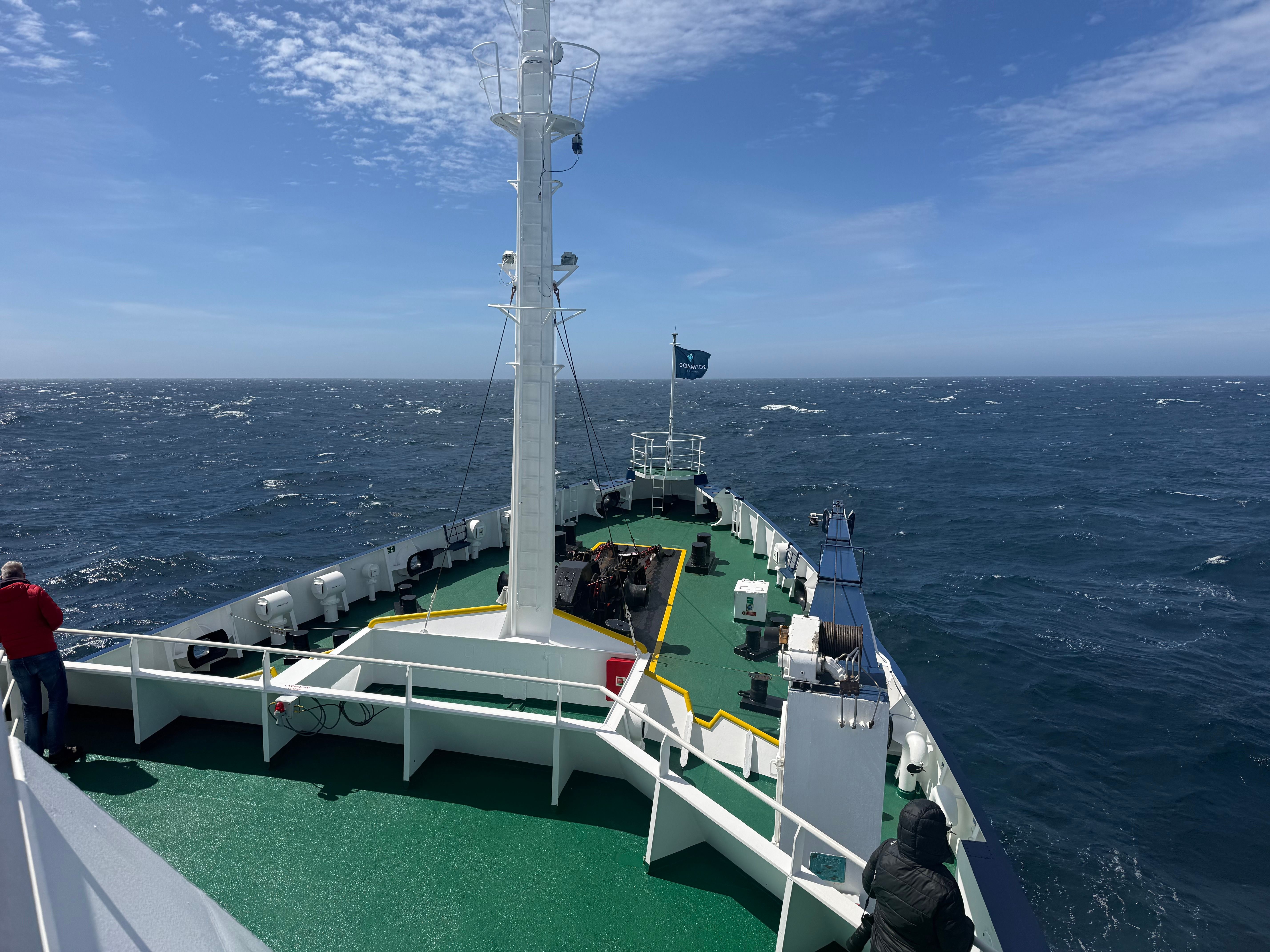
The Plancius is a former Dutch Navy ship, built in 1976. Since being purchased by OE in 2009 and retrofitted to hold 108 passengers in 50 cabins, it has been sailing Arctic and Antarctic itineraries. This ship is not a luxury ship; there is no spa or gym, no pool or sauna, only one dining room where everyone eats at the same time, and one large lounge and bar area with comfortable seating. Cabins are nicely appointed with typical small bathrooms, comfortable beds, and basic amenities such as shampoo and soap. We were quite comfortable and surprised at how perfect the ship actually was.
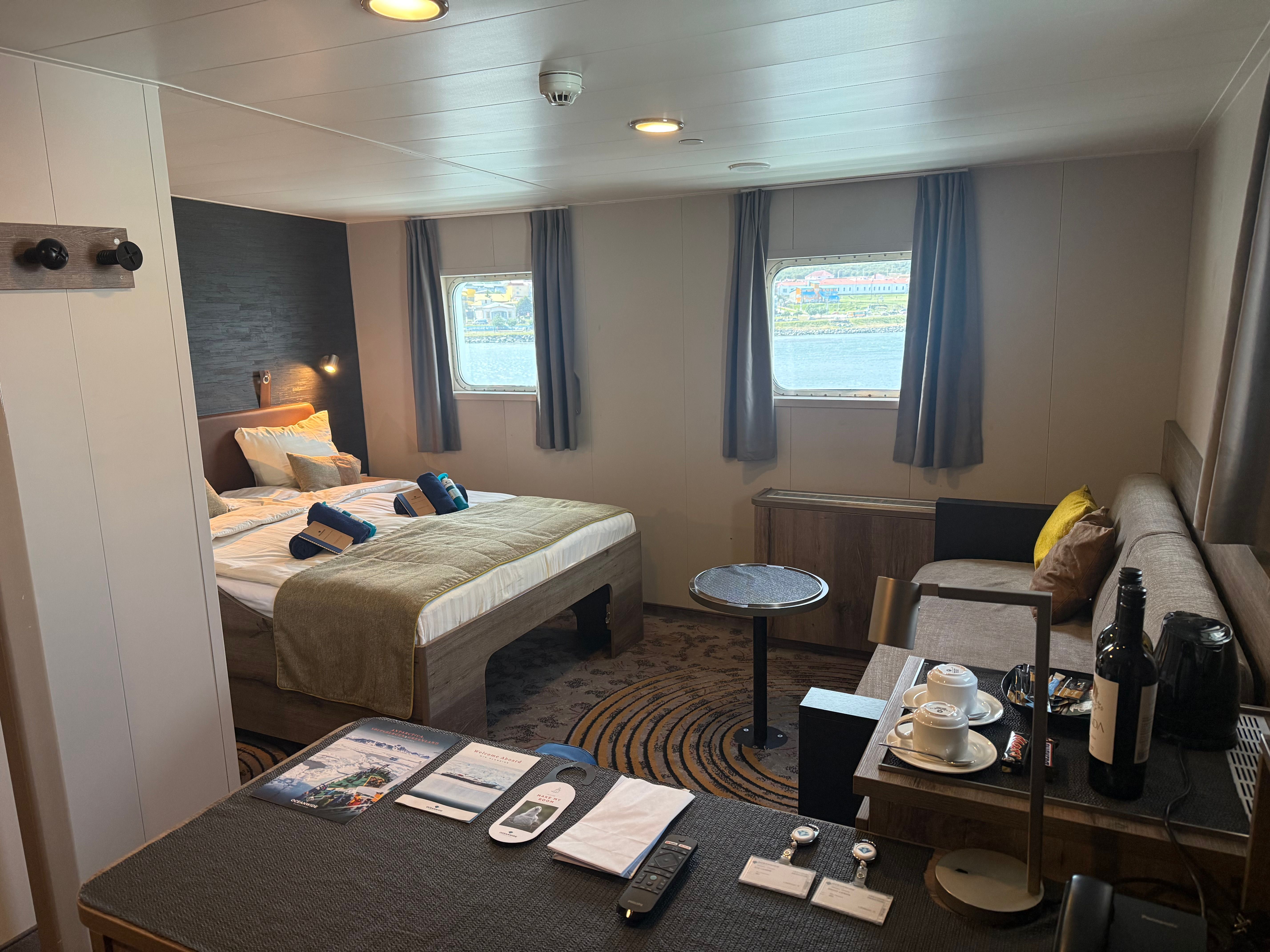
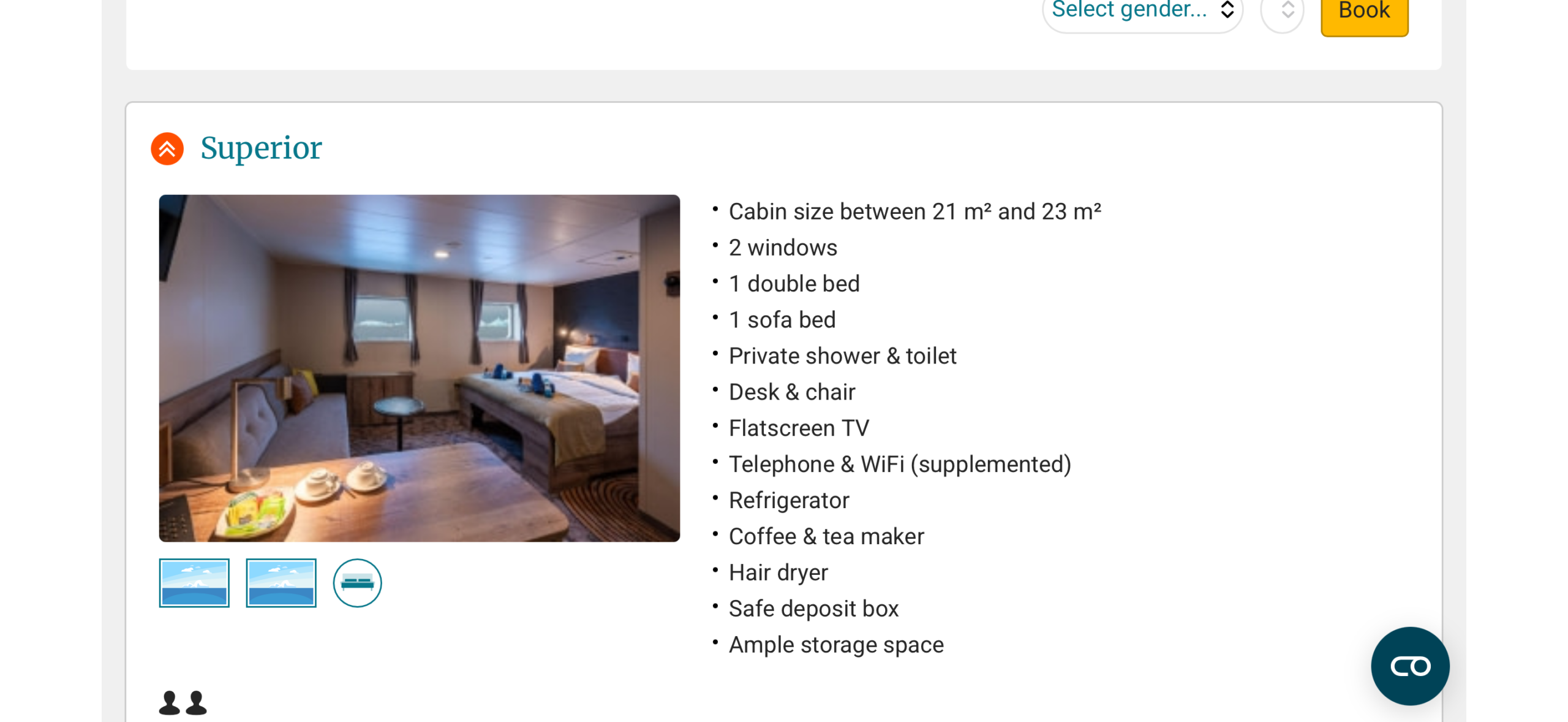
We booked a superior cabin on the top (6th) deck and were assigned cabin 602. Our cabin was quite spacious, with three windows (we happened to be on the corner), a large couch, a desk and chair, a closet with a safe, and quite a bit of storage. Our cabin also included a refrigerator, coffee and a kettle, and two bottles of wine that we could take to the dining room with no corkage fee. Other cabin categories include twin and twin deluxe with windows, and triples and quads with portholes. Single passengers are welcome and will be assigned a roommate or two, depending on the category booked.
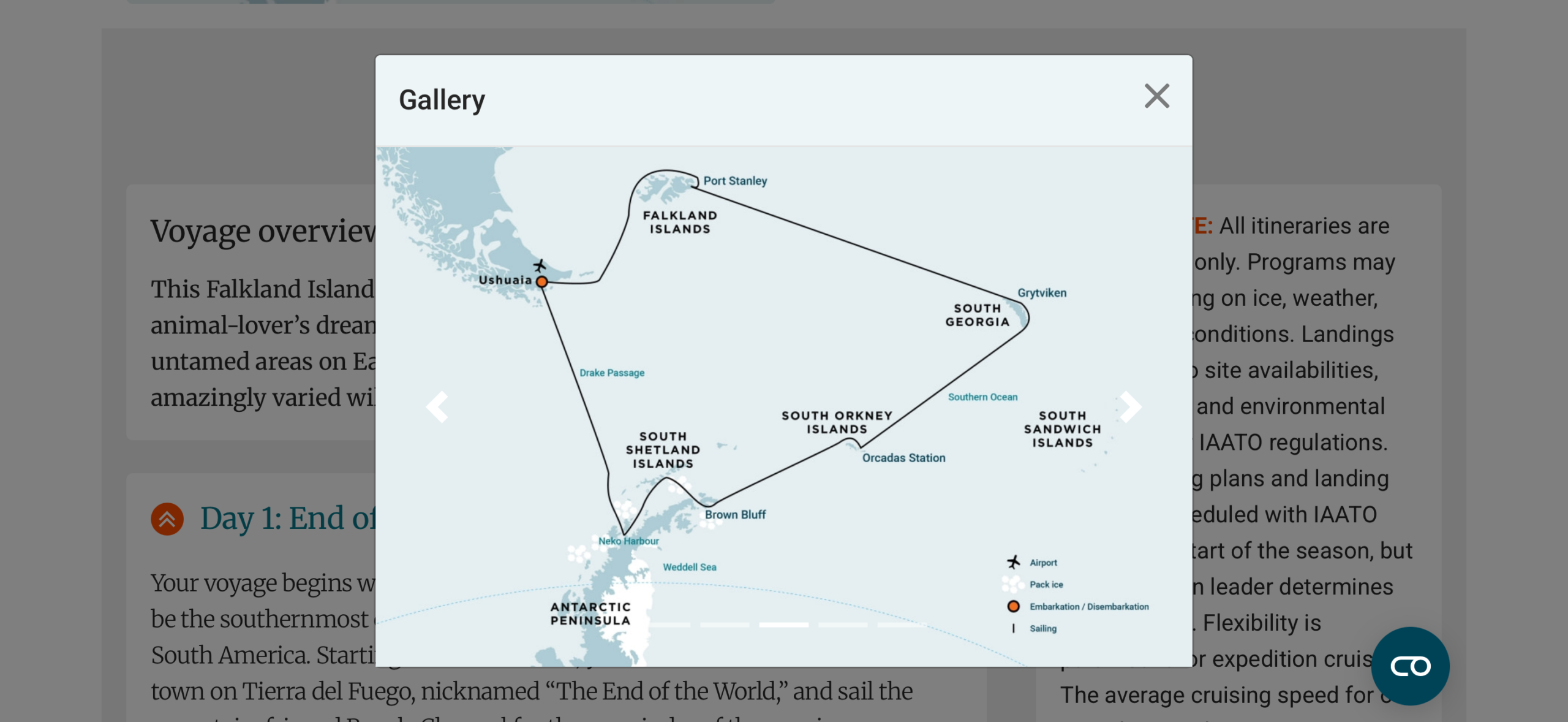
Most sailings from Argentina leave from Ushuaia or Buenos Aires. We sailed out of Ushuaia, headed north to the Falkland Islands and spent two days making landings there. We then spent two days sailing to South Georgia Island, where we spent four days making landings. Three days were spent sailing to the Antarctic peninsula, where we also spent three days making landings before our two day crossing of the Drake Passage and returning to Ushuaia.
The Gear and Packing
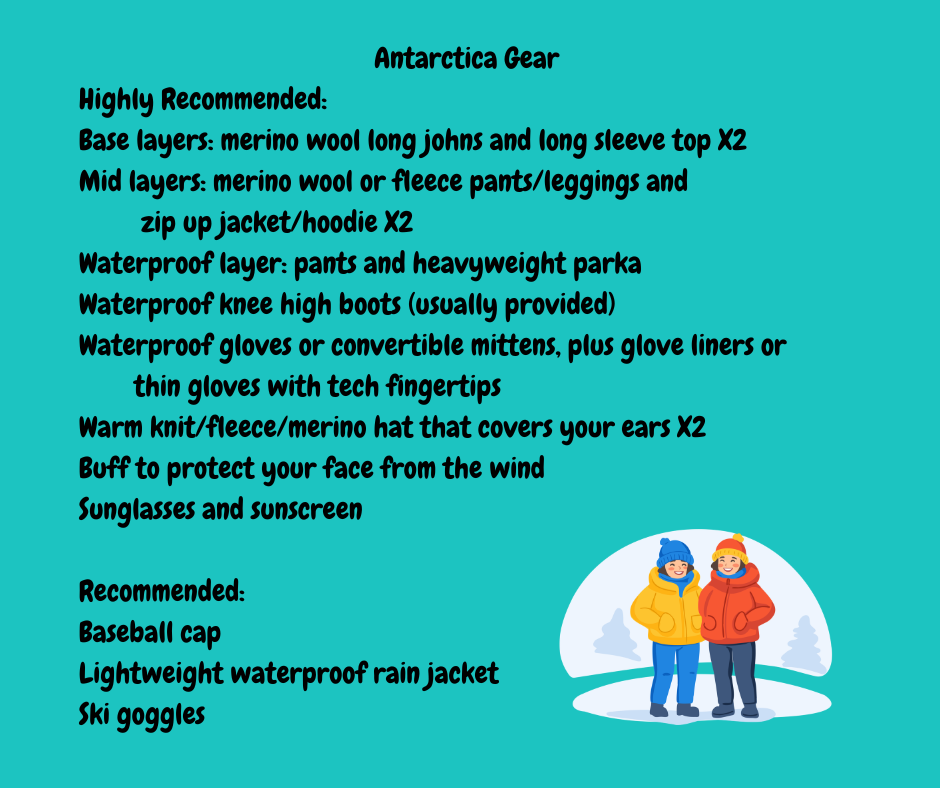
An expedition trip to Antarctica does require some specialized gear, but much of it is likely already in your closet, unless you live in a year round hot climate. Oceanwide will send you a list of recommended items, and there are some really good resources available in their related Facebook group that I mentioned earlier. We recommend a base layer if you need it, a mid layer, and a waterproof layer for all Zodiac/shore excursions. We generally did not need two layers as the days were warm when we were there and we tended to be too warm when hiking on shore, but YMMV. Oceanwide does not provide parkas, so we highly recommend renting a waterproof parka from New Headings in Ushuaia. This information will be sent to you. Rentals were $89. I picked mine up in Ushuaia and left it on the ship as instructed. We also rented ski goggles online at New Headings before leaving the US. We did not have enough bad weather to need them, but were glad to have them with us in case, as we both wear glasses. (See our blog post for the funny story of me leaving my own parka that I planned to bring with me in my car at the airport.)
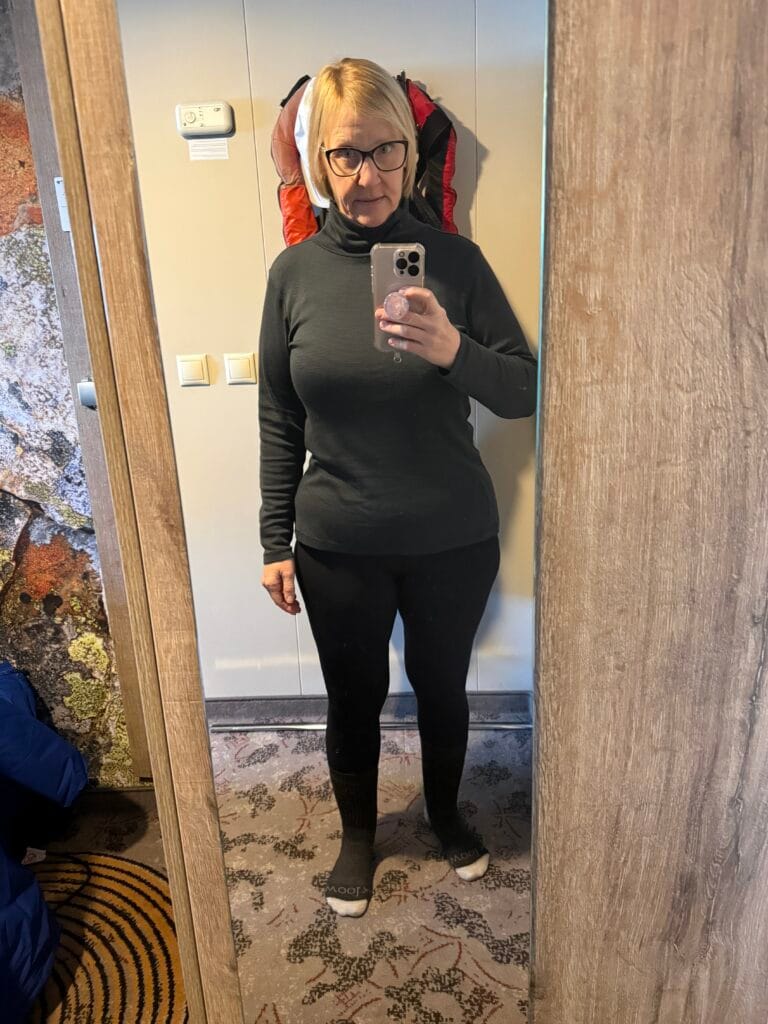
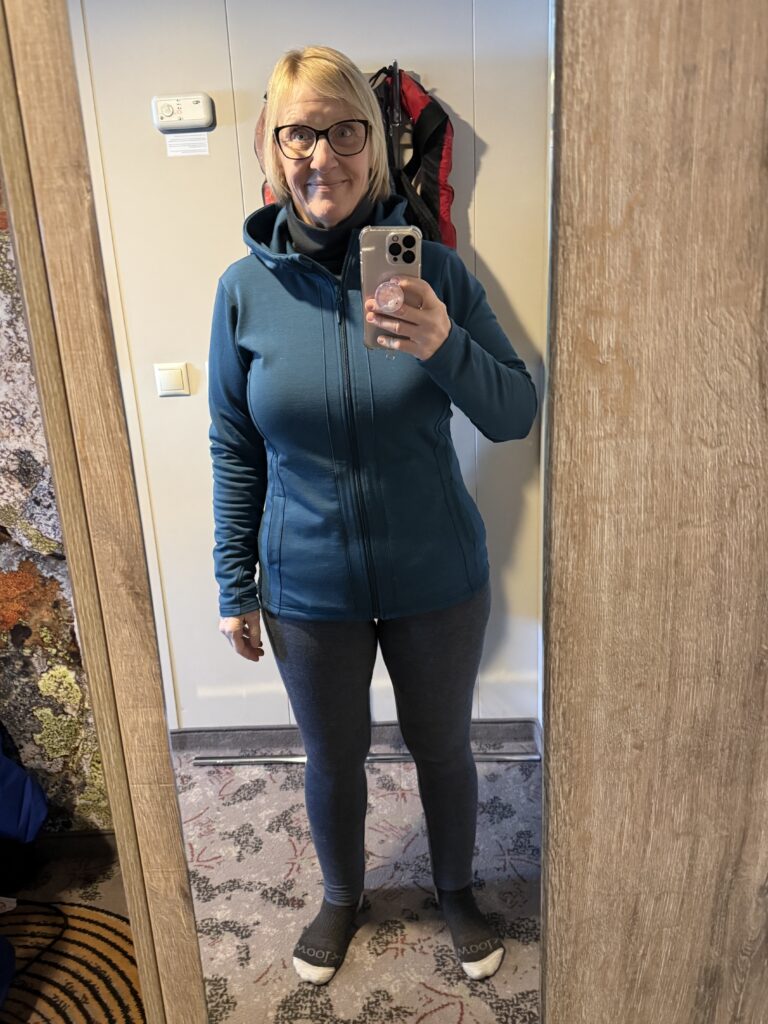
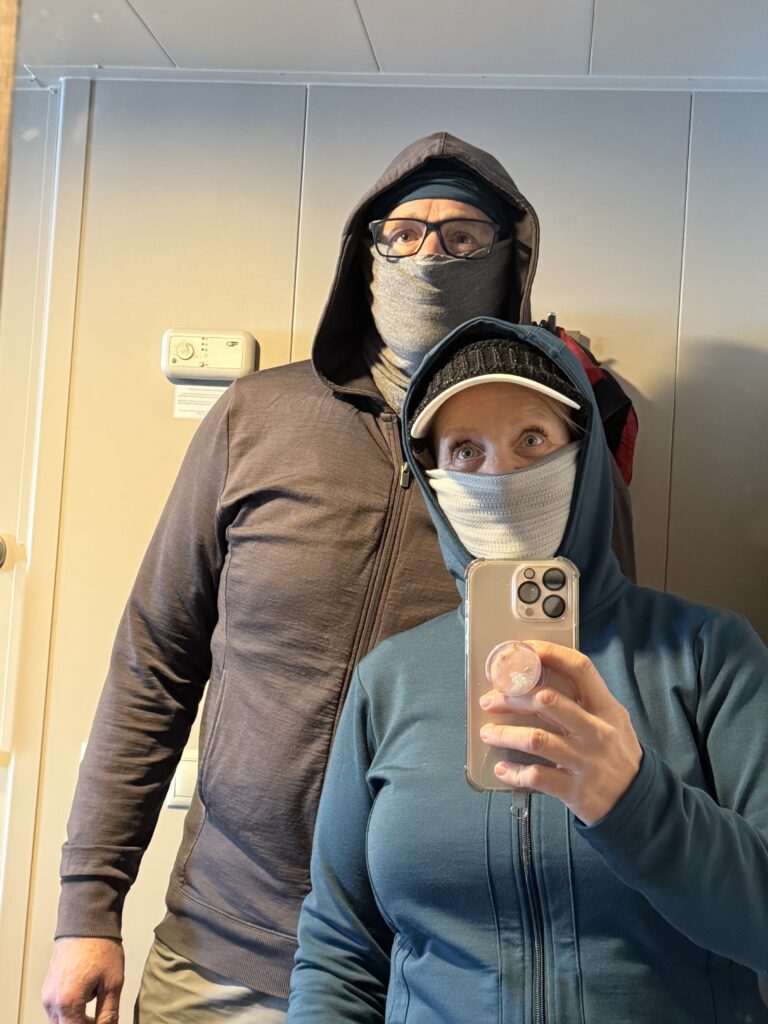
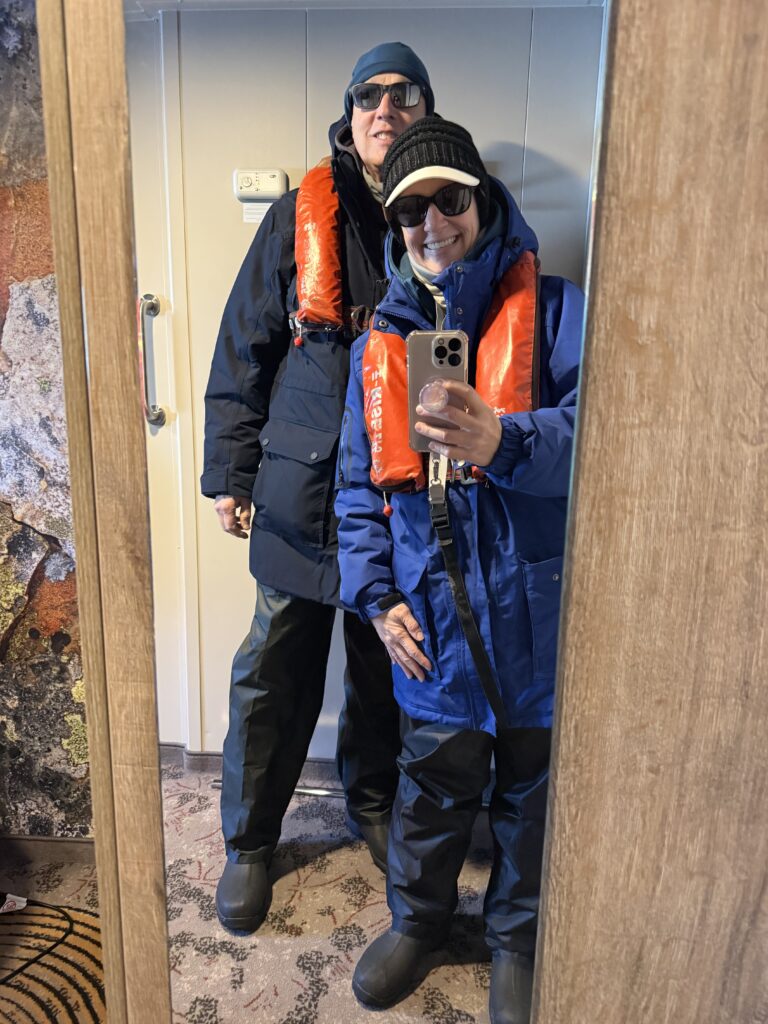
If you have ski gloves and ski pants, these will be perfect for your waterproof layer. We don’t ski, so purchased these waterproof convertible mittens and these waterproof pants for me, and these for Steve from Amazon, plus we took thin merino gloves with tech fingertips, but rarely wore them. In addition to a heavyweight parka, we also recommend a regular lightweight waterproof raincoat. There were many days our heavy parkas were too warm and we found ourselves wishing we had a lightweight rainproof jacket instead. You will also want a down puffer type coat. We wore these out on the deck, as well as under our parkas to have a jacket when we took off the parkas on shore. (You are required to wear waterproof pants and coat on the Zodiac rides.) Oceanwide will issue your waterproof Muckboots on the ship, and these are also required for all Zodiac rides. With regard to hats, we recommend two warm hats. You will likely get a bit wet on at least one Zodiac ride, and if you are doing two trips per day, you will have a dry hat to wear (ask me how I know). The same is true for your base or mid layers. If they get sweaty, which ours did under our waterproof pants, you have a dry set for the next ride. I have super sensitive eyes, so I also wore a baseball cap. In addition, I took a merino wool headband, as I find full hats too warm when hiking.
The ship has a very casual vibe and most people wore the same couple of outfits around the ship each day. There is no changing for dinner, everyone just wore whatever they had on. We packed in a carry on and backpack each, but we pack light and don’t mind washing things in the sink when we travel. There is laundry service available on the ship, but we did not use it so I don’t have the prices. For more detailed information about packing, see our complete packing article here.
The Flights
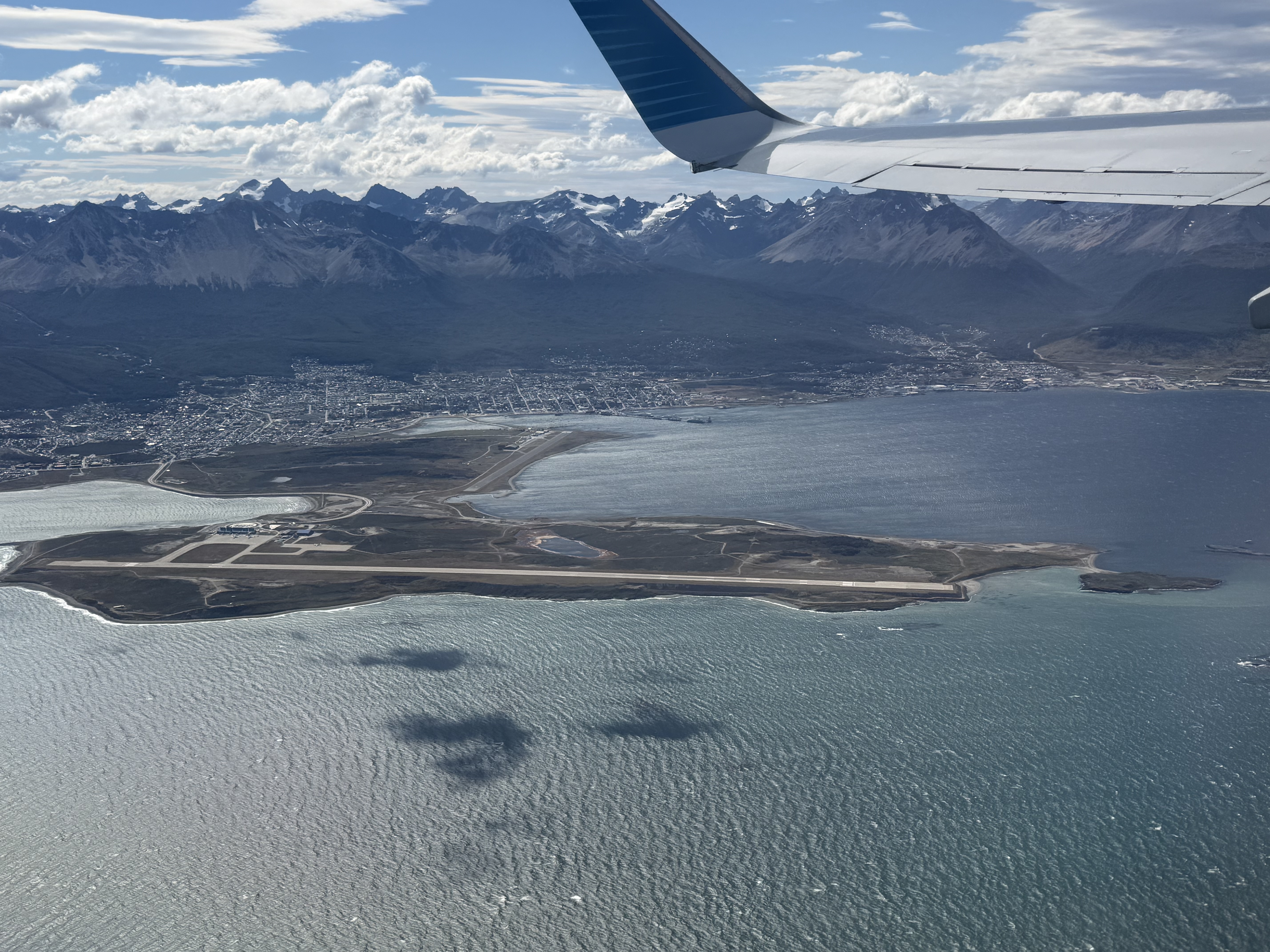
We opted to book two separate round trip tickets for this trip, as we didn’t like the choices when trying to book the trip from Louisville, KY all the way to Ushuaia. We booked a R/T on Delta from Louisville to Buenos Aires with a layover in Atlanta, then a separate R/T from Buenos Aires to Ushuaia on Aerolineas Argentinas (AA). This was a 3.5 hour flight. AA is practically the only show in town that travels between the two cities. There are other airlines, but the market is highly dominated by AA. Be careful choosing flights on AA, as there are two airports in Buenos Aires. The main airport is Ezeiza International (EZE), and the smaller domestic airport is Aeroparque Jorge Newbery (AEP). Often, AA uses AEP for their Ushuaia/Buenos Aires route, then passengers have to take a taxi or Uber to or from EZE for their international flight, so be aware. We were fortunate to book our trips on AA through EZE and not have to switch airports. Also be aware that Aerolineas Argentinas is famous for changing your flight after you’re booked and confirmed. Ours was changed just once, and it was to our advantage, but others have reported their flight dates or times being changed more than once, and being changed to the other airport from what they booked.
Ushuaia, Taxis, and Money
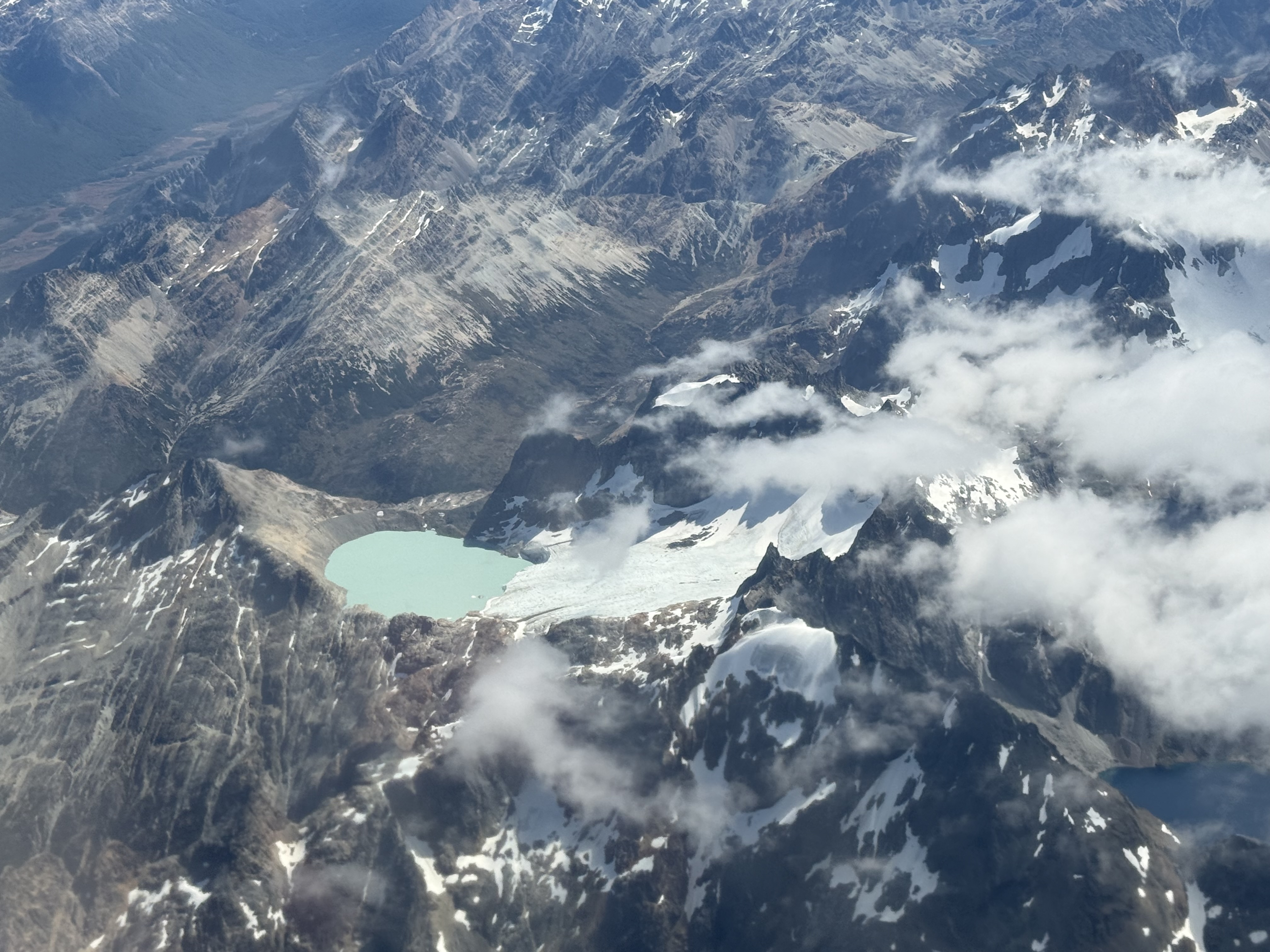
We flew into Ushuaia two days before embarking our ship. This is always good advice, especially if you check your bags. If the airline loses your bag, you have a couple days for it to catch up. You also have a couple days to adjust to the time change (it’s only three hours difference from the east coast of the USA) and to rest up or see some sights. Many people opt for a day trip to Tierra del Fuego National Park. We understand this is a great way to spend the day, but we opted to rest up. We arrived late in the day after our long trip with an overnight flight, so we had dinner at the Patagonia Brewing Company and went to bed.
We stayed at Hotel Albatros, directly across the street from the pier where we boarded the ship, so it’s a perfect place. The hotel was a typical three star hotel with a nice included breakfast buffet and comfortable beds. It’s within walking distance to lots of shops and restaurants. Our taxi driver drove us through the downtown area and pointed out a couple things before dropping us off at the hotel.
Speaking of taxis, our travel agent and Oceanwide Expeditions recommend only using a taxi from the official taxi stand located in the airport baggage claim area. There are apparently a number of unscrupulous taxi drivers, in Buenos Aires especially, and you can be taken advantage of. We heeded this advice and easily found the taxi stand. We paid 10 USD for our trip to the hotel from the Ushuaia airport, and tipped him 2 USD. They are happy to take USD, and they will ask you how you prefer to pay before they walk you outside to secure the driver.
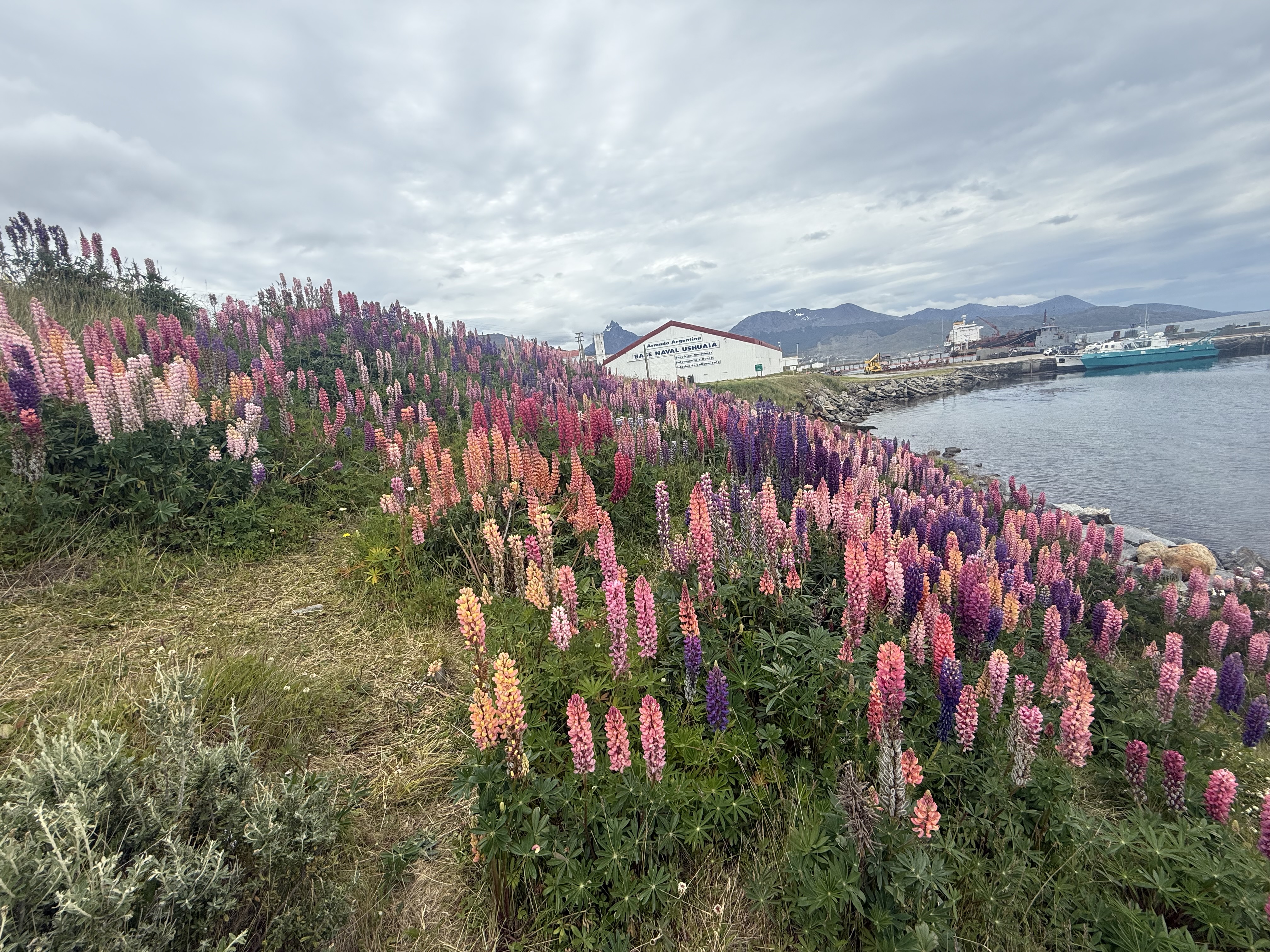
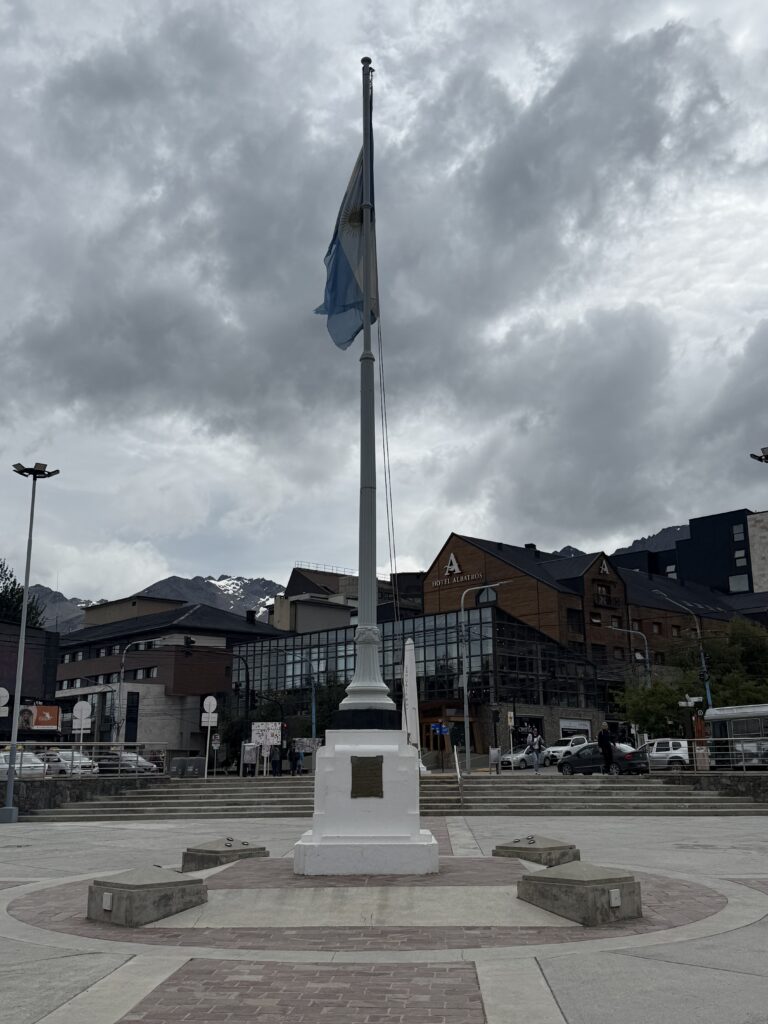
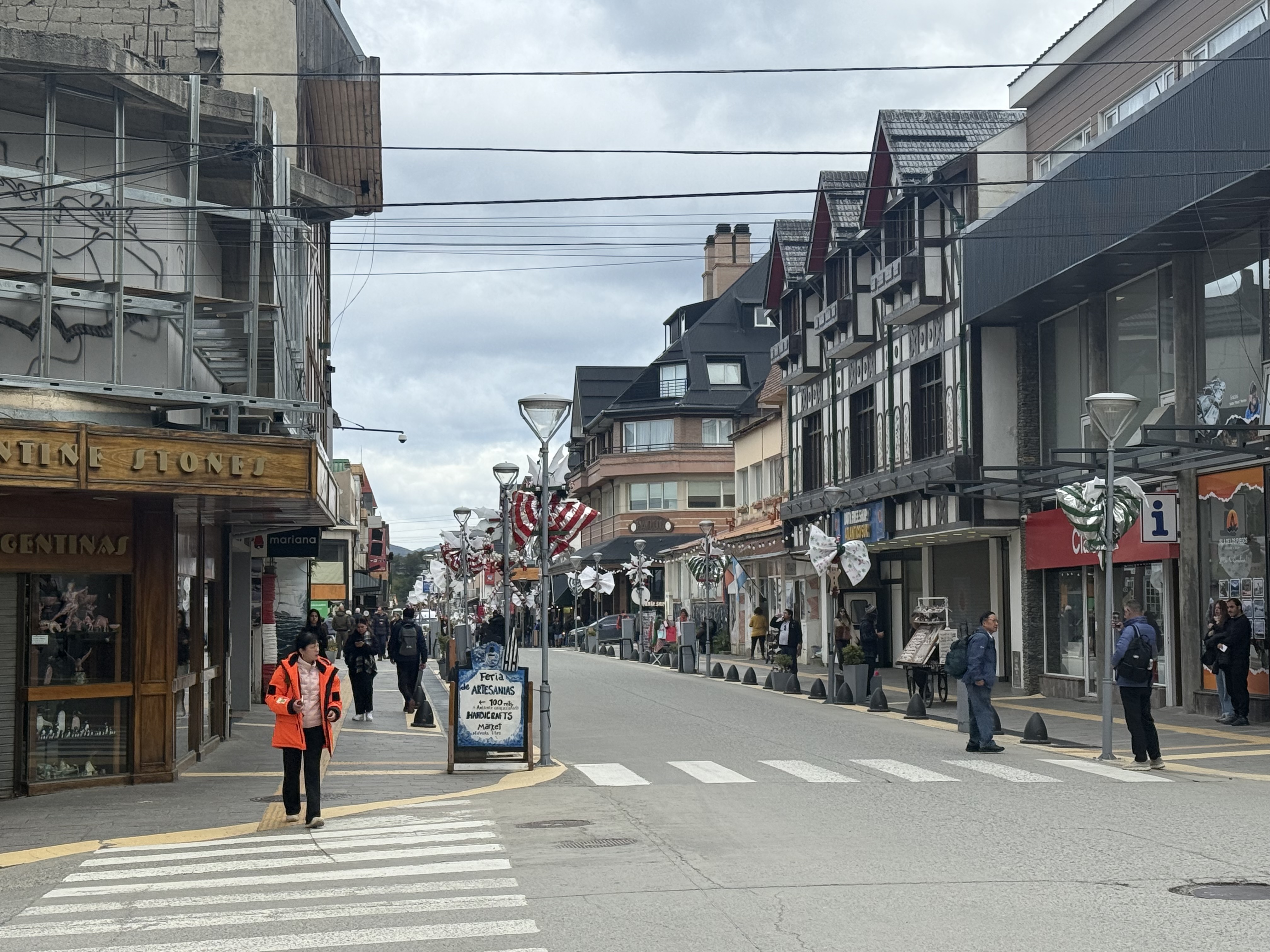
We did not have the need to get any Argentine pesos, as we used a credit card for our meals and purchases while in Ushuaia. Credit cards and Apple Pay/Google Pay are widely accepted. We understand that using an ATM can be problematic in Argentina, and to only use an ATM that is inside a bank. Do not use currency exchanges or free standing ATMs. The scam game is very high there, unfortunately. Please see our related article on how to use ATMs safely while abroad.
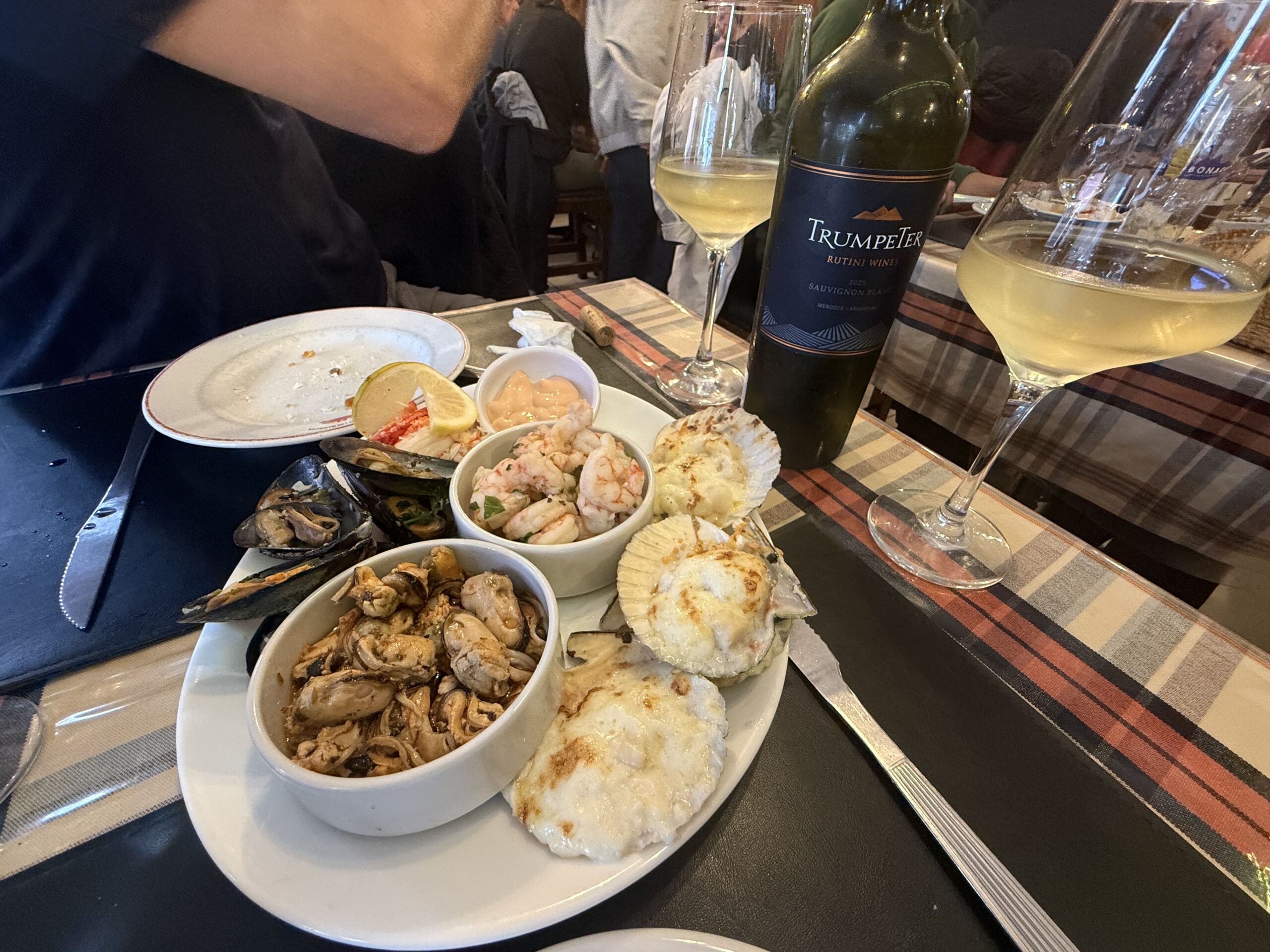
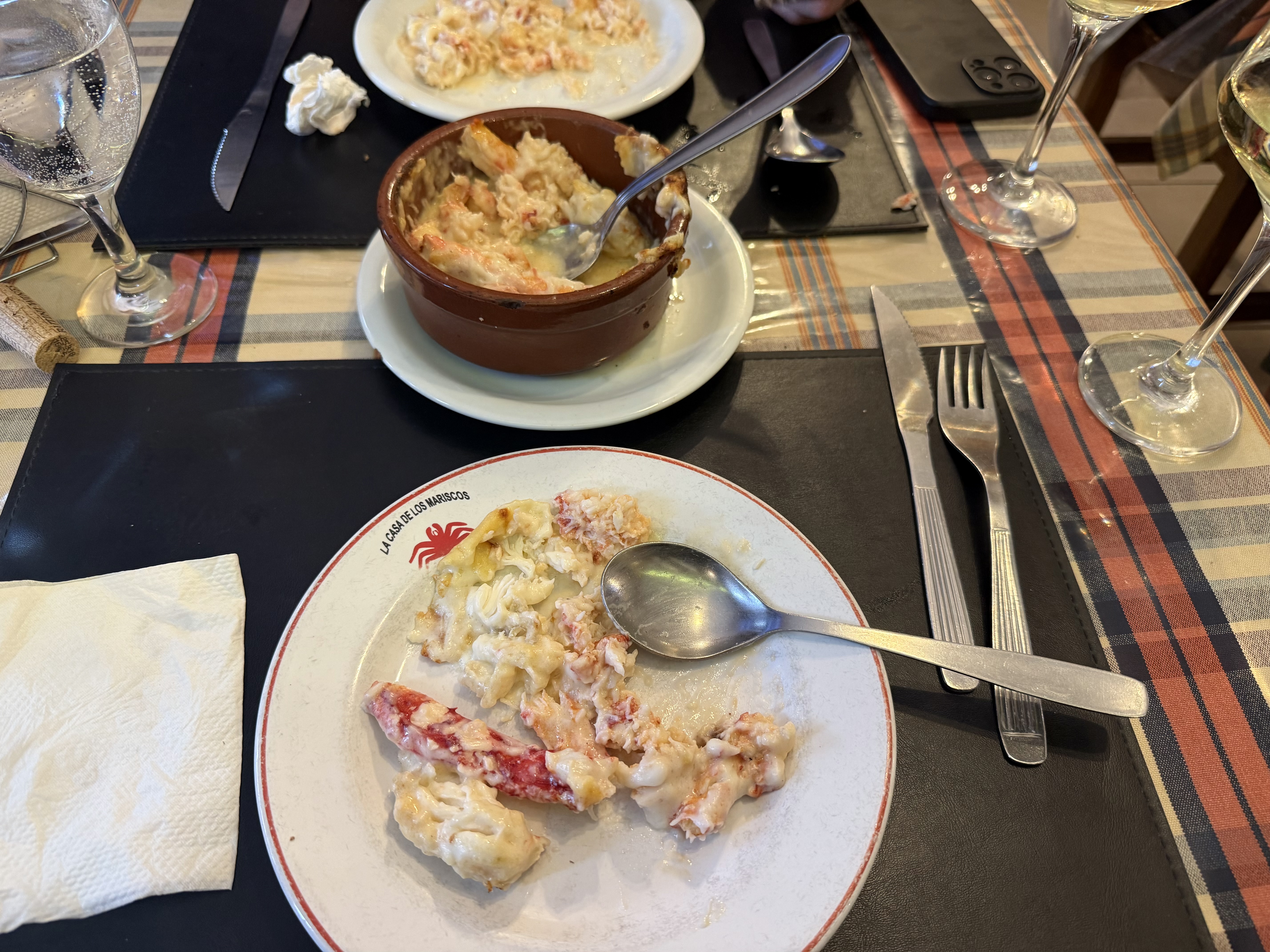
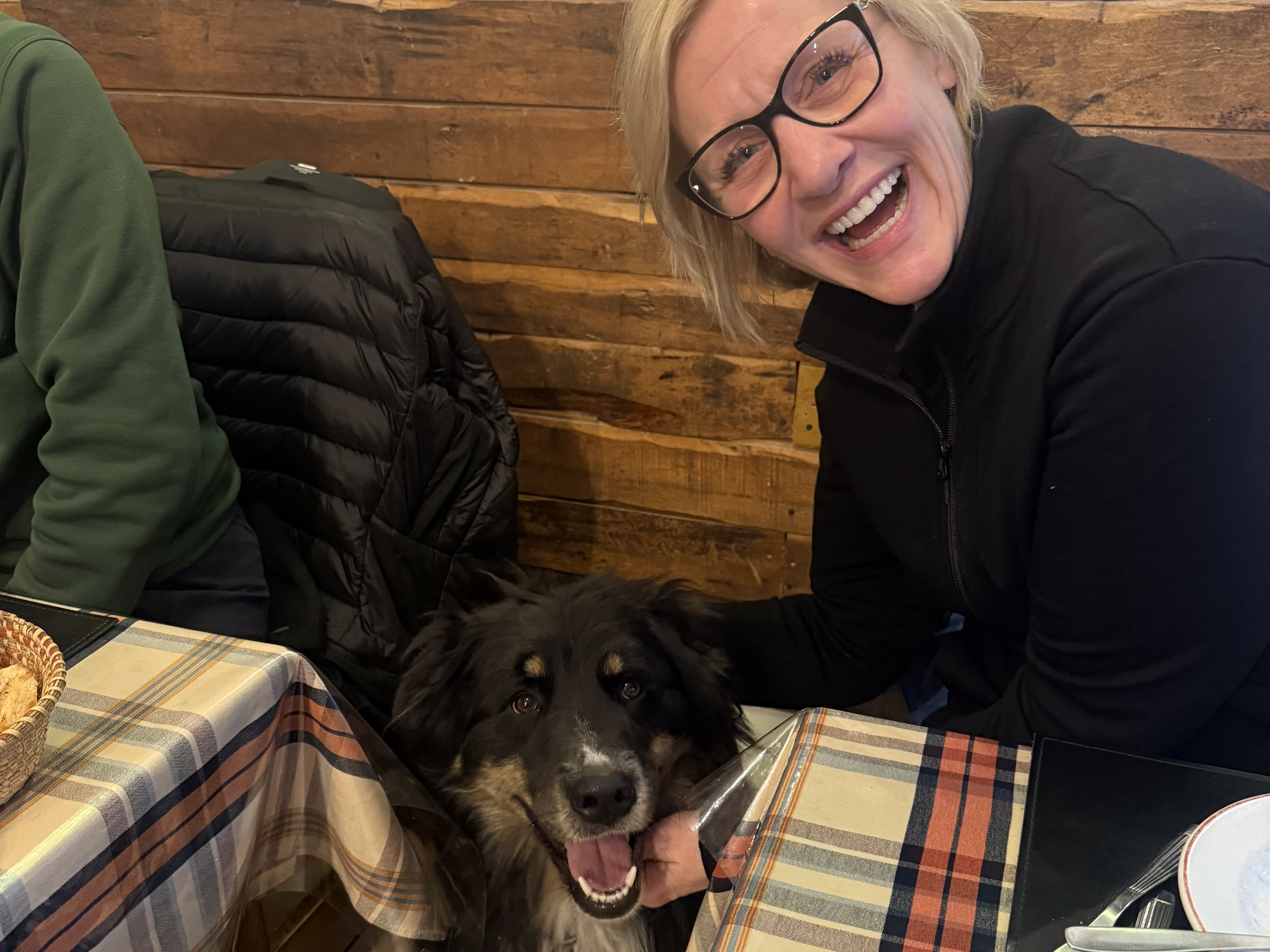
On our free day in Ushuaia, we slept in, walked around town, purchased some small souvenirs, visited three museums, and picked up my rental waterproof parka. We made a dinner reservation at La Casa de Los Mariscos. Be aware that there will be a long line outside the building before they open at 7:30 pm, with people without reservations hoping to get a table. When the gentleman came outside with the reservation list, we just walked up to the front of the line, gave him our name, and were immediately seated. The service and the food were great and we highly recommend having dinner here if you get the chance. Lots of King Crab is on the menu. Petting the random dog that came in when someone opened the door is optional. Today’s blog post is located here.
Boarding the Ship 1/19/26 Monday Day 1
Oceanwide considers the day you board the ship as day one, so you will see this reflected on their website and in this article. We boarded the ship at 4 pm on Monday. Most of the ships do a same day turn around when they come into port. They have to disembark the passengers, clean, resupply and ready the ship, as well as change some crew and guides, depending on the next sailing. Regulations prevent passengers from carrying their luggage onto the ship, so we were required to drop off our luggage between 8 am and 2 pm at a predesignated location. All of this information was made available to us before leaving the US. The drop off location is less than a half mile (about 2000 feet) from Hotel Albatros, so we opted to walk our bags down to the drop off point. It was a sunny day and it was a nice, albeit very windy, walk. Your mileage may vary if the weather is bad or if you have lots of luggage. We only had a carry on bag and a backpack each, so the walk wasn’t bad. The hotel can secure an official taxi for you if you don’t want to walk. We hung around in town, had some lunch, and visited a museum before heading down to the pier.
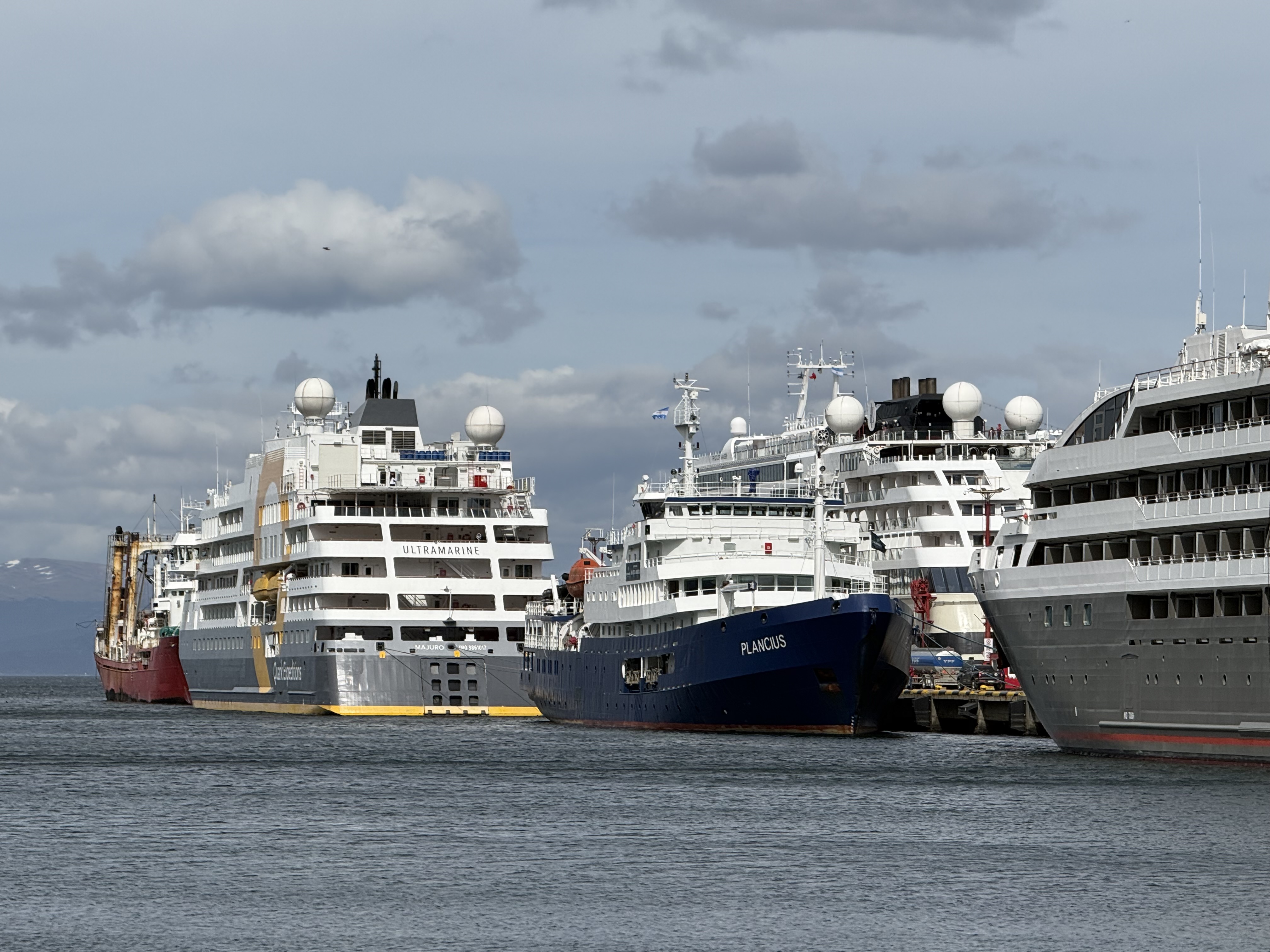
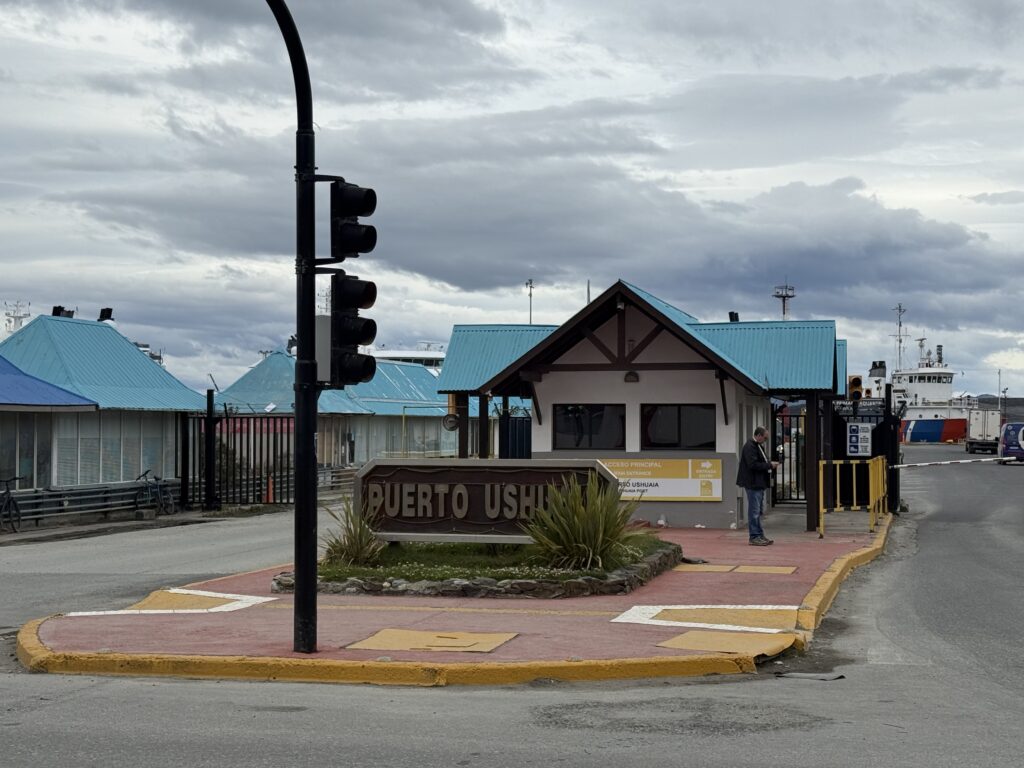
When boarding the ship, all passengers must enter the port area through the security checkpoint. It is clearly signed and easy to locate, directly across the street from Hotel Albatros. Be prepared with your passports and your boarding passes, pre-printed from home from your final documents. Once through security, all passengers can walk onto the pier and locate their ship. The pier is not large or especially long, and there were six ships in port on the day we embarked. Ours was easy to find…it was the one that looked like a tiny tug boat compared to the larger ships.
Once aboard the ship, a staff member will take you directly to your cabin, where you will find your luggage and your key card waiting for you. You will need to scan your card when leaving and returning to the ship, as usual. On the back of your key card, you will find the instructions for the WiFi and your specific password. Each passenger gets 1.5 Gig free internet each day, and it resets at midnight. It can use be used on only one device at a time, but you can use it for multiple devices, provided you log out and then log back in on the second device.
We needed more internet than the provided amount, so we both purchased a 5 Gig package for 25 Euro each. I generally used the free internet on my phone, and the package for my laptop to make my blog updates. Steve only needed extra on a couple of sea days, but was glad to have it. Be doubly sure to log out when you are not using it, even for meals and lectures. We both accidentally left ours on overnight on one occasion, and found we had no free internet the next morning. You must disconnect on the disconnect page, as turning off your WiFi will not disconnect it, per the reception desk personnel. My package lasted until the last two days, so I used Steve’s package, and we still had some left over at the end.
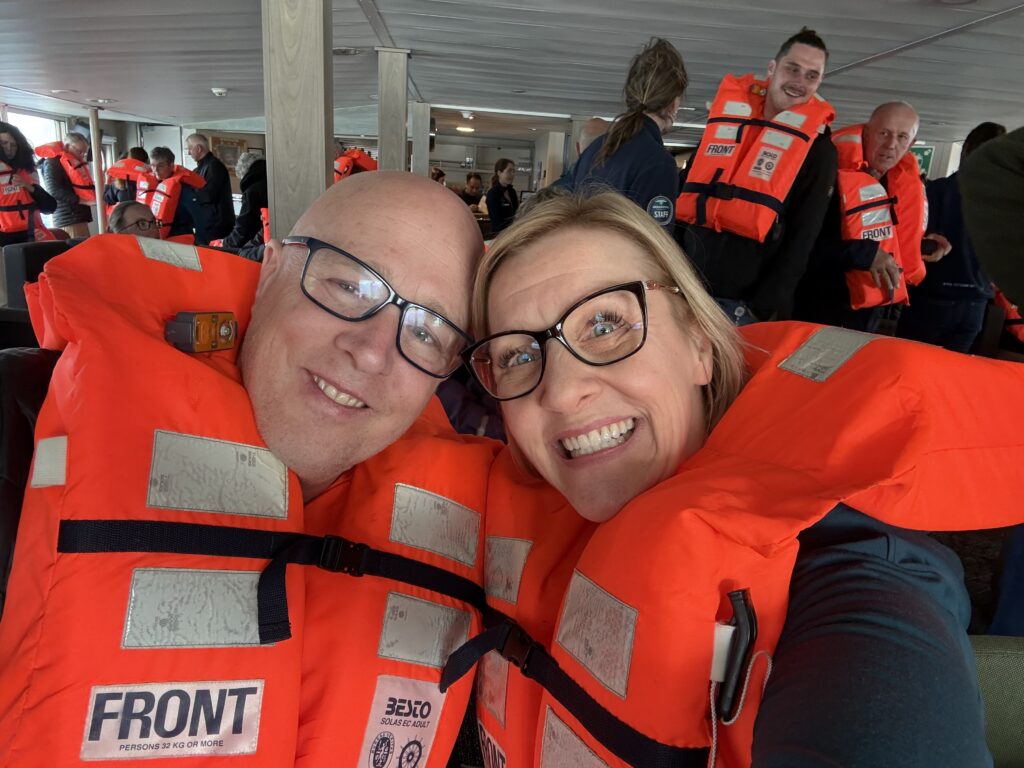
We unpacked our bags, checked out the ship, and met our lovely bar tender Raquel, who has worked for Oceanwide for 12 years. She’s fabulous. We had our mandatory lifeboat drill before dinner. We had to go outside to our actual lifeboats, so that was new. There are only two lifeboats, which was also new! Since this is our first experience on such a small ship, it will be interesting to note all the differences. After the lifeboat drill, we all met in the lounge and had an introduction from the expedition team. We have a very highly educated and experienced group of expedition guides on this ship. Our Expedition Leader, Ali Liddle, gave a brief overview of what we can expect during the next two weeks.
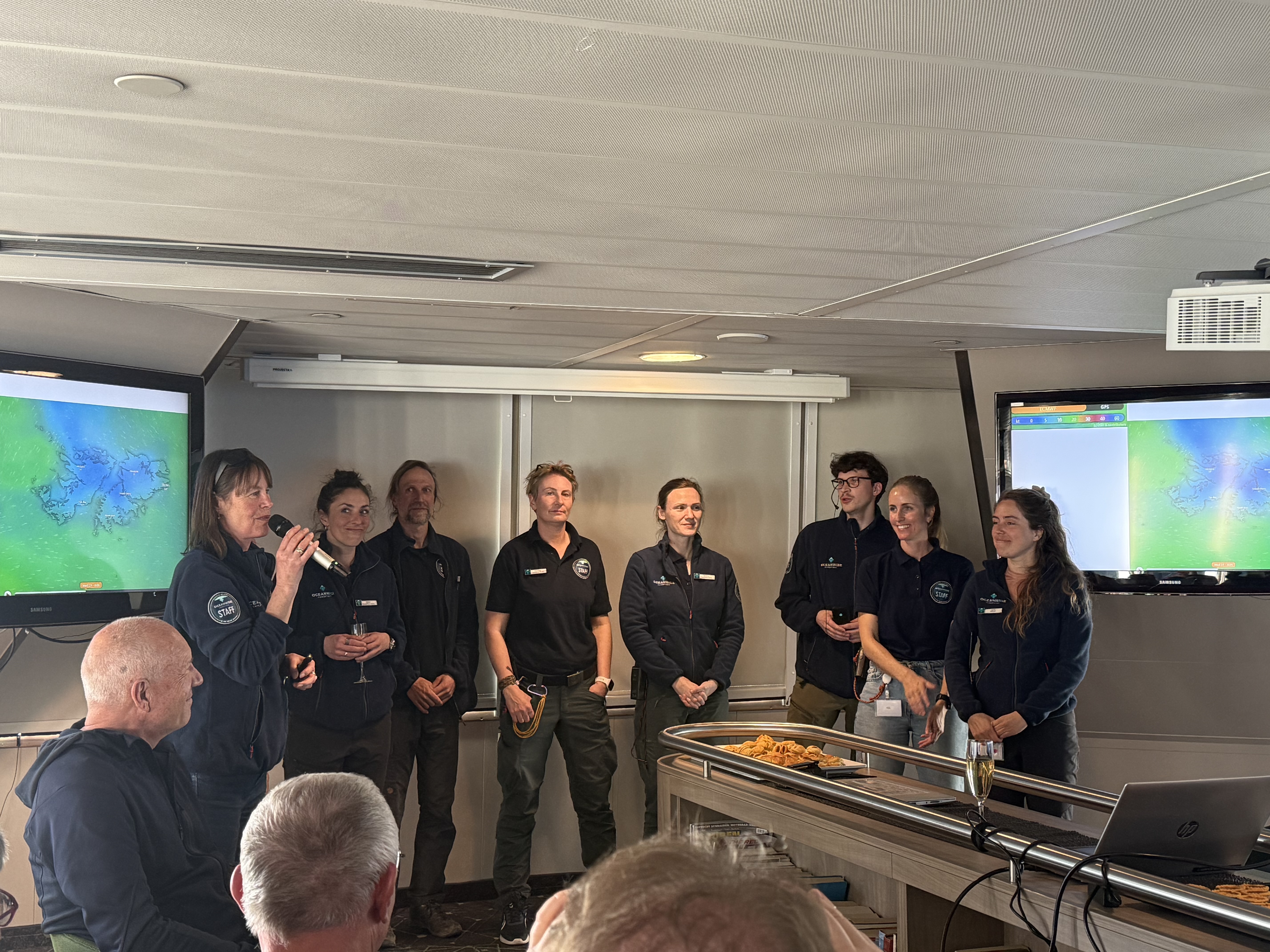
Our sailing was advertised on the Oceanwide Expeditions website as a bilingual English/German sailing. It is common for OE to offer sailings in various languages. More than half of the passengers were German, and most others were from various European locations. We had 17 nationalities in the 95 passengers, with an additional seven nationalities in the crew and guides. Some of the guides were German, all the announcements were made in English and German, and the daily program and signage was also in both languages. They had interpretation devices for those who wanted them, and they also offered most lectures in both languages. We found it a delight to meet so many people from around the world. The sailing after ours was bilingual English/French.
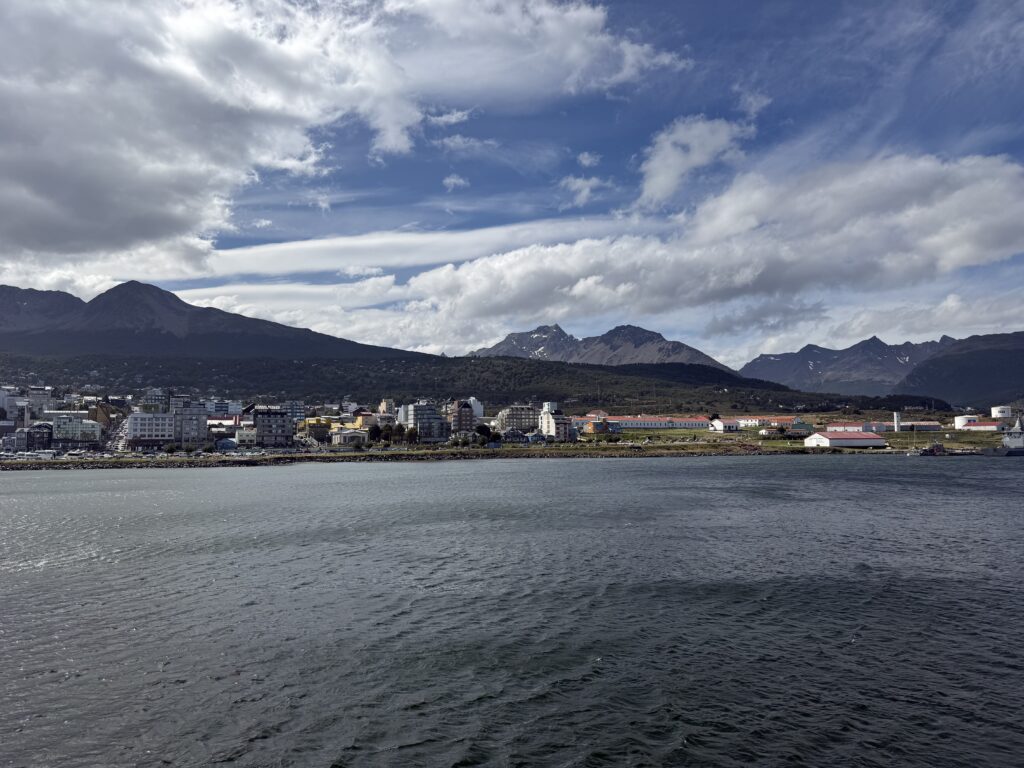
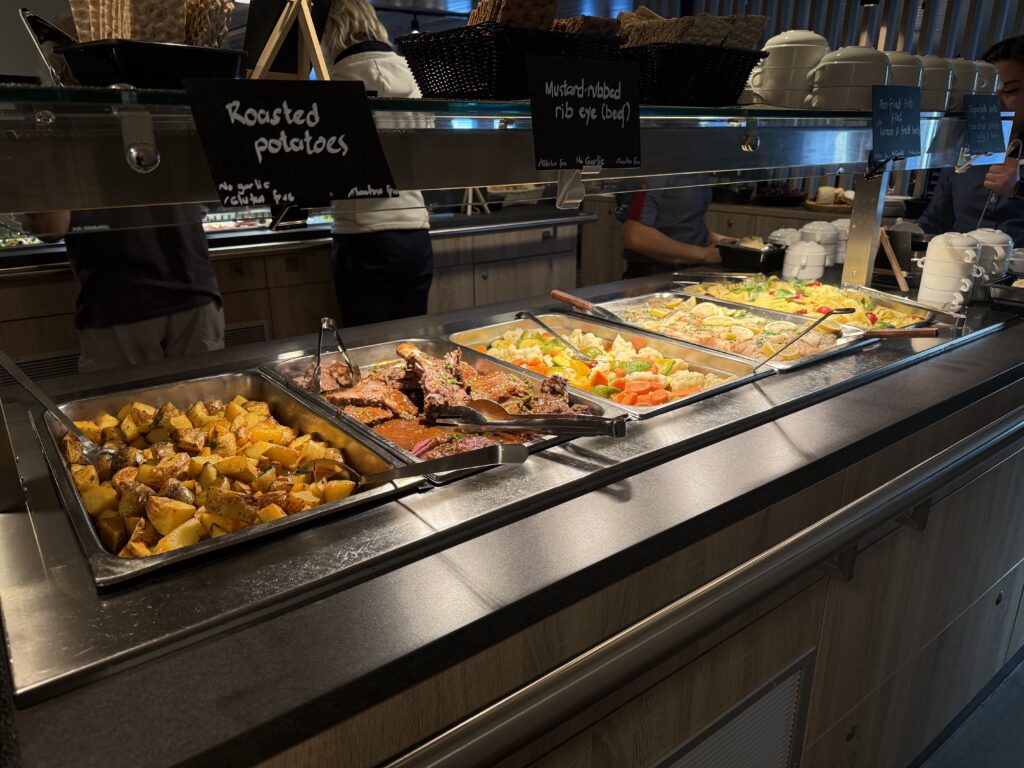
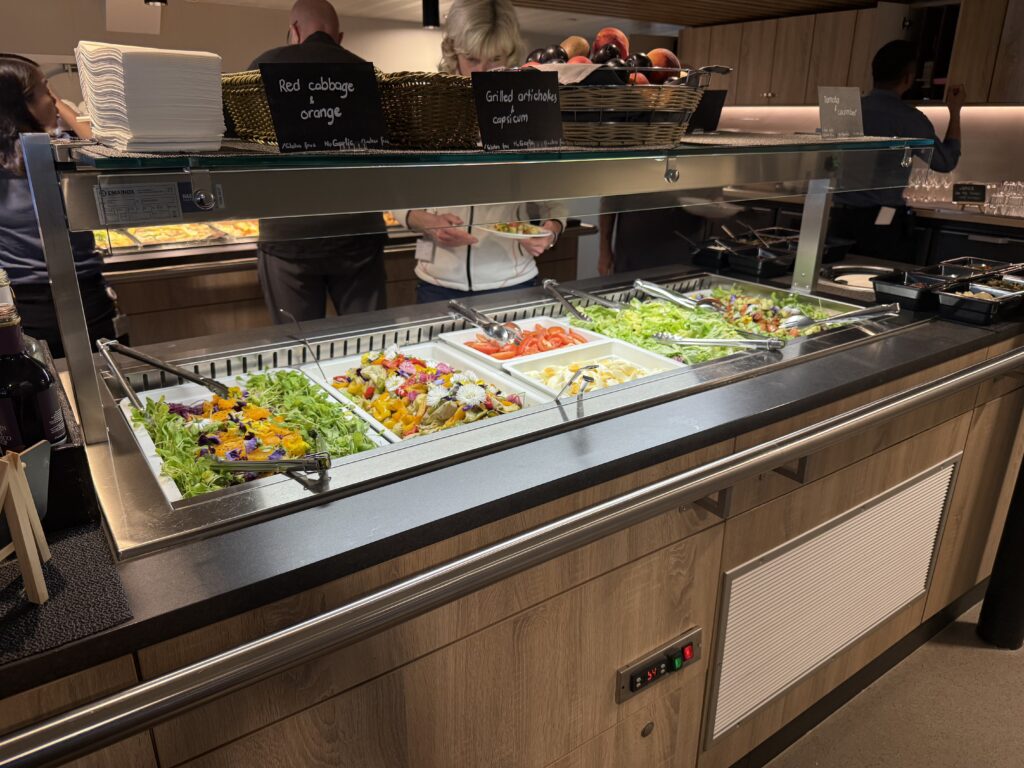
Dinner was a buffet this evening, and the food was delicious. There are lots of choices to fit every taste. If you have any dietary restrictions, they are happy to work with you, but they do ask that you let them know ahead of time in the info sheet you fill out and submit prior to leaving the US, as there is no opportunity to restock the ship once you leave The Falklands on day four. Some dinners will be served plated, especially if the weather is bad and the ship is rolling a lot. They make an announcement when it’s time for all meals, and everyone eats at the same time. Meal times are listed in the daily guide, which is on your room TV, and also posted in various locations around the ship. The expedition guides eat with the passengers, so it’s a great opportunity to get to know them. We were scheduled to leave Ushuaia at 6 pm, but the winds had picked up so the port was closed. The wind had died down a bit later in the evening, so we pulled out and headed down the Beagle Channel about 8 pm. Our top cruising speed is about 11 knots, so when we reached the open ocean, all those big ships soon left us in the dust. For more information and photos of the ship, you can read today’s blog post here.
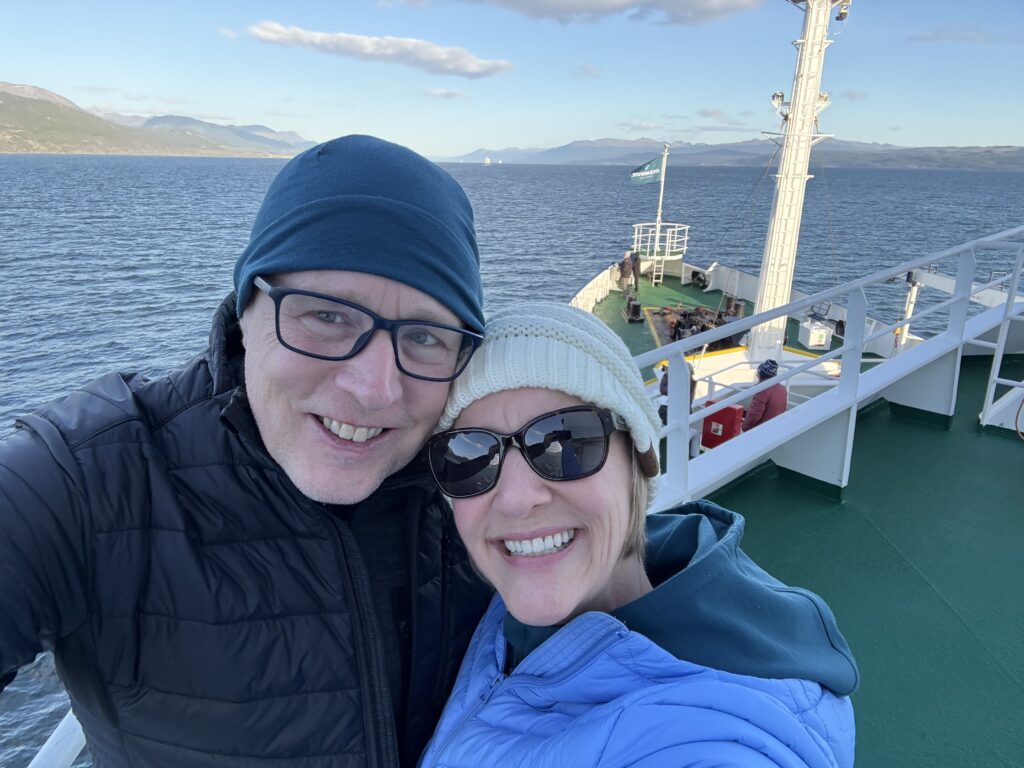
Sea Day 1/20/26 Tuesday Day 2
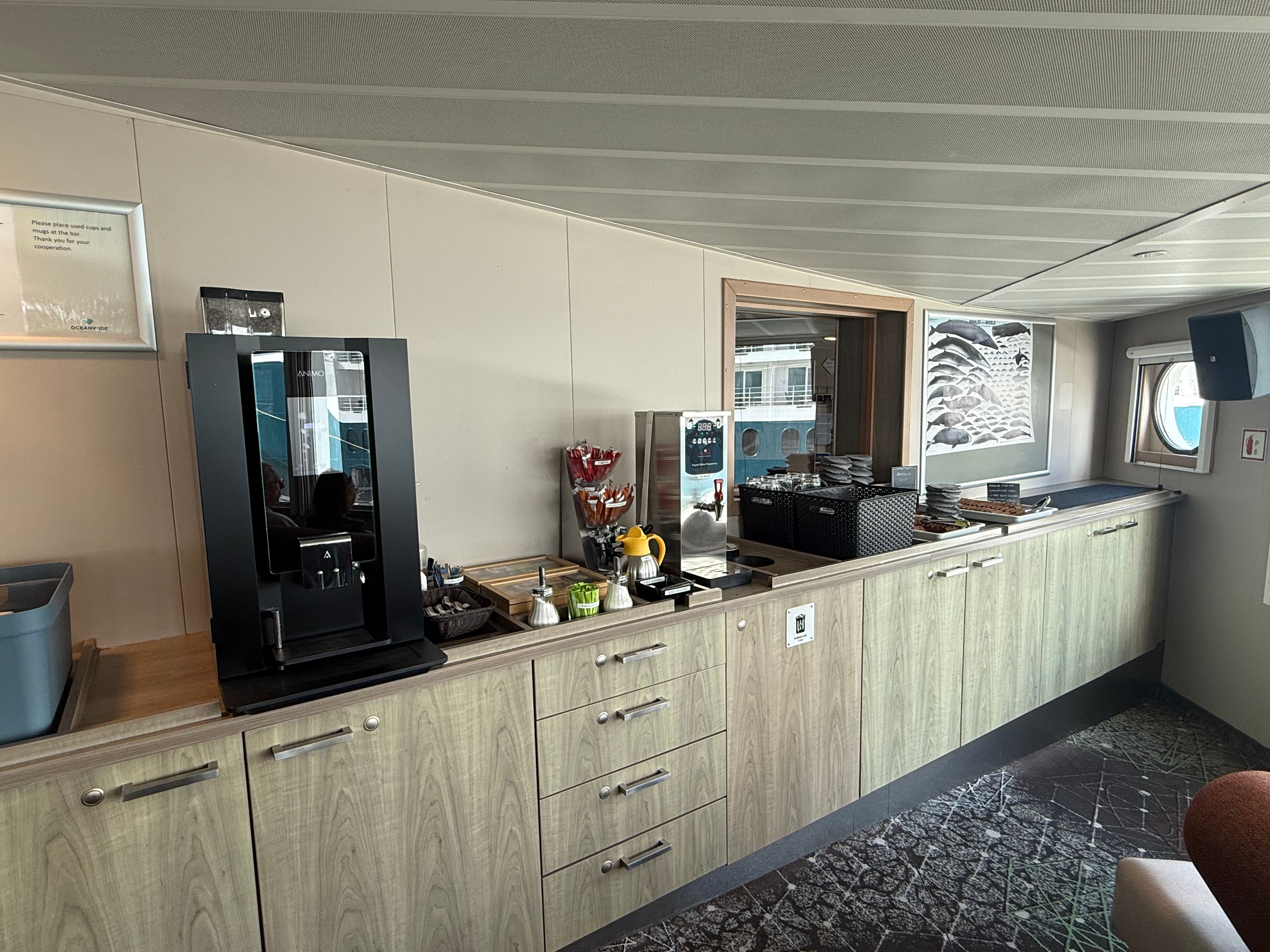
Today was a sea day as we were headed up to the Falkland Islands. The Expedition Leader will do a wake up call over the loud speaker each morning. On sea days, the wake up call is generally 0745 with breakfast available from 0800-0900. Of course, you are welcome to get up anytime and head to the lounge for tea or coffee, or explore the ship. There is a complimentary coffee machine in the lounge that will dispense a variety of coffee drinks such as a latte, mocha, hot chocolate, etc. There was also sugar, creamer, and Stevia available, in addition to a large selection of tea bags and hot water. Iced tea is not one of the complimentary beverages available in the lounge, but you could always get free ice at the bar in the lounge.
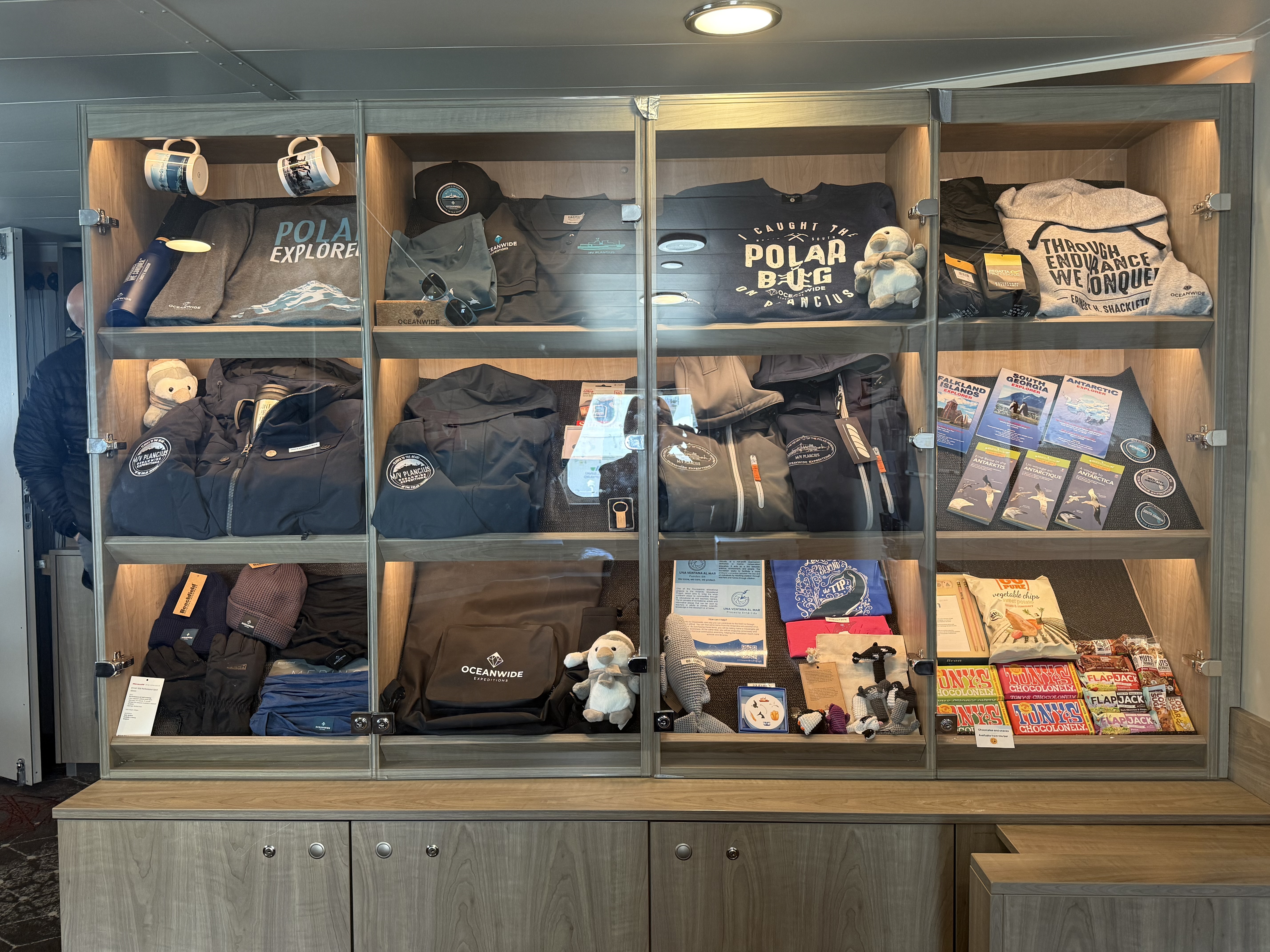
Breakfast and lunch are served buffet style. Again, lots of choices to satisfy everyone. They served brewed coffee in the dining room, and there was a selection of complimentary juices. You may also purchase soft drinks, wine, or other beverages in the dining room. All purchases go on your onboard account, which you will settle on your last day with a credit card. The ship’s prices are all in Euro. There is a small gift shop located in the library near the lounge on deck 5. You can actually purchase waterproof parkas and jackets here, with Oceanwide branding. As I recall, the parkas were about 200 Euro.
Drink prices were reasonable compared to some of the other cruise lines we have been on, but not cheap. Soft drinks were 3.95 € and they had Coke, Coke Zero, and Sprite. Bottled and canned beer, and wine by the glass, was 5.50 €, and mixed drinks were 9.50 €. There was also a charge for tonic water, ginger ale, and sparkling water. You are welcome to bring snacks and beverages, including alcohol, on board with you. There is a grocery store in Ushuaia and in Stanley (Falklands) where you can purchase anything you might need. In retrospect, I should have brought some Sprite Zero on board with me, as that is my soft drink of choice. I did find myself missing it.
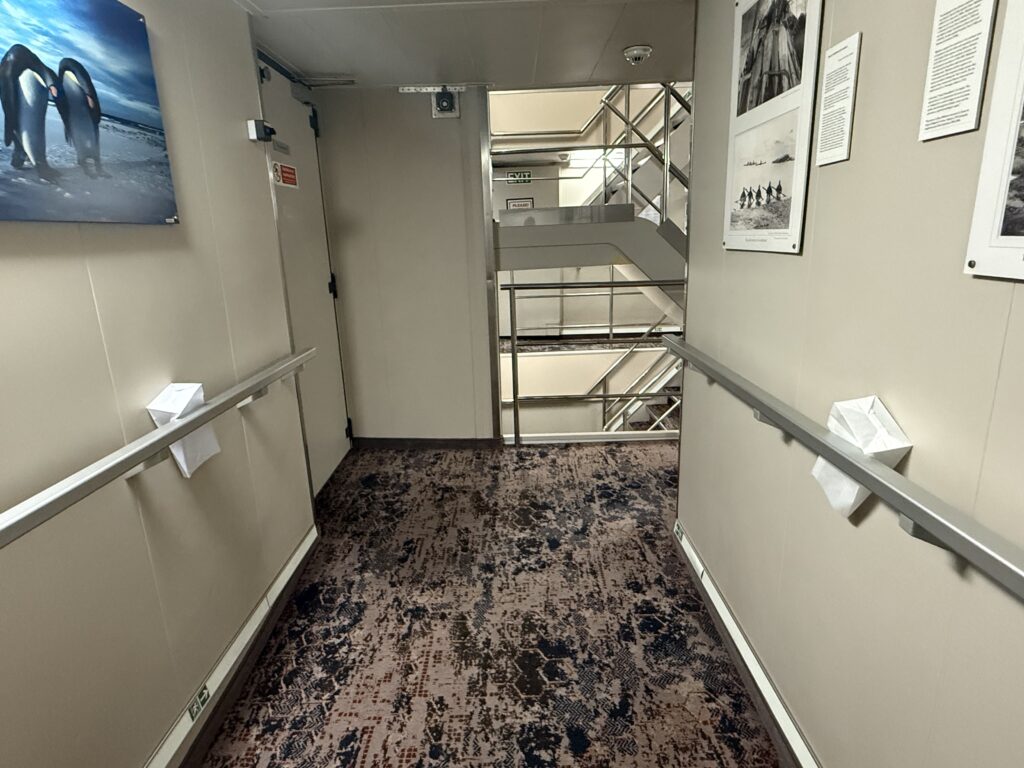
The seas were quite rough on this day, and many people were not feeling well. We got a kick out of the strategically placed emesis bags stuck in the railings all around the ship. It was almost like the crew had done this before. The winds were around 33 mph so the outside decks were closed for safety. They placed signs and made announcements when the outside decks were closed. We all had a bit of trouble getting our sea legs, and many of us stumbled around and hung onto the railings. The rule is “one hand for you and one hand for the ship.”
There are no stabilizers on the Plancius, as there are on many ocean cruise ships. Therefore, the Plancius does a lot of rolling and pitching in the high winds. Our cabin was on the top deck, so we really felt the rolling up there. I likened it to the Vomit Comet ride at the county fair. Truly. Everyone worries about the Drake Passage, but it’s not only the Drake that can be bad. We brought Scopolamine patches with us and Steve put his on last night. I waited until today to put mine on and was not feeling very well for most of the day, so I think he made the smarter decision. Be like Steve.
The staff offered several lectures for us today. Topics included The Falkland Islands (one of our guides had lived there), whales and dolphins (one of our guides was a marine mammal expert), and Antarctic seabirds (one of our guides was an ornithologist). They were all quite interesting. We had a mandatory Zodiac briefing before dinner. Here is today’s blog post if you would like to read more about it.
New Island, Falkland Islands 1/21/26 Wed Day 3
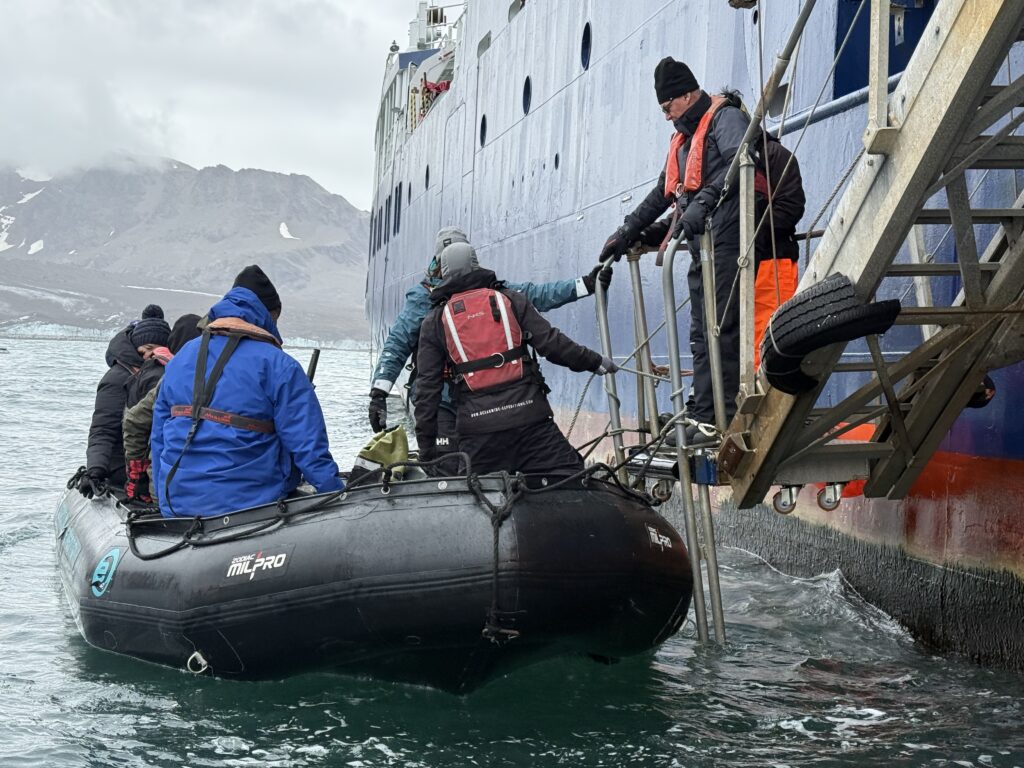
Today we stopped at New Island, which is one of the over 750 islands that make up the Falkland Islands. The Falklands is a British Overseas Territory. Our wake up call was 0645 with buffet breakfast from 7 to 8 am. After breakfast we prepared for our first Zodiac ride and landing on the shore. On the Plancius, you will store your parkas, boots, and life vests in your cabin, and you will get completely dressed in your cabin as well. Because it is a small ship, there simply is not enough room to store these items in the boot room, as other ships do. Your Expedition Leader will make an announcement when it’s time to head to the gangway to board the Zodiacs. Since we only had 95 passengers on our ship, we could all be on shore at the same time. This was one of the big advantages to sailing on the Plancius. They generally placed 10 people in a Zodiac. The expedition guides, as well as some crew drivers, all worked together to get us on shore as quickly and seamlessly as possible.
When you get to shore, you will be doing a wet landing. This means you have to get off the Zodiac while it’s still in the water, and you will walk a couple steps in knee high water to the shore. Be sure to keep your waterproof pants over your boots, and not tucked into your boots. This keeps the water from going over the top. Not to worry, they will remind you. The landing sites will vary from cruise to cruise, depending on weather, winds, and scheduling. Your landing sites may be completely different than ours. Even when landings are scheduled, they may change or cancel completely depending on conditions. This is the biggest gamble when booking a trip to Antarctica, as there are no refunds for cancelled ports or landings due to the unpredictable weather and wind. It is possible, but extremely rare, to not make any scheduled landings, so you must consider this possibility when booking your trip, and be willing to accept this risk.
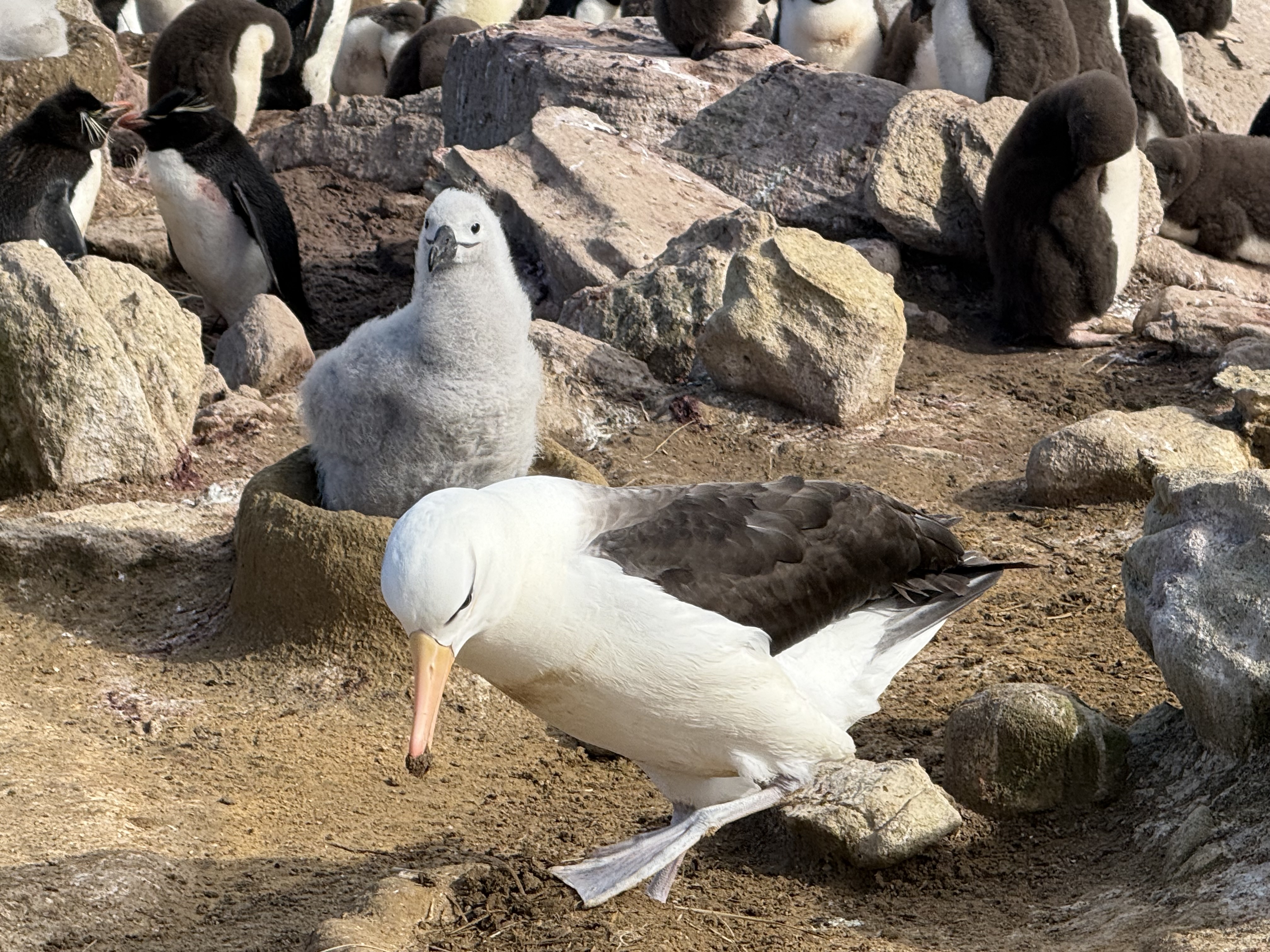
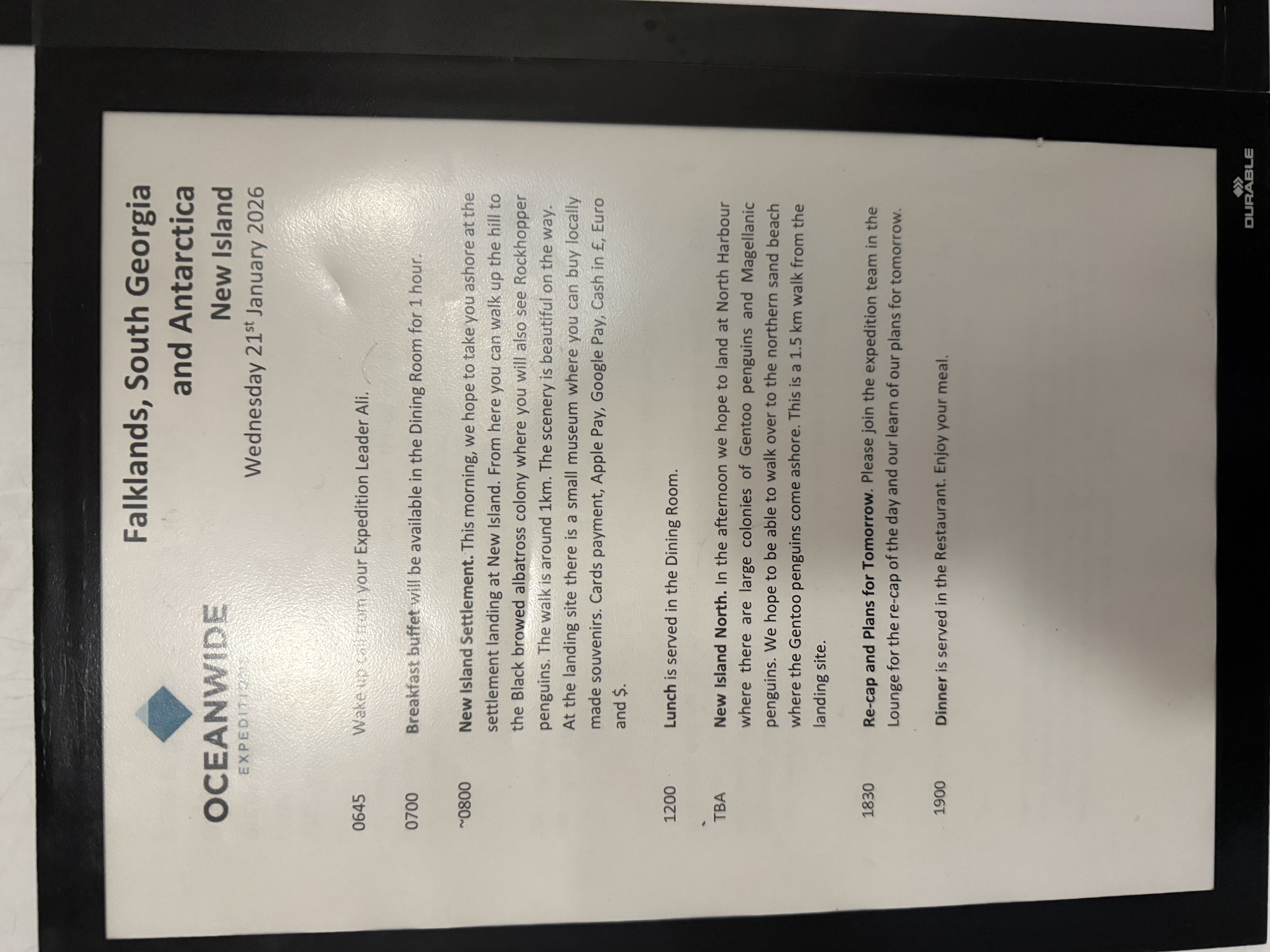
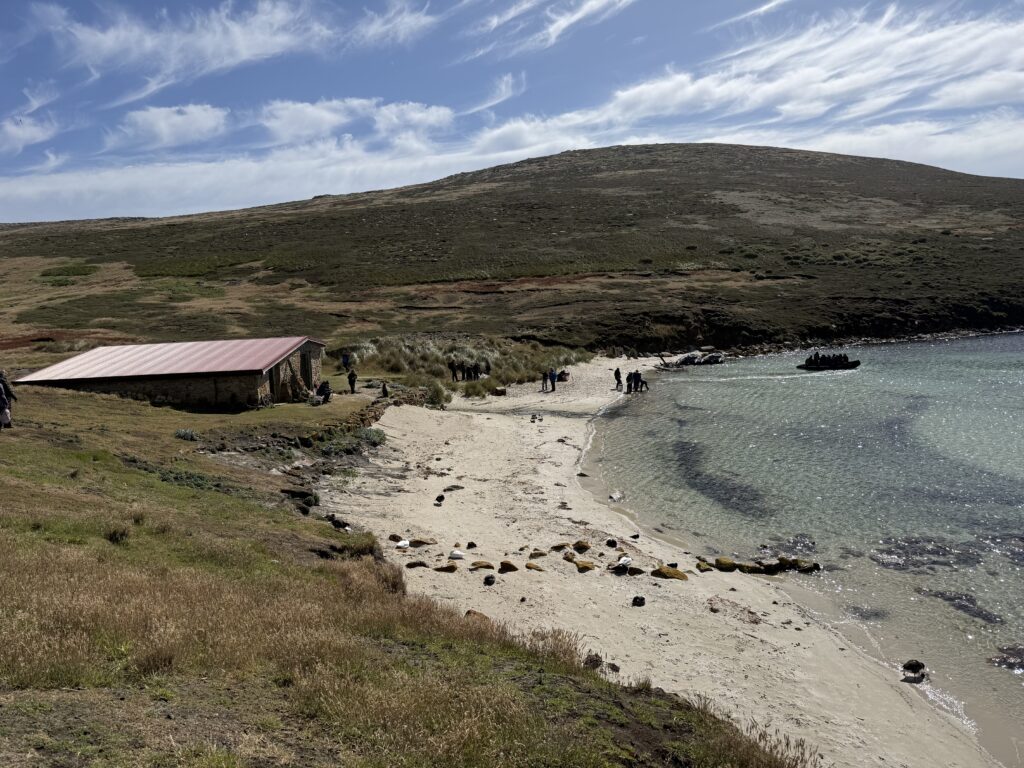
We landed at the location of the cabin where Captain Charles Barnard and some of his crew had once stayed for over two years. It’s an interesting story, and you can read about it in today’s blog post. The cabin is now a small gift shop and post office where you can pick up a souvenir or mail a post card. We took a short hike up to the Rockhopper Penguin colony, where those little birds live up to their names. We also saw lots of beautiful Albatross. Both the Rockhoppers and the Albatross were busy raising their cute little fluffy chicks.
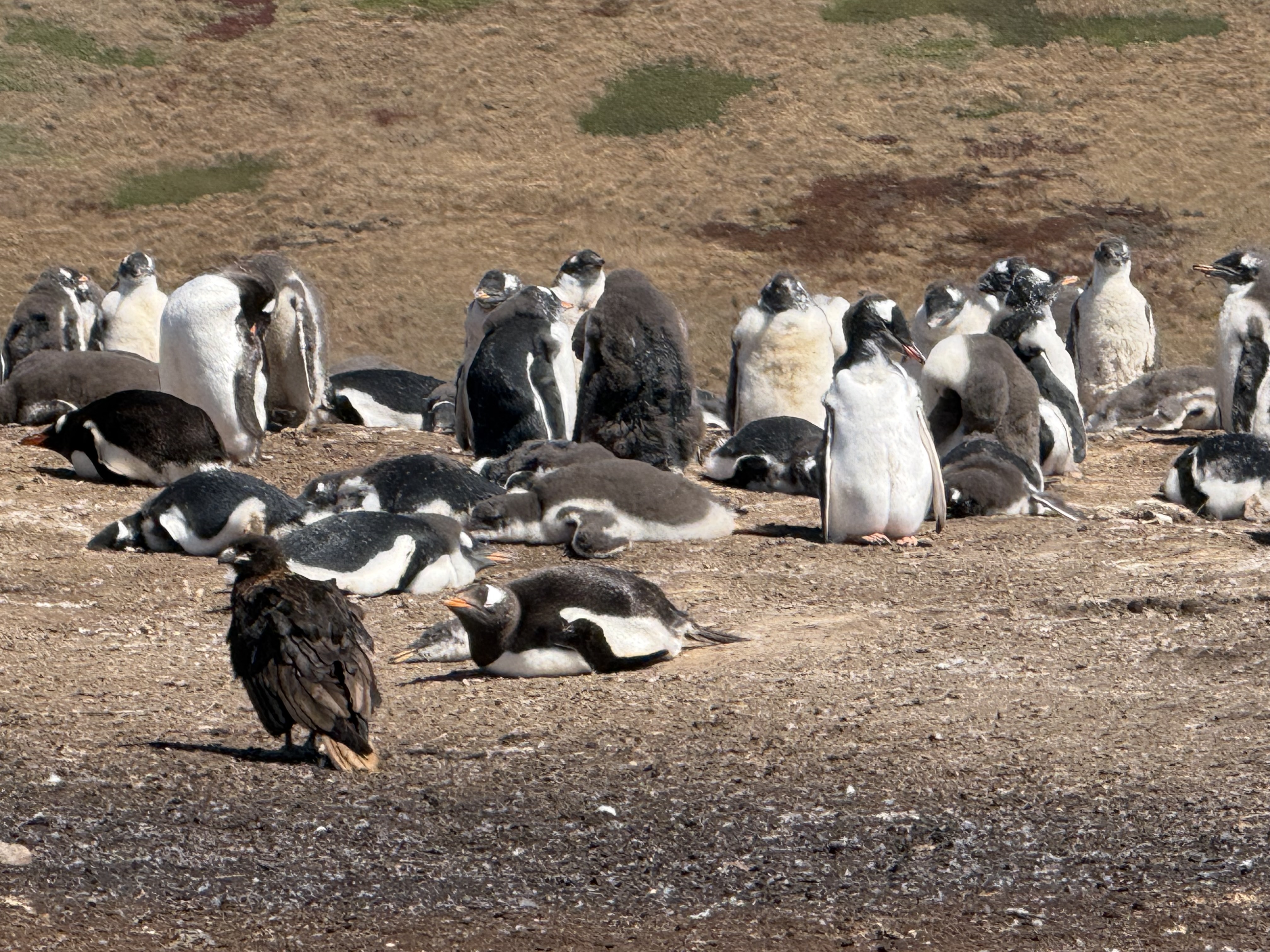
After lunch on the ship, we had our second landing on the north side of New Island, where we saw a colony of Gentoo Penguins running back and forth to the beach along their penguin highways. They were being closely watched by several Striated Caracara, who were looking to pick off the weaker baby penguins. Caracaras and their cute babies have to eat too! On the way back to the ship, we encountered a pod of Peale’s Dolphins who were having a ball racing the Zodiacs. The weather was glorious at 58 def F and sunny, another advantage to sailing in the peak of summer in January or February.
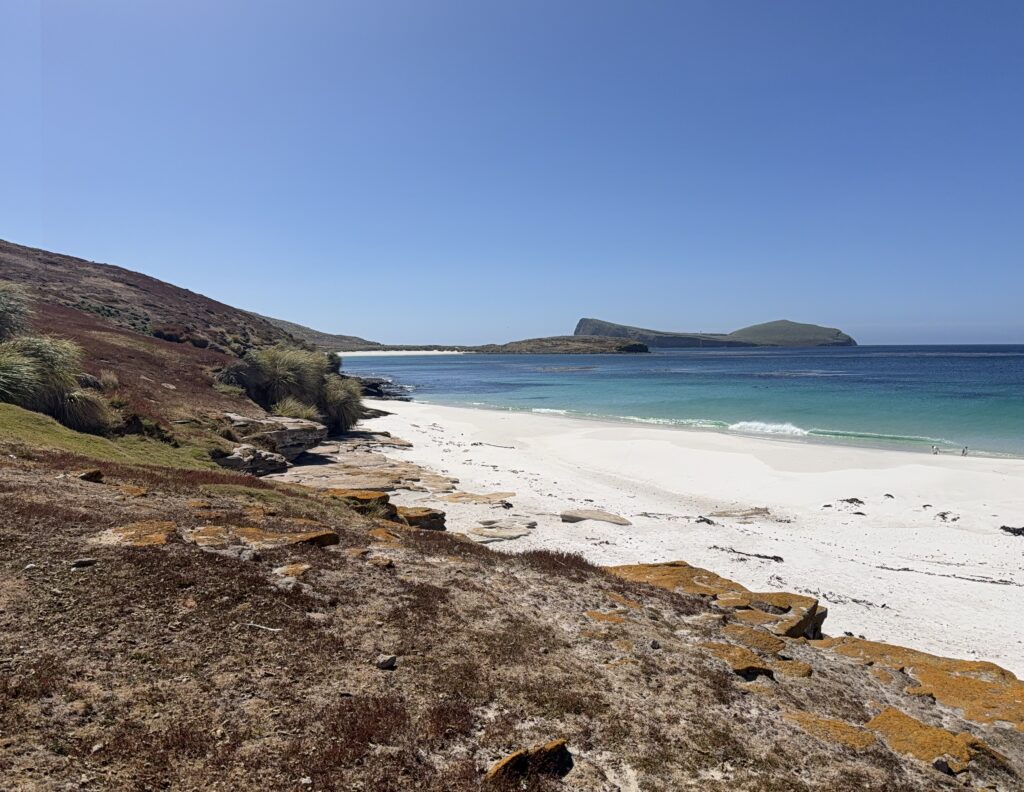
Stanley, Falkland Islands 1/22/26 Thursday Day 4
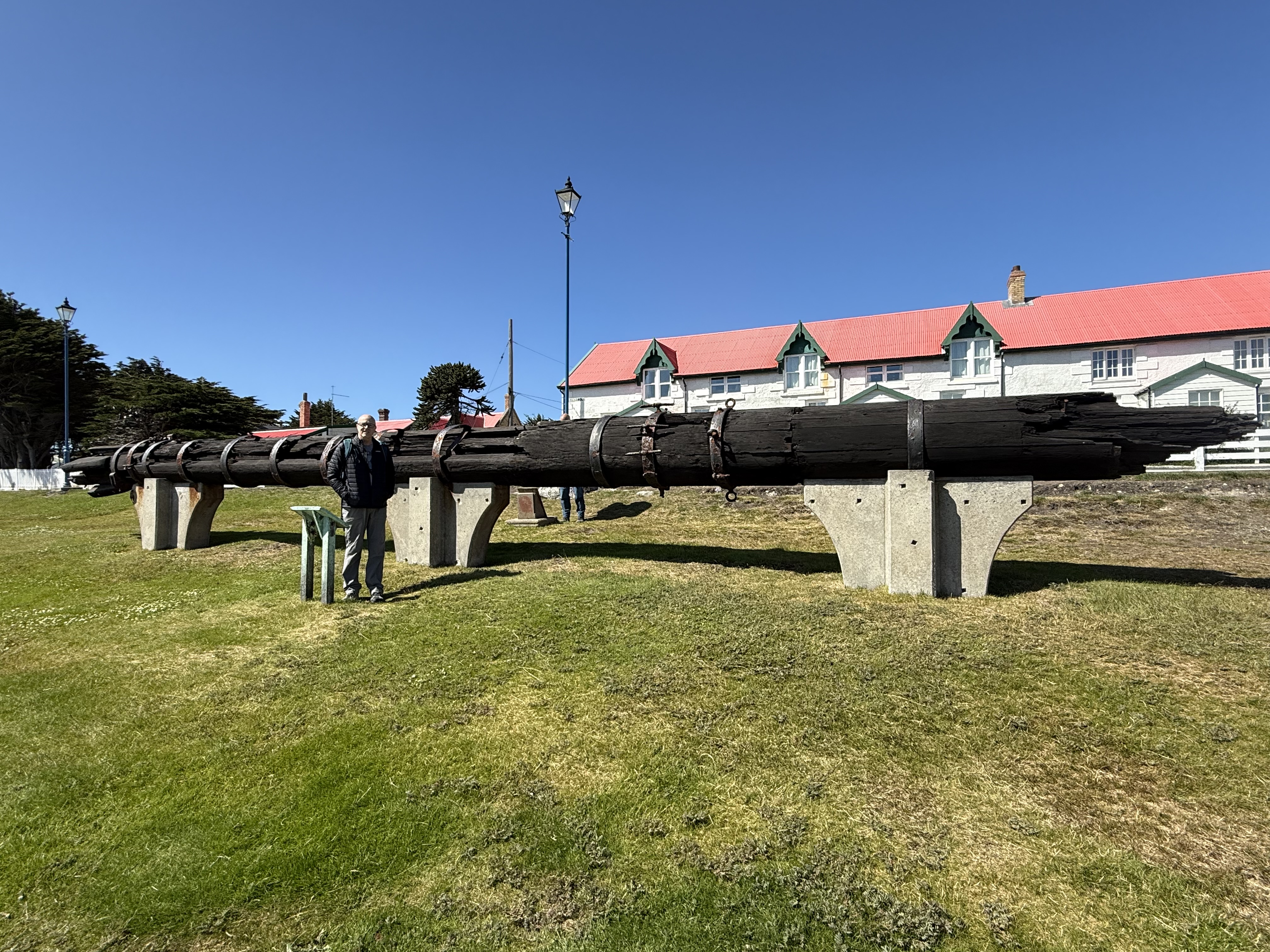
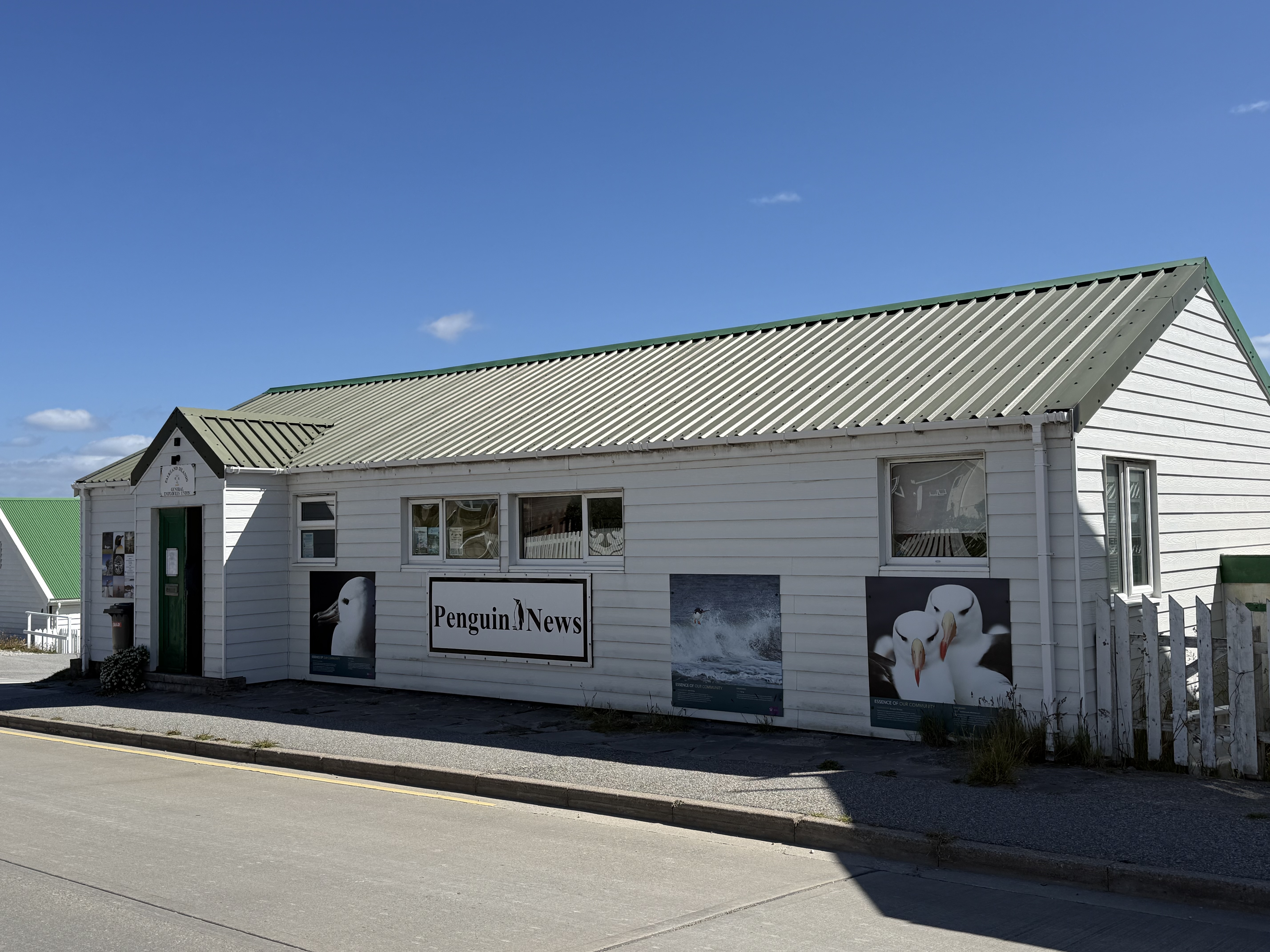
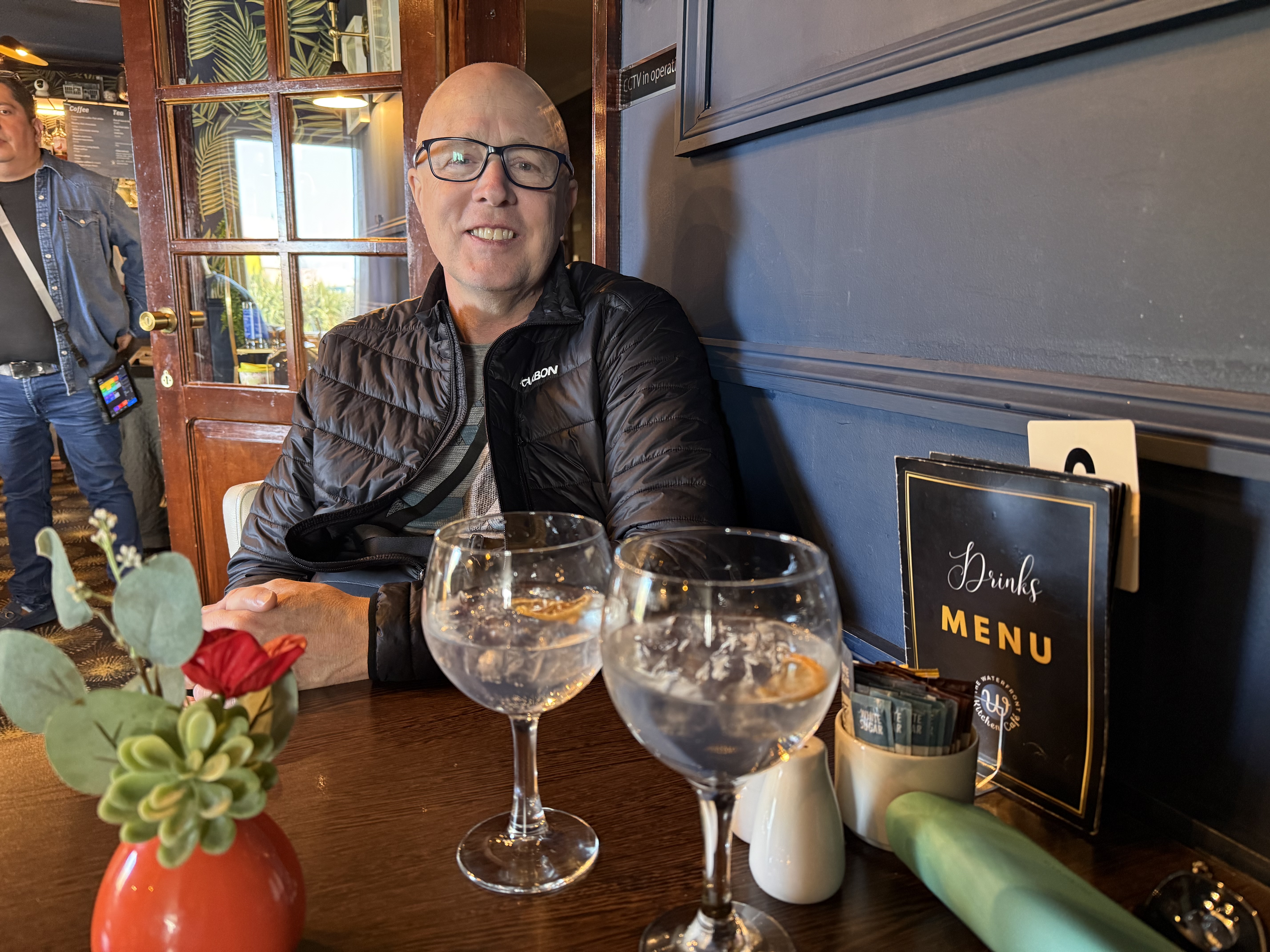
Today we stopped at Stanley, the capital of the Falkland Islands. We took the Zodiacs to shore, but had a dry landing at the dock in town. This is the only dry landing you will have on this trip. They did not require us to wear our boots. We had about four hours to spend in town if we chose to. We decided to stay and have lunch instead of returning to the ship for lunch. There are several choices for food and drink in town. We ate at Groovy’s and had Gin and Tonics with local gin at the Waterfront Café. We also visited the National Museum of the Falkland Islands, visited the Victory Memorial to the Falkland War victims, saw a few other sites, and did a bit of souvenir shopping. There is a grocery here if you wish to take some soft drinks or anything else back to the ship. This is the last place on this journey to make a purchase before returning to Ushuaia. Stanley is a lovely town. The weather was once again sunny, beautiful, and 59 deg F.
In the afternoon, our Expedition Leader Ali gave a presentation on life in the Falklands. She lived there for about 16 years and had a lot of interesting stories to tell. After dinner, we began our two day journey to South Georgia Island. The wind picked up quite a bit and the ship did a lot of rocking and rolling through the night and the next two days. You can read more about Stanley in today’s blog post.
On the Way to South Georgia Island and Passing the Antarctic Convergence 1/23-1/24 Friday/Sat Day 5/6
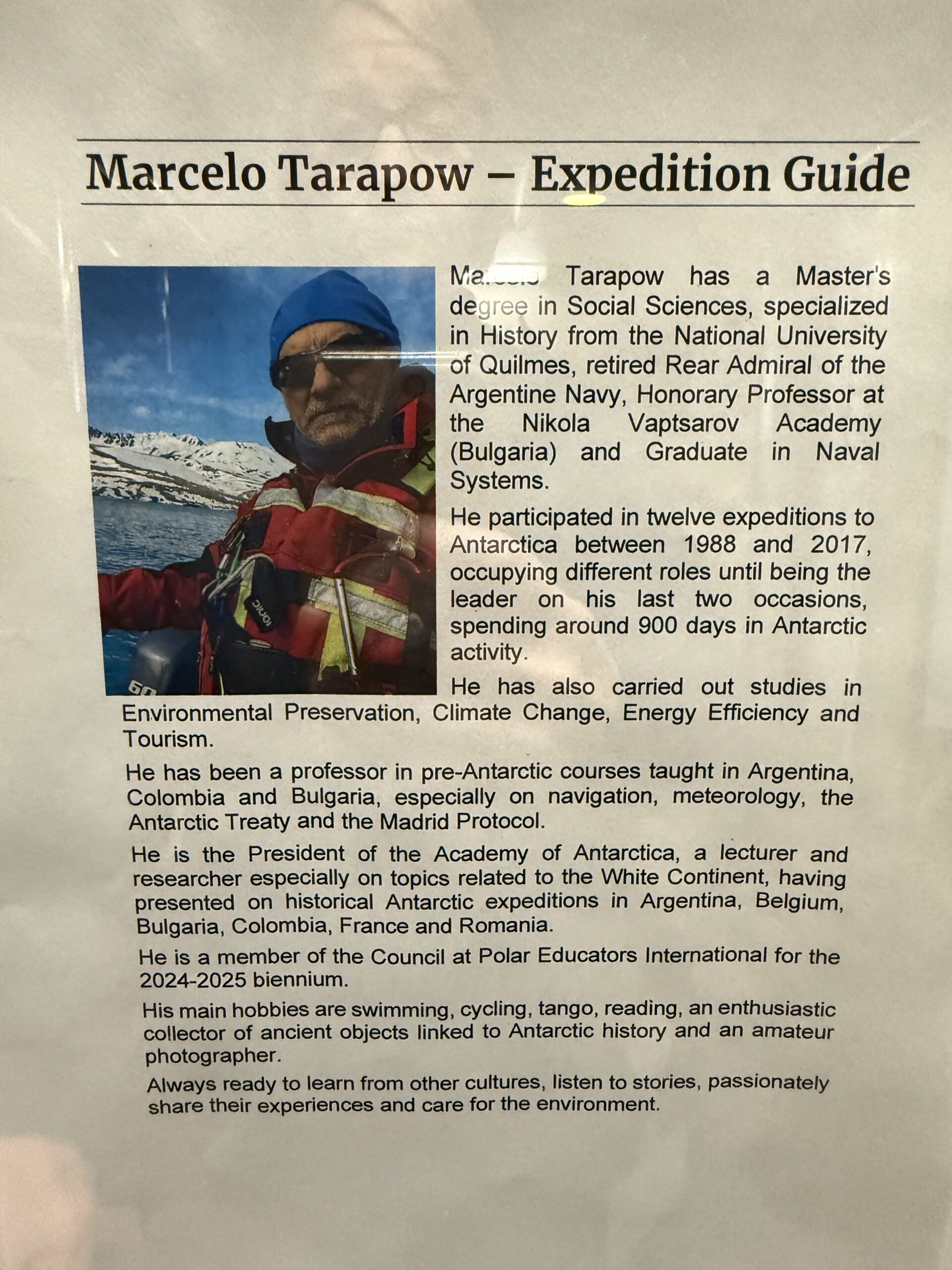
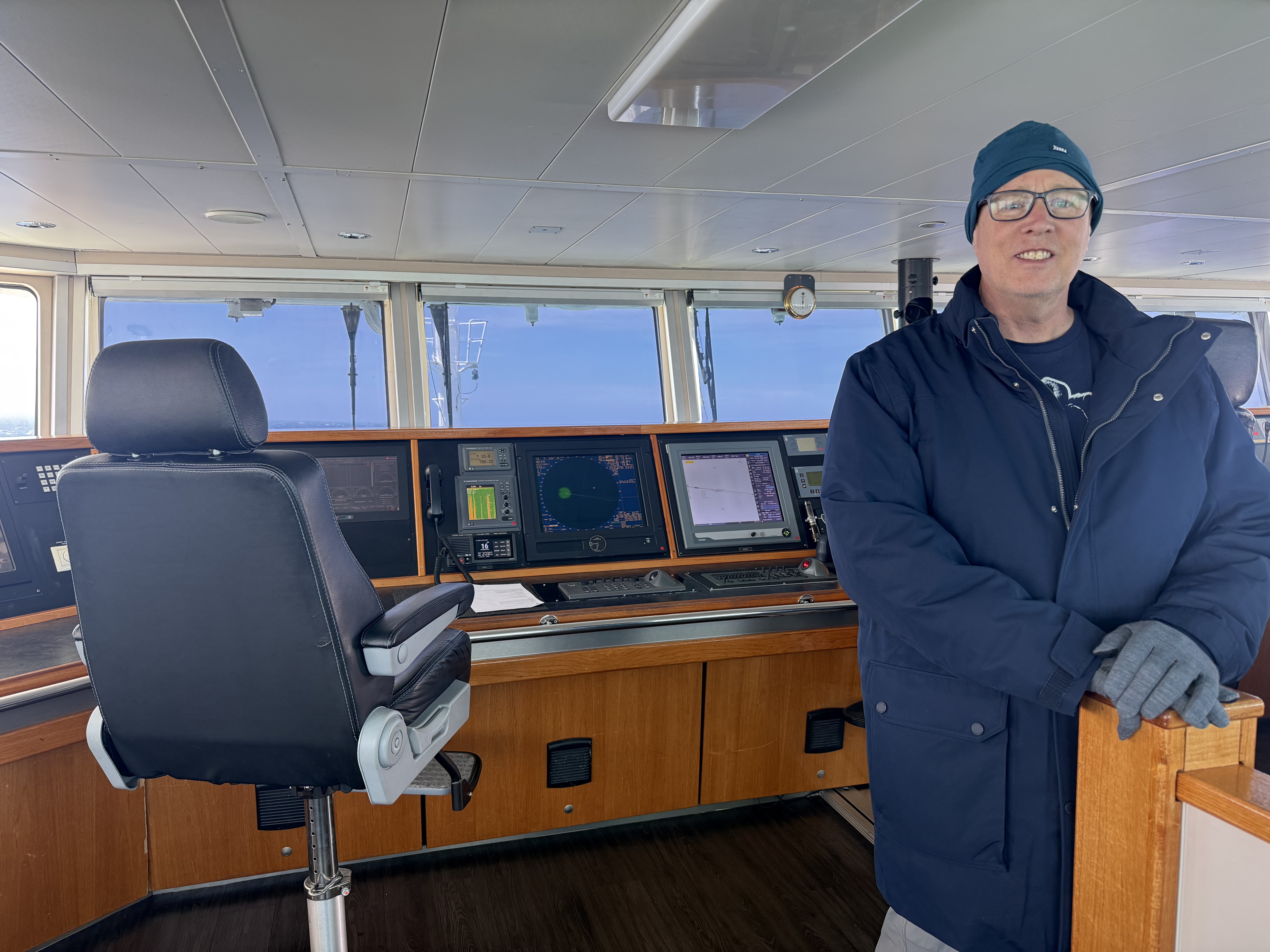
We had some more rough seas on Friday on our way to South Georgia Island, but milder than the first two days. It seems most folks were dealing with it OK, and had recovered from the earlier rough seas. The staff kept us well informed and entertained with lectures and movies. Topics included South Georgia, Fur Seals, and Shackleton. One of our guides is a retired Argentine Navy Admiral and an expert on Shackleton and Antarctic exploration history, and his knowledge and stories are quite impressive. We saw also watched a BBC documentary called Ice Worlds. When the wind calmed down, they opened the outside decks and we were able to get some fresh air and visit the bridge. Oceanwide has an open bridge policy, so passengers are welcome to visit the bridge anytime, barring any difficult weather. It warmed up to 50 F today, so it turned out to be a beautiful day.
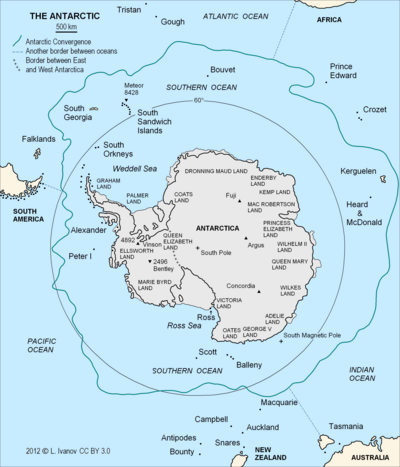
On Saturday, we passed the Antarctic Convergence as we continued to sail toward South Georgia Island. The convergence is located between the 48th and 61st parallels, depending on the area of the globe, and SGI lies at the 54th parallel. The convergence is just north of the Antarctic circumpolar current that flows in a clockwise pattern around the continent. This convergence is the border between two very distinct bodies of water, each with its own micro climate and variety of sea life. The convergence also stirs the water and brings up large quantities of various sea life, including Krill, and therefore several species of whales, including Orca, Sei, Humpback, Minke, and Blue.
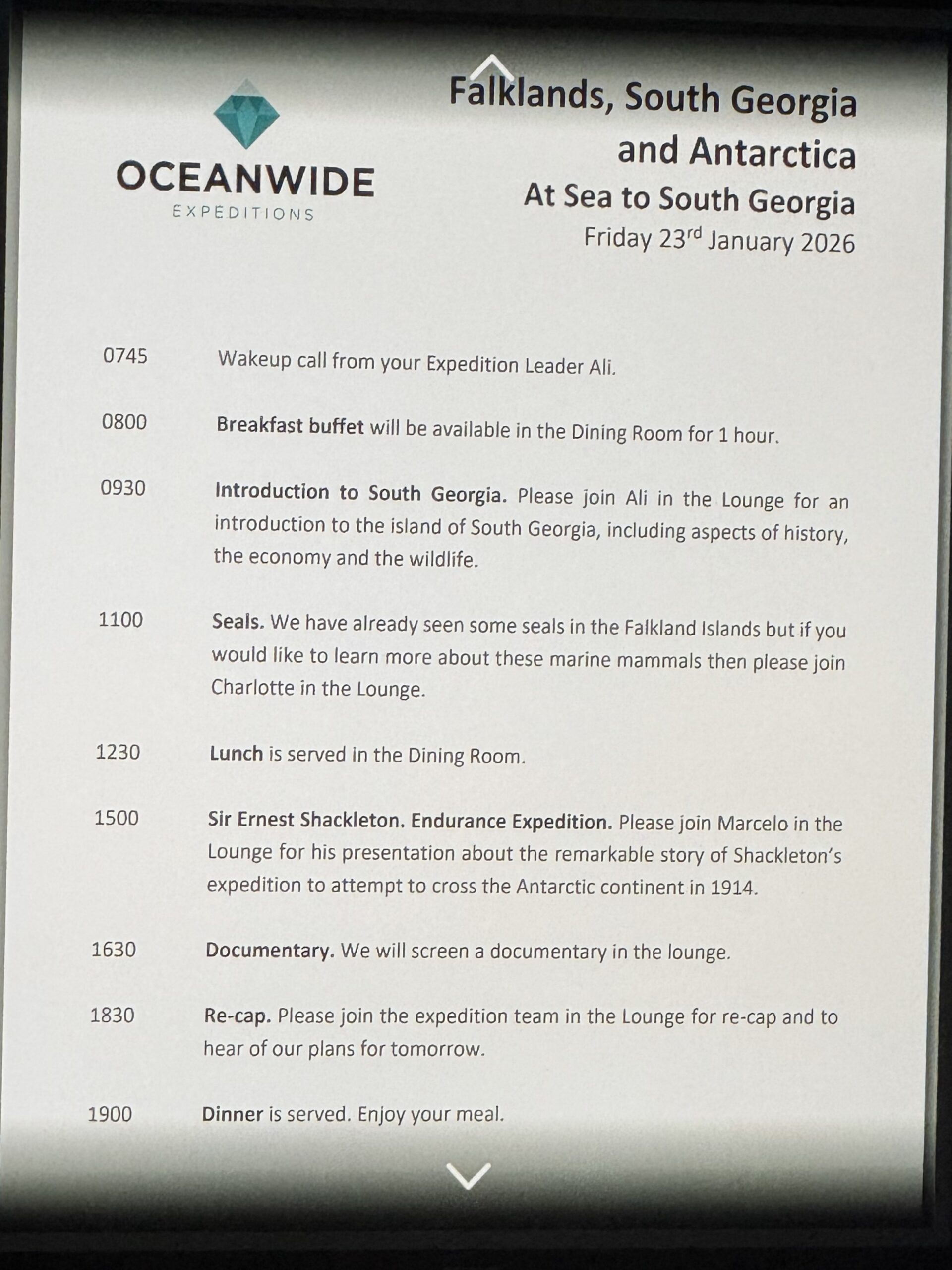
The weather cooled considerably today and the wind got a bit stronger. It was fairly foggy with a high around 40 F. We want to stress that this might not be the ship for you if you are really prone to motion sickness. While we expected the Drake to be a bit unruly, we did not anticipate the rough seas on the way to the Falklands and SGI. You will definitely want to be prepared with motion sickness meds and remedies that work for you. We highly recommend talking to your doctor to help you navigate the choices.
In addition to a lecture on penguins and a documentary on Polar Bears (Oceanwide is getting us excited about a trip to the Arctic), we also had our biosecurity checks today in preparation for our landing on SGI. They are quite serious about travelers leaving Antarctica exactly as they found it, and not tracking any plant material or organism onto the islands or the mainland of the continent. You can read more about this process on today’s blog post.
South Georgia Island 1/25-1/26 Sunday/Monday Days 7/8
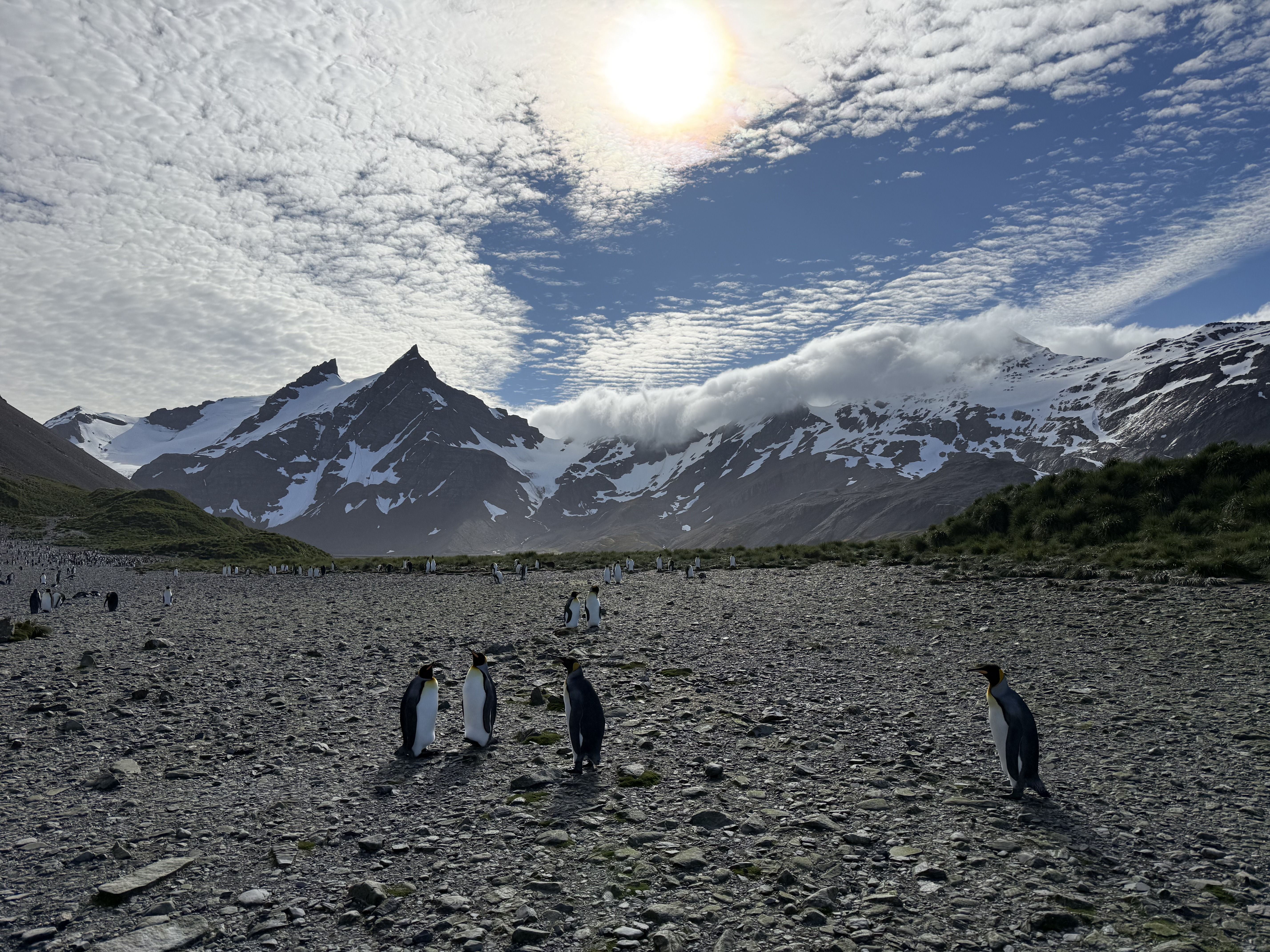
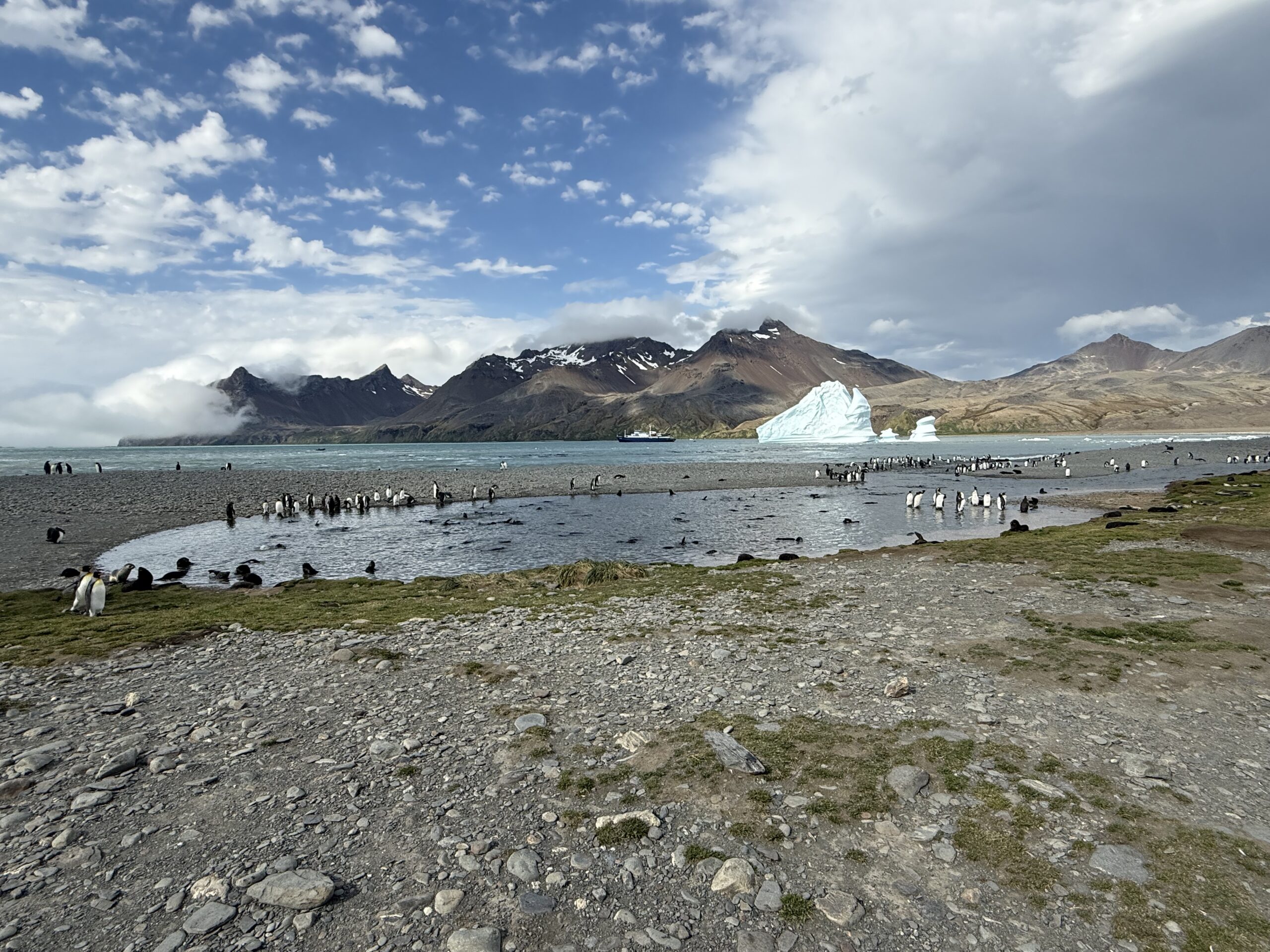
Be prepared for South Georgia Island to be one of the most beautiful places you have ever visited. There are mountains with snow covered peaks and waterfalls, large icebergs floating by, glaciers slowly inching down the slopes, vast beaches that stretch for miles full of sunning Fur Seals and Elephant Seals, and King Penguins colonies that number into the thousands of (usually but not always) mated pairs. Acres of Tussac grasses create hidey holes for seals, and small lakes and glacial streams create fresh water ponds for the seals and penguins. We were simply amazed at its beauty.
While on SGI, the expedition staff plans to take passengers on two Zodiac rides or landings per day, depending on weather, wind, and swells. Again, the location of the various landings might change from cruise to cruise, or it might change or cancel even after the day’s schedule is posted. Most of the landings will include a walk or hike to get you closer to the colonies of penguins, and allow you to see the landscape and the various wildlife. They will let you know how long the hikes are. Many are around one to two miles. If you have questions about how strenuous the hikes are, talk to one of the expedition guides, as they are always glad to help. The guides will have already landed to assess beach conditions and map out the routes with brightly colored poles. You will likely be greeted by lots of curious Fur Seals at each landing. The staff will tell you to how to handle them by making yourself “big” to deter their sometimes overly curious nature. I was accosted by three curious seals at one landing and Steve got a kick out of filming it. Watch out for the last of the three, a cute little baby on the right, at the very end of the video. They are sneaky little buddies.
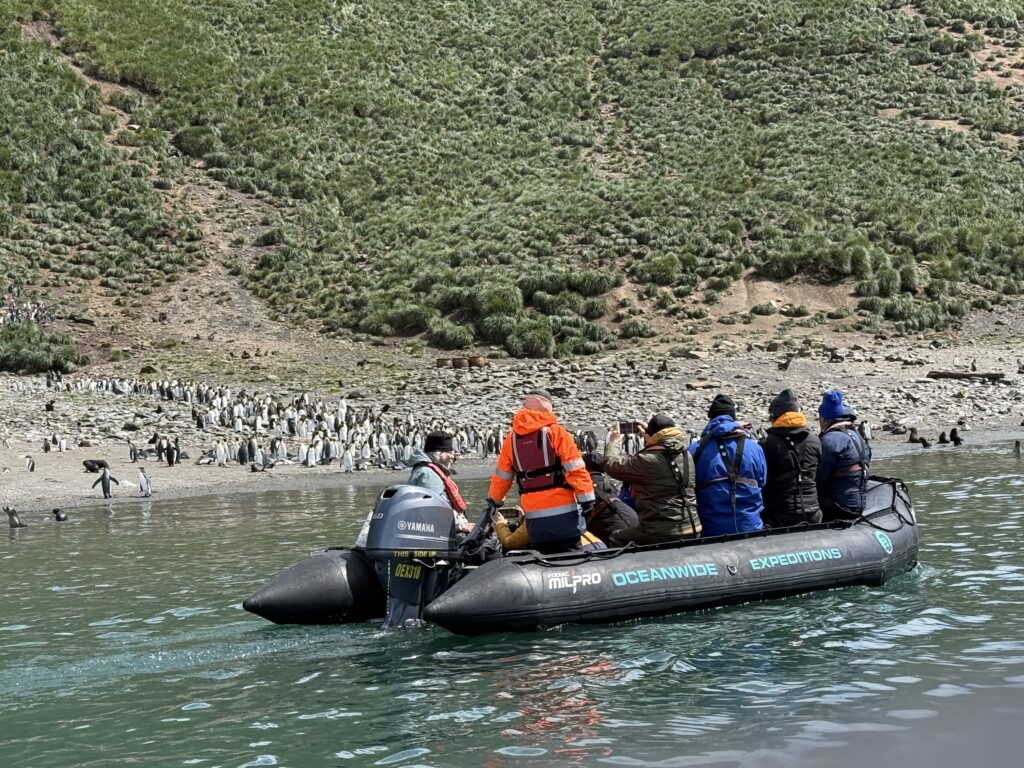
You will again need all your waterproof gear and have wet landings at all the beaches on SGI. If it’s warm enough, we recommend wearing a lightweight rainproof layer on the Zodiacs. If you wear your heavy waterproof parka, we recommend taking your lightweight puffer or other jacket with you for the hikes on shore. Of course, we were there in February, so if you go in November, a lightweight raincoat may not be needed.
Our stops on Sunday included a Zodiac cruise at Elsehul Bay where there is a King Penguin colony, and a landing at Right Whale Bay with another King Penguin colony. On Monday, we landed at Salisbury Plain (Bay of Isles) and Fortuna Bay, both with large King Penguin colonies. Our landing at Fortuna Bay was cut a bit short when the wind picked up and we got called to return to the ship a bit early. The swells were getting challenging for the team to get us back onto the ship, and it was a very wet ride in the Zodiacs. This is a good place to remind you to make sure your parka’s hood is not trapped in your life vest. I really needed that hood on that last ride, and got soaked down my neck and back. I did not make that mistake a second time. This is also the reason you need two sets of base layers to wear under your waterproofs. You can read more details on the landings in today’s blog post.
Grytviken and Godthul Cove Hike Tuesday 1/27/26 Day 9
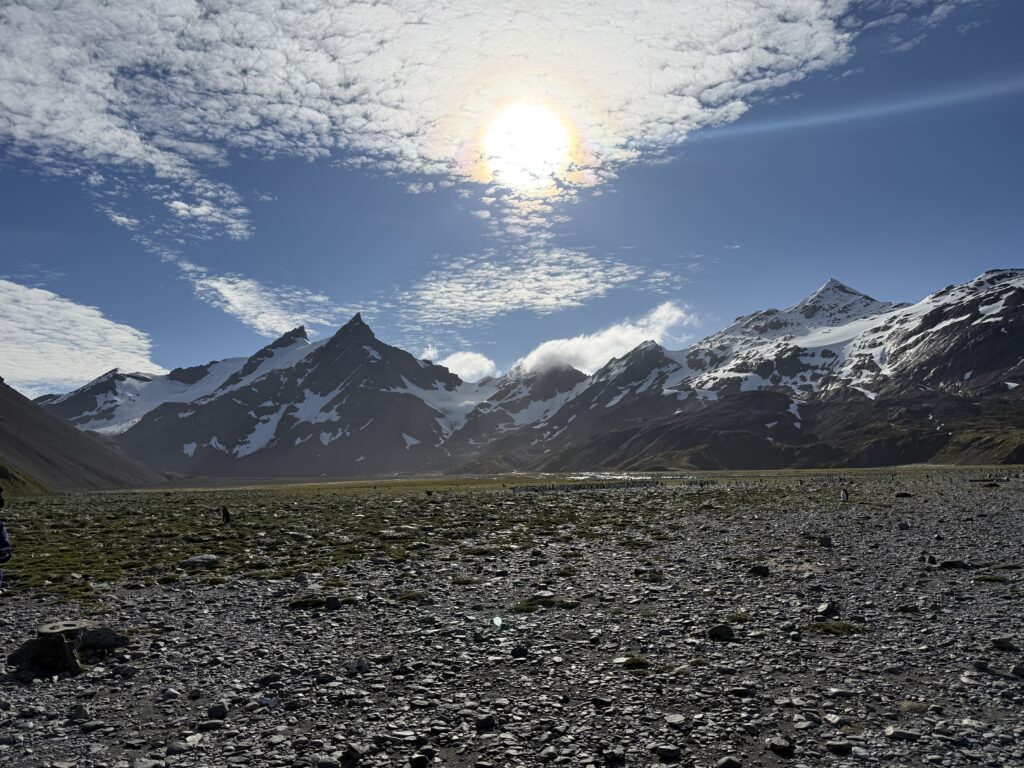
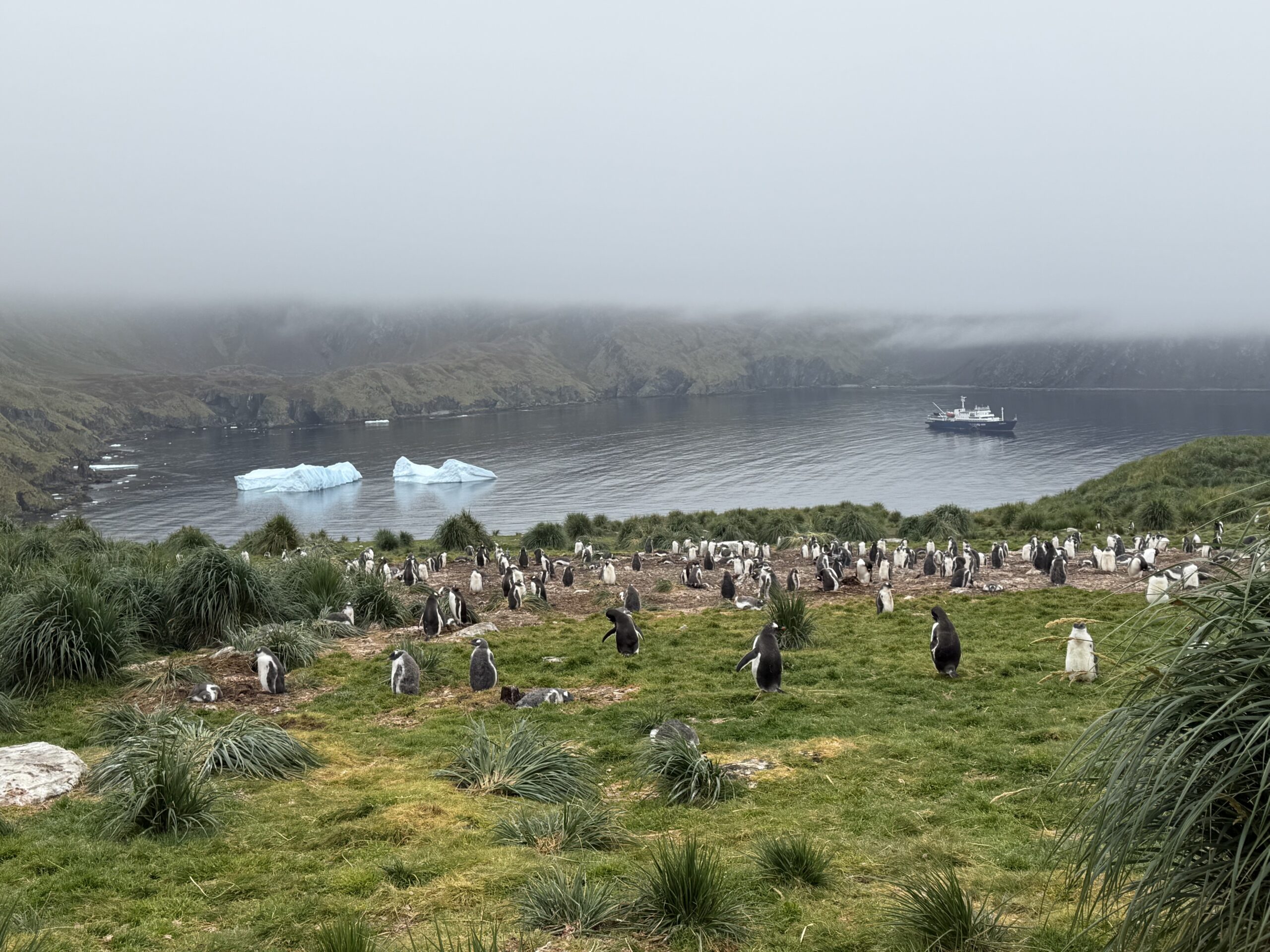
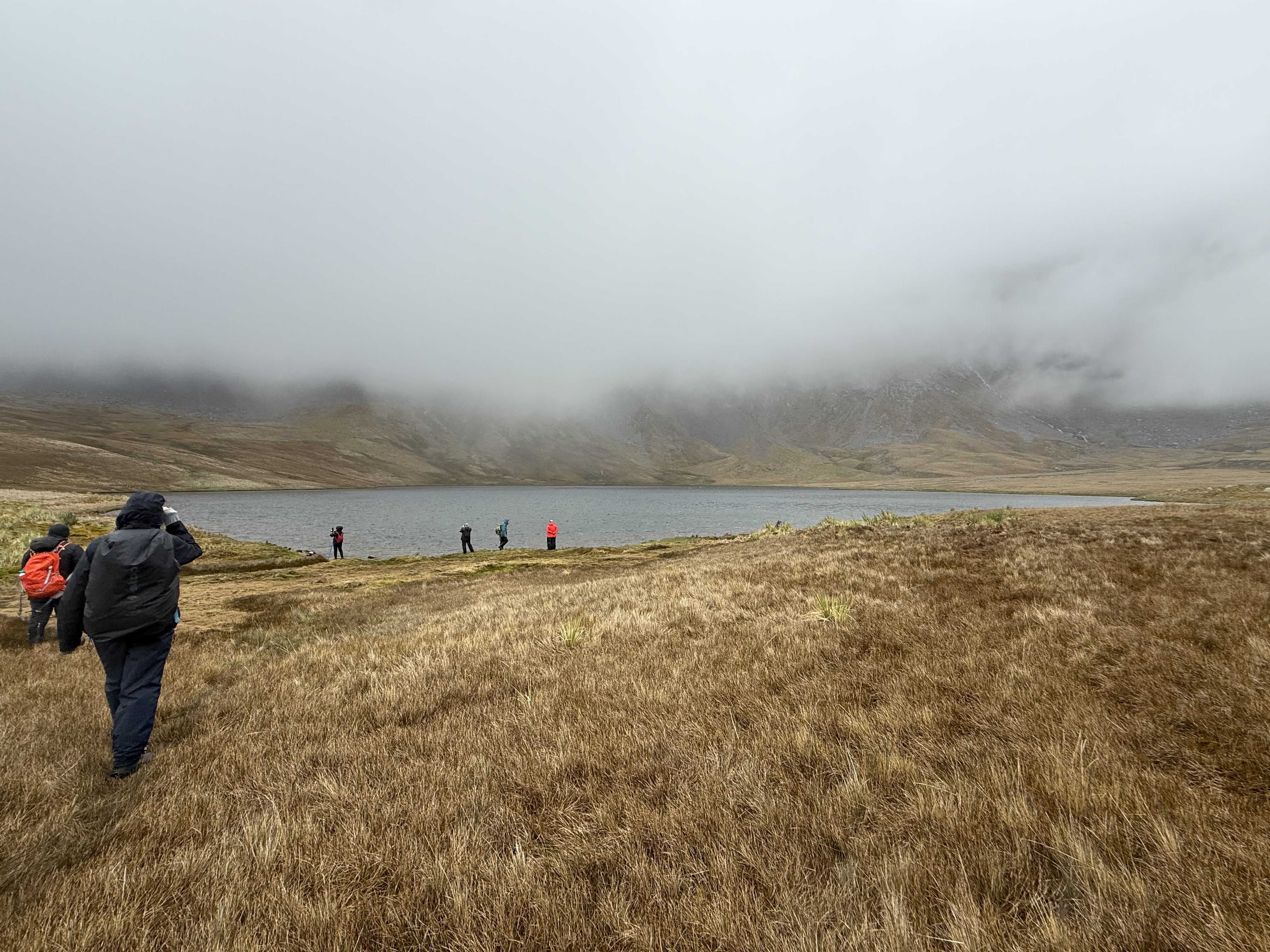
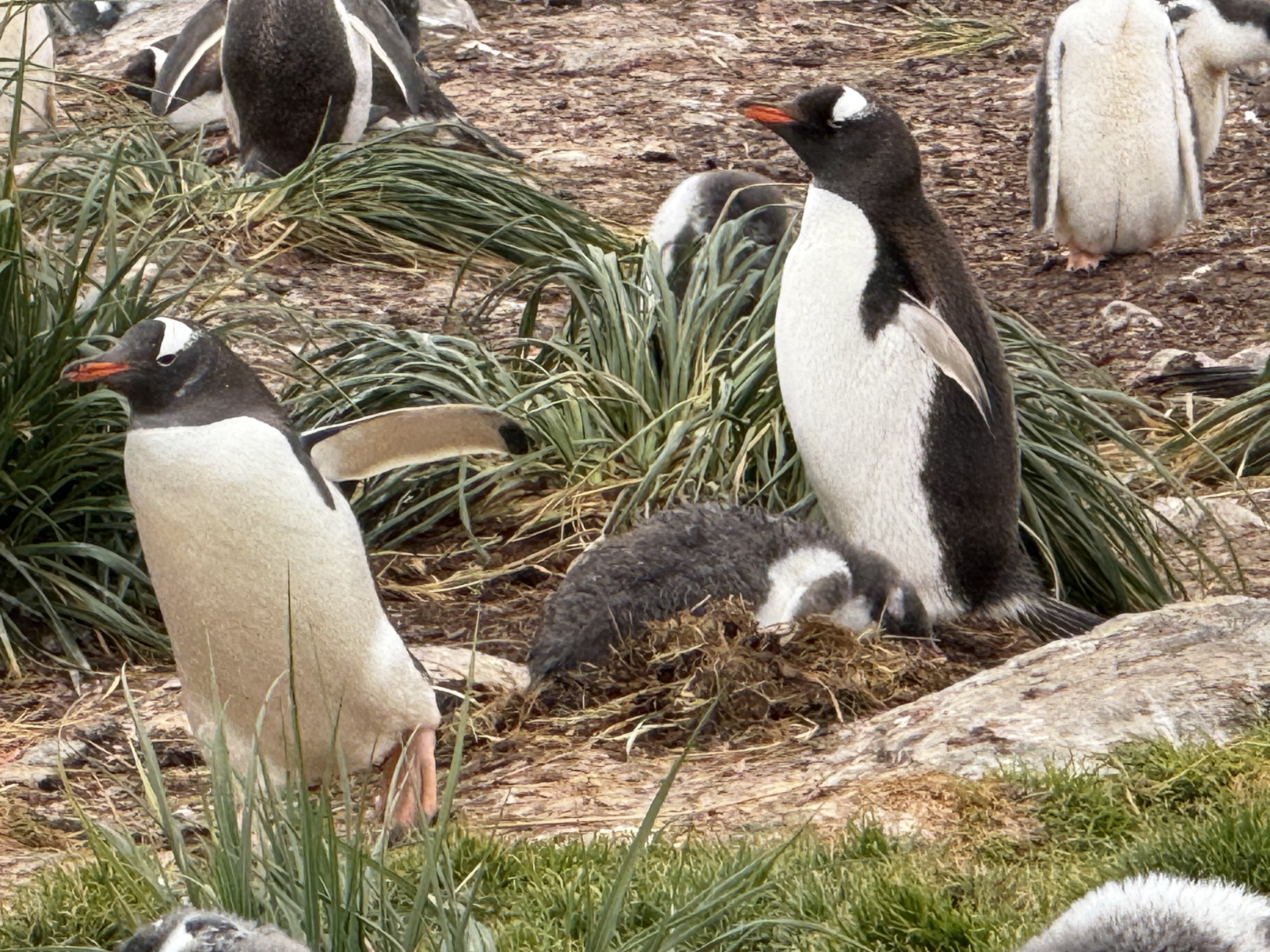
Today we landed at Godthul (Good Hollow in Norwegian) on SGI. The beach here is very small, but the surrounding landscape and the amphitheater the hills create at the landing are just beautiful. If you stop here, you will not be able to stay at the beach. Our guides organized two hikes that we could choose from. Both hikes involved a pretty good uphill portion through Tussac grass with mud, holes, and lots of seals hiding. If you like hiking with poles, this will be a good place to use them. The short hike took us to a Gentoo Penguin colony with lots of molting babies, and one mama penguin who kept stealing material from a nearby nest to use for her own baby. It was fun to watch them. The longer hike continued on from the colony to reach another Gentoo colony, see some beautiful vistas, cross some muddy streams, see a lot of penguin highways that they use to access the beach, and on to Lake Aviemore. You will be on shore over three hours if you take the longer hike, so don’t drink too much coffee before you head out! Most of us took the longer hike.
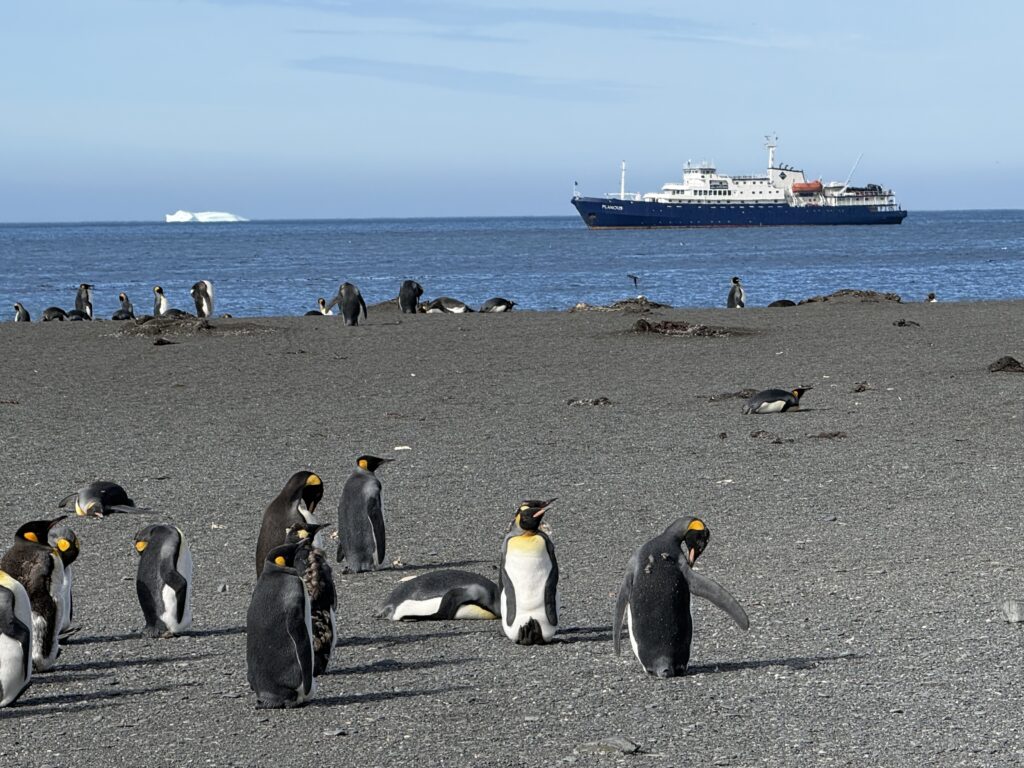
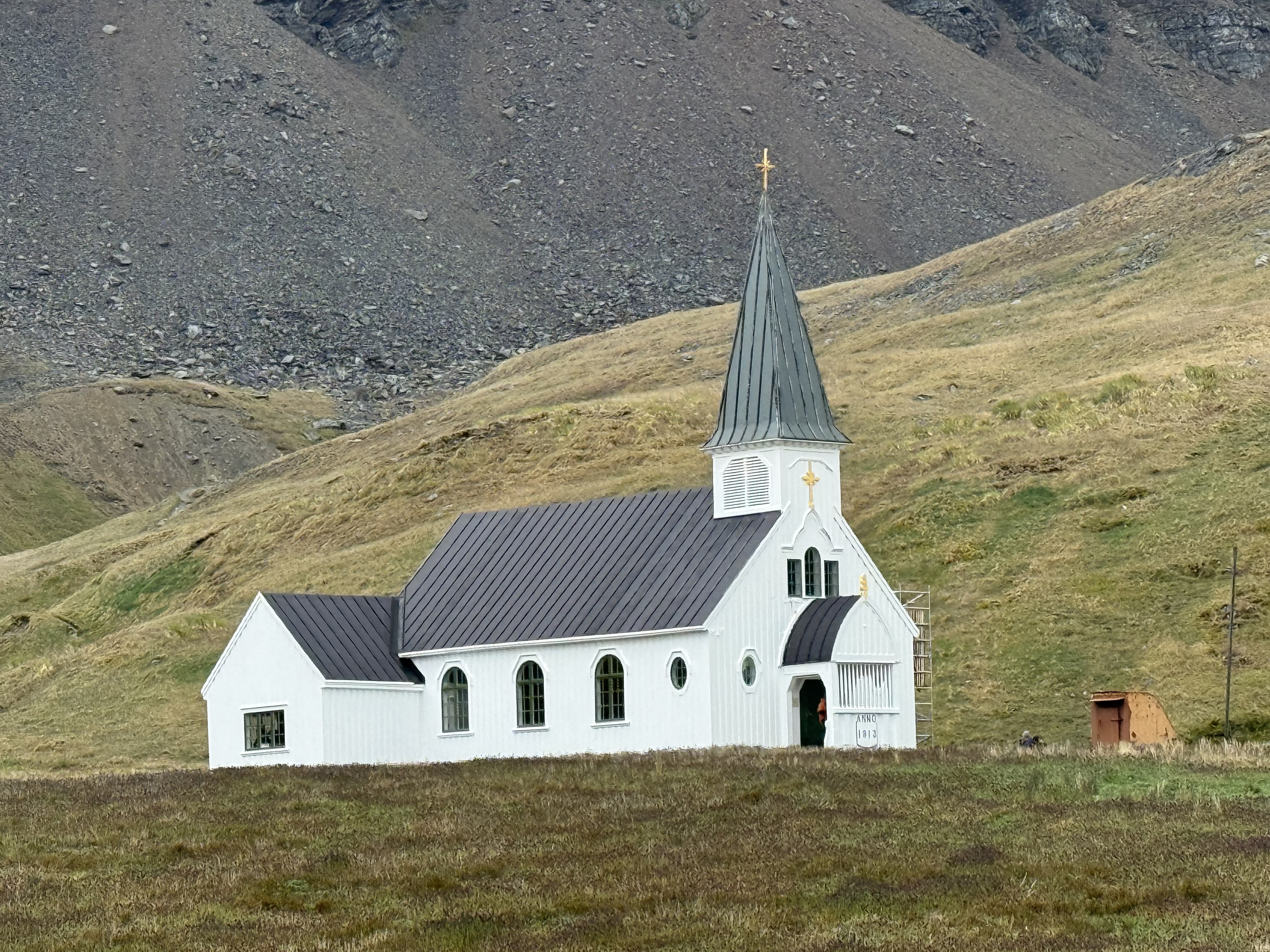
We finally landed at Grytviken in the afternoon. While our ship was being inspected by local authorities, two ladies who work in the museum came onboard to give a short lecture about the history and current events on the island. Grytviken was once a very large whaling station, where over 175,000 whales were slaughtered for their blubber. The famous Antarctic explorer Ernest Shackleton died here in 1922 and was buried in the Whaler’s Cemetery at the request of his wife. We highly recommend reading about Shackleton and watching a couple of documentaries before you go. There are several available.
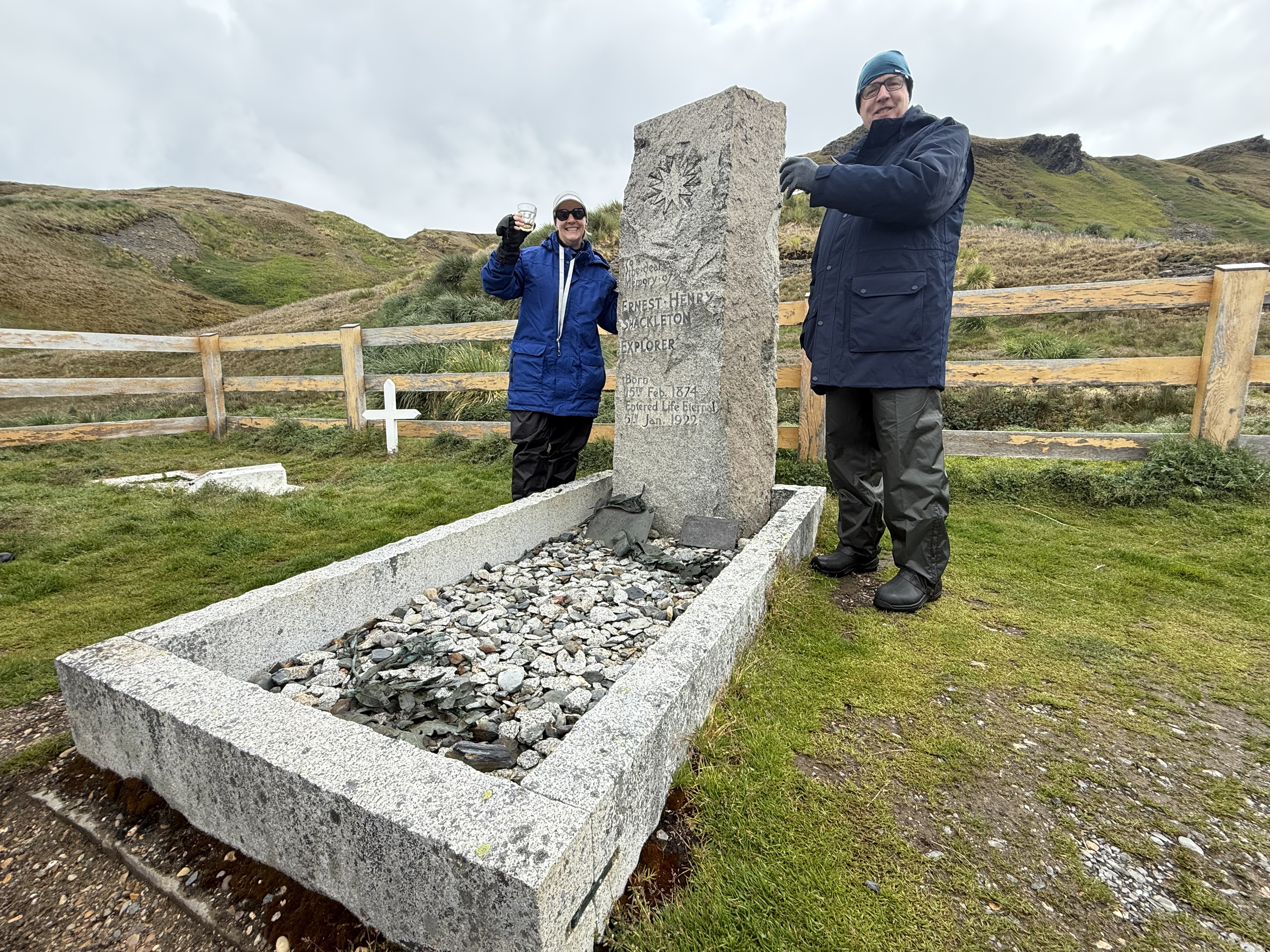
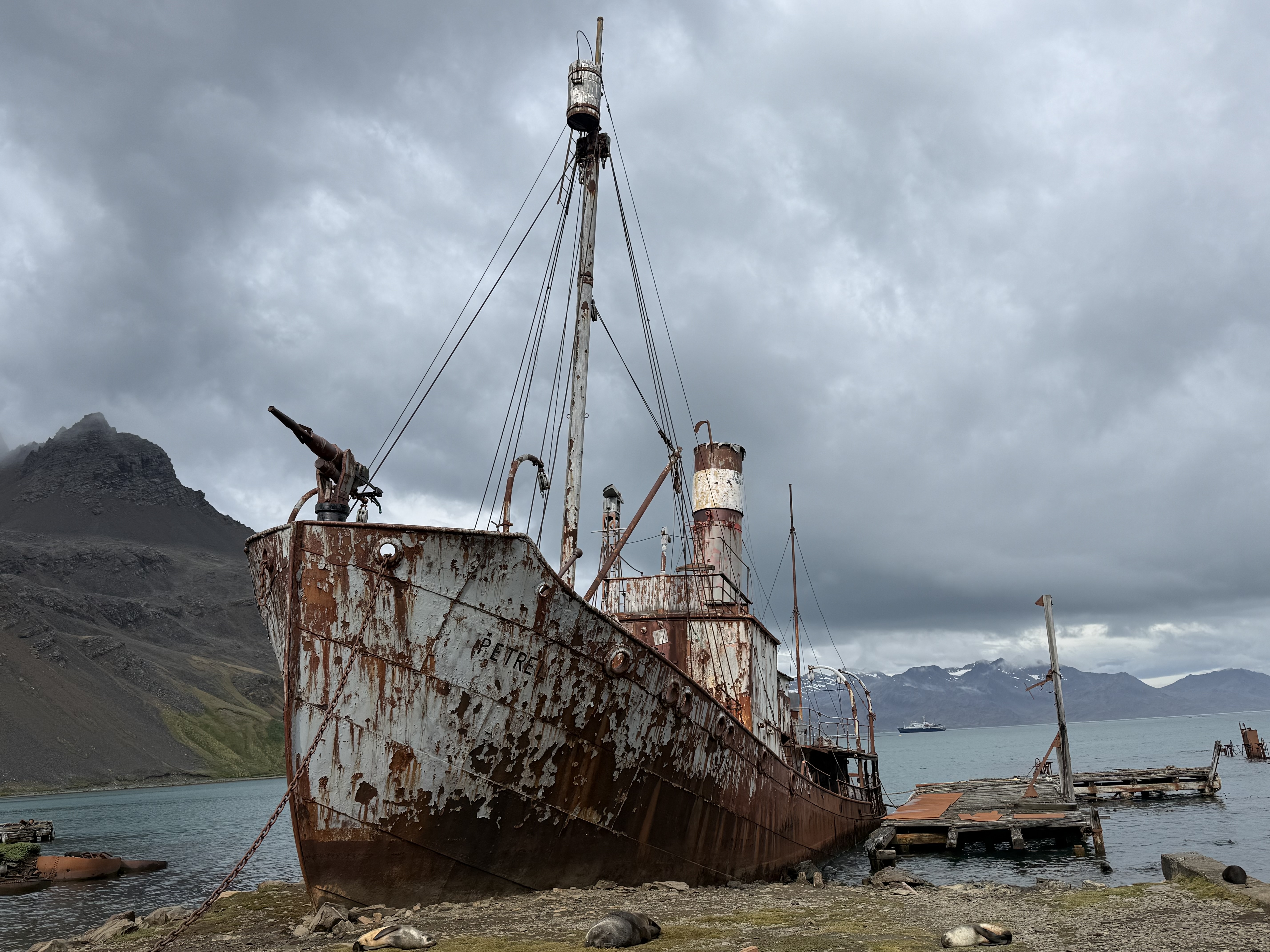
While at Grytviken, we visited Shackleton’s grave and toasted “The Boss,” as he was known, with some Shackleton Whisky served by our guides. After learning so much about Shackleton, it felt like being in a fascinating moment in history. We also visited the post office, where we mailed another post card, the museum, the church, a dormitory that housed the workers, and the ruins of the whaling machinery. Grytviken was quite a vibrant and busy place for six decades, and many people made their living here. Three former whaling ships are also grounded and in decay here. You can read more about Godthul and Grytviken in today’s blog post.
St Andrews Bay and Drygalski Fjord Wednesday 1/28/26 Day 10
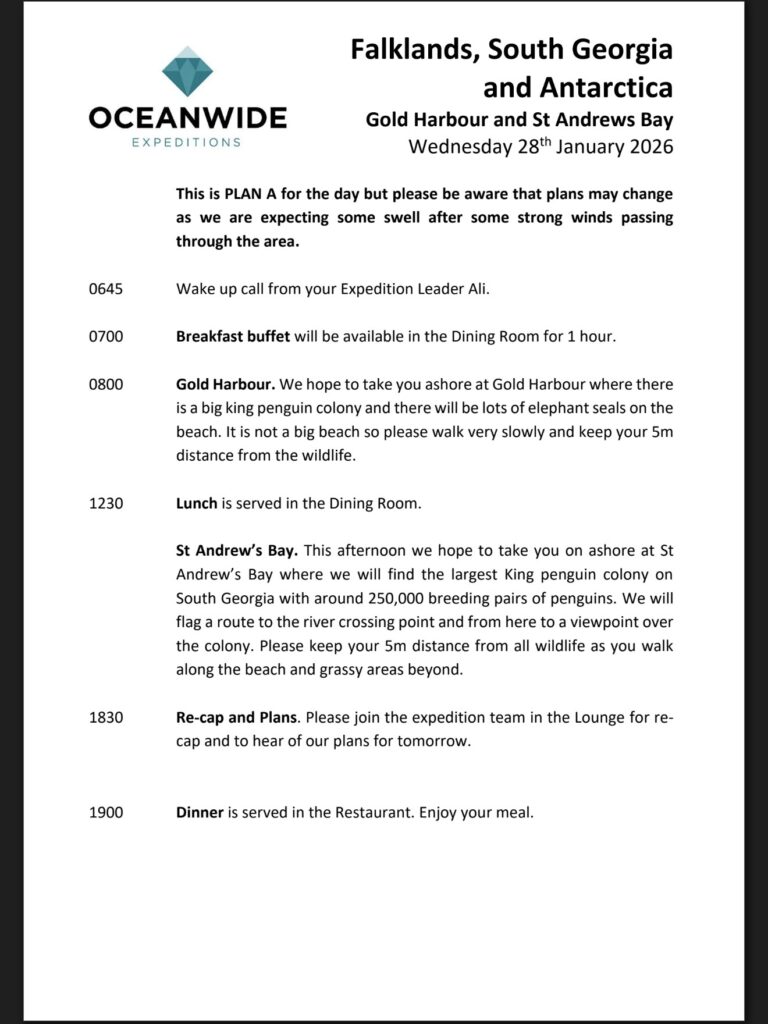
This was our last of four days on South Georgia Island. The preliminary itinerary called for landings at Gold Harbour and St Andrews Bay, but it is always subject to change depending on the conditions. After the wind and swells were assessed, we had to skip Gold Harbour and headed on to St Andrews Bay, where we pivoted to a Zodiac cruise instead of a landing, The guides attempted to land on the beach, but felt it was unsafe to take passengers ashore.
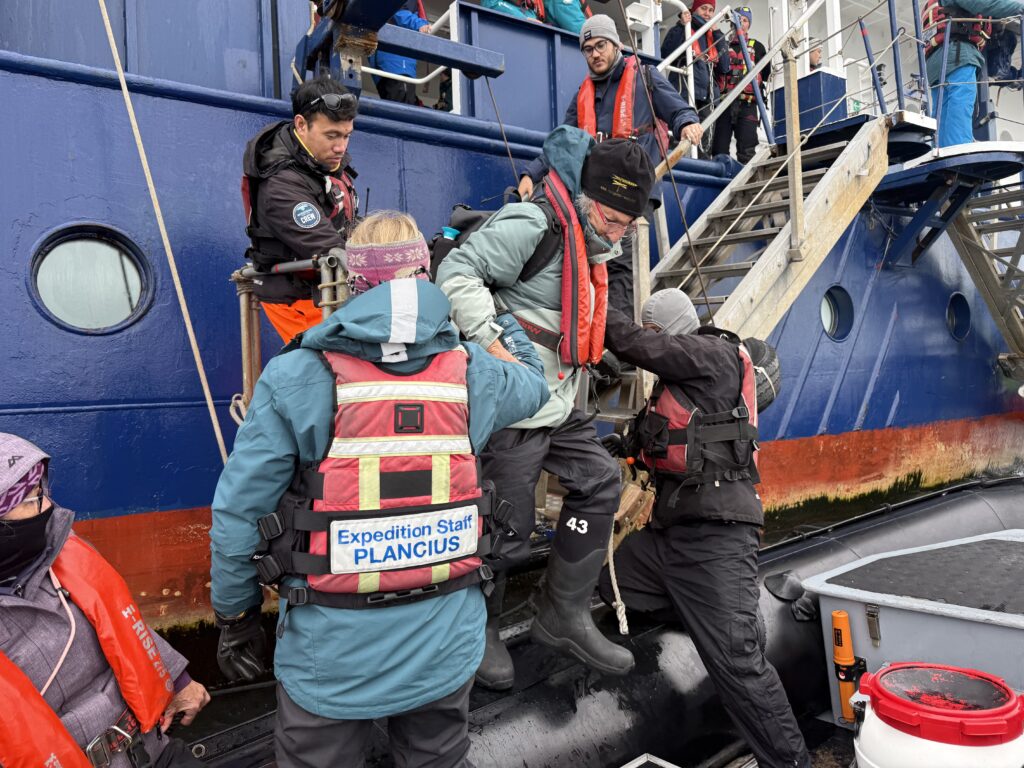
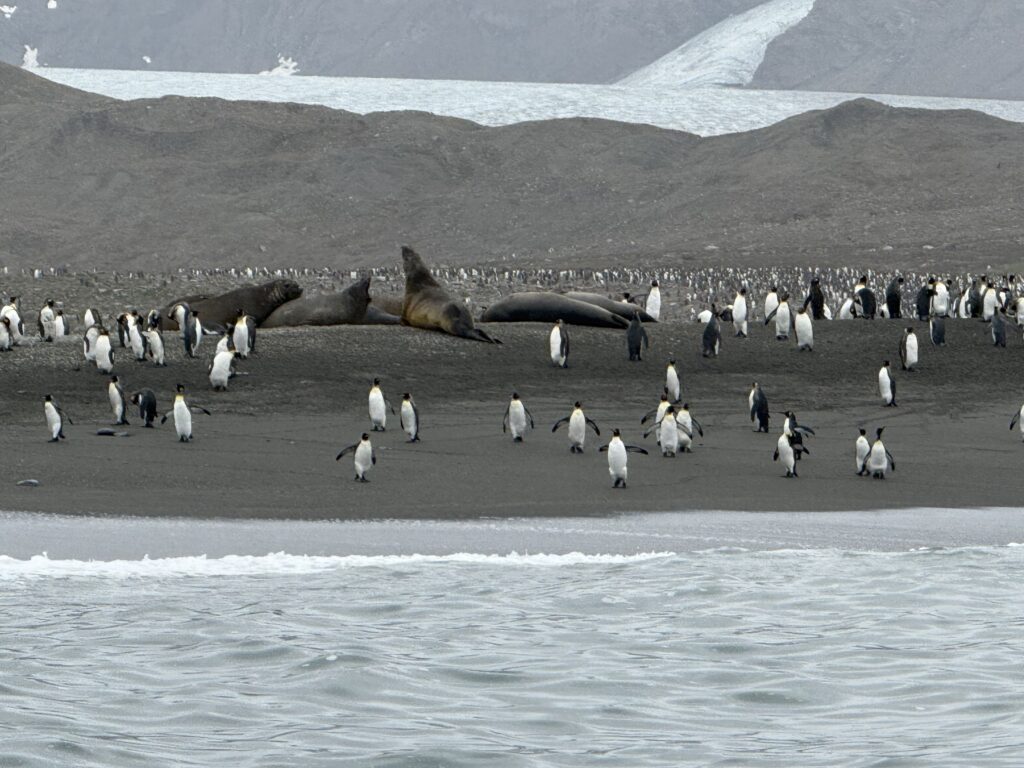
Getting into the Zodiacs was its own challenge this morning, with the waves crashing up over the gangway and the staff fighting the boats to keep them in place. If you have some minor mobility issues, or you simply want to skip it, you definitely not have to get into the Zodiacs if you don’t feel comfortable doing so. Once we all made it into the Zodiacs, we had a nice cruise near the beaches. St Andrews Bay is home to three large glaciers, lots of Elephant and Fur Seals, and the largest King Penguin colony on SGI with over 250,000 (usually) mated pairs. We enjoyed watching a few penguins trying to navigate hopping over a crack in the rocks and doing a lot of face planting. They are pretty resilient creatures, if not very agile.
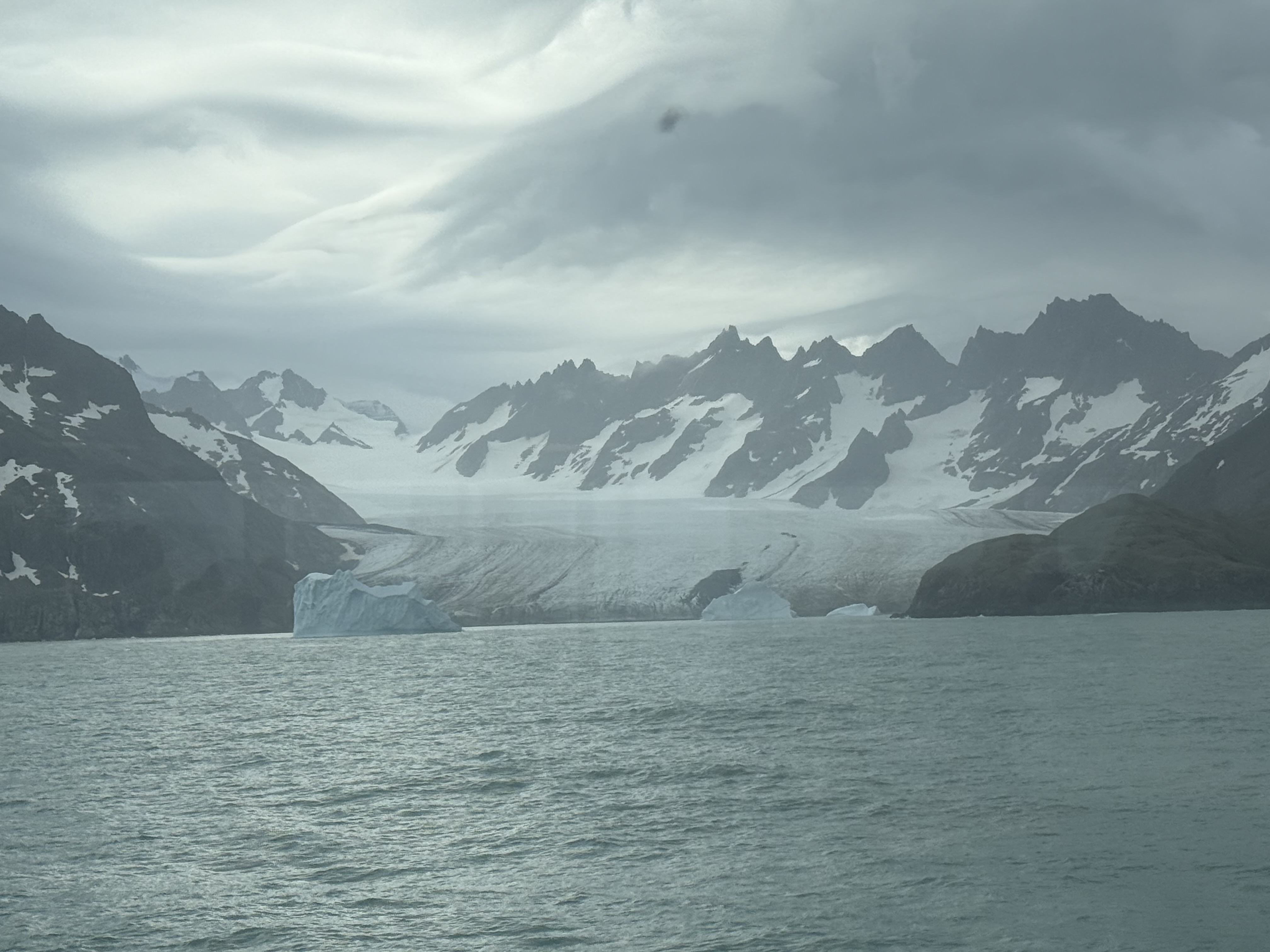
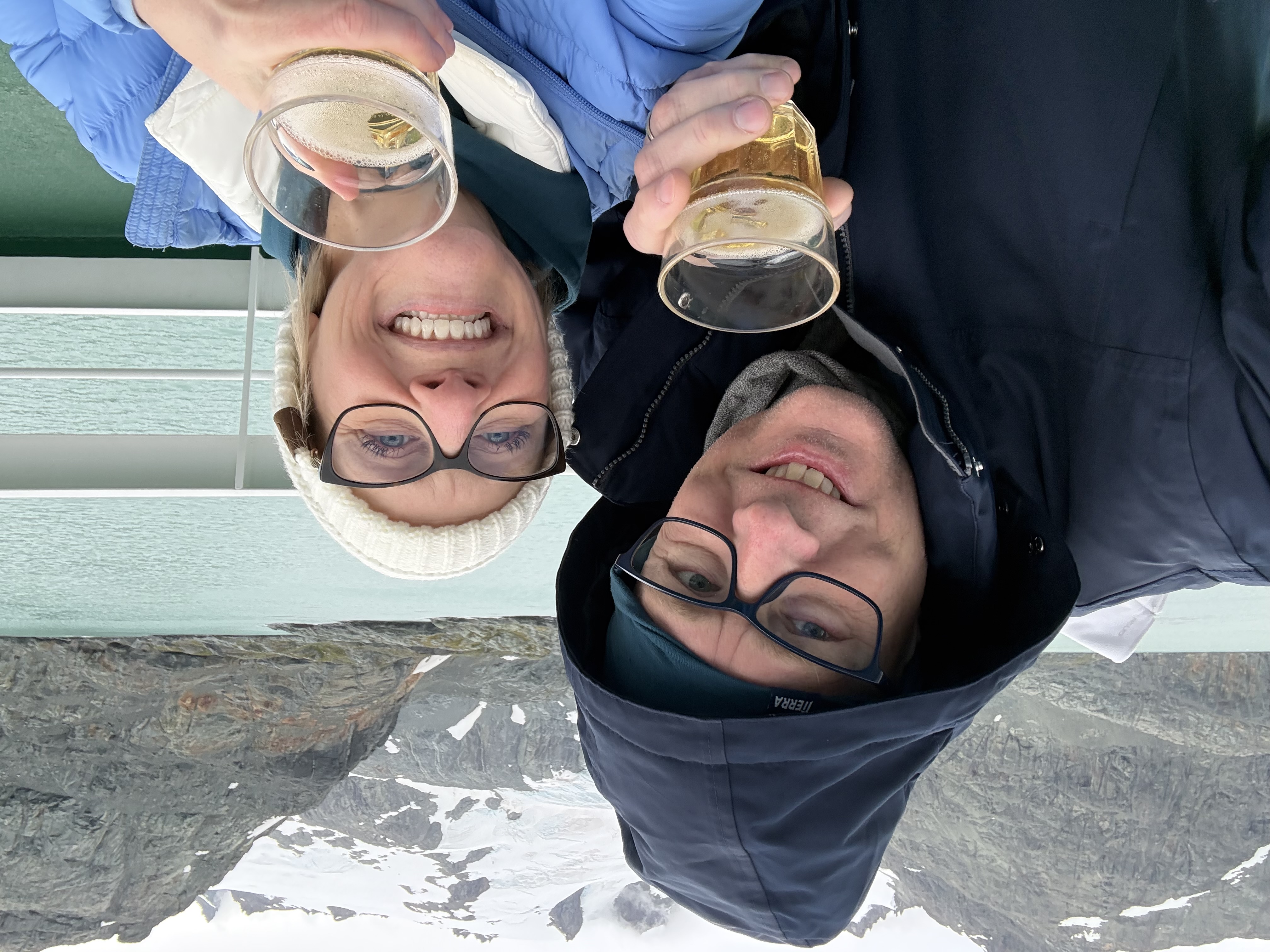
Since we had skipped Gold Harbour this morning, in the afternoon we were treated to sailing into Drygalski Fjord. Oh my goodness, was it ever beautiful. Most ships don’t get to experience it, so we felt very fortunate to see it. The water is turquoise and both sides of the steep fjord are lined with glaciers, waterfalls, and inlets. When we reached the mouth of the fjord, the staff prepared a Champagne toast for us outside on the deck behind the bridge. It felt like a happy celebration of the skill of the crew who sailed us into the narrow fjord, along with a celebration of the fabulous expedition staff who worked so hard to get us into the Zodiacs this morning. The scenery was truly was spectacular. It was also quite windy and very cold. After turning around and sailing out of the fjord, we sailed past Cape Disappointment and began our trip south to the Antarctic peninsula. You can read more about St Andrews Bay and Drygalski Fjord in today’s blog post.
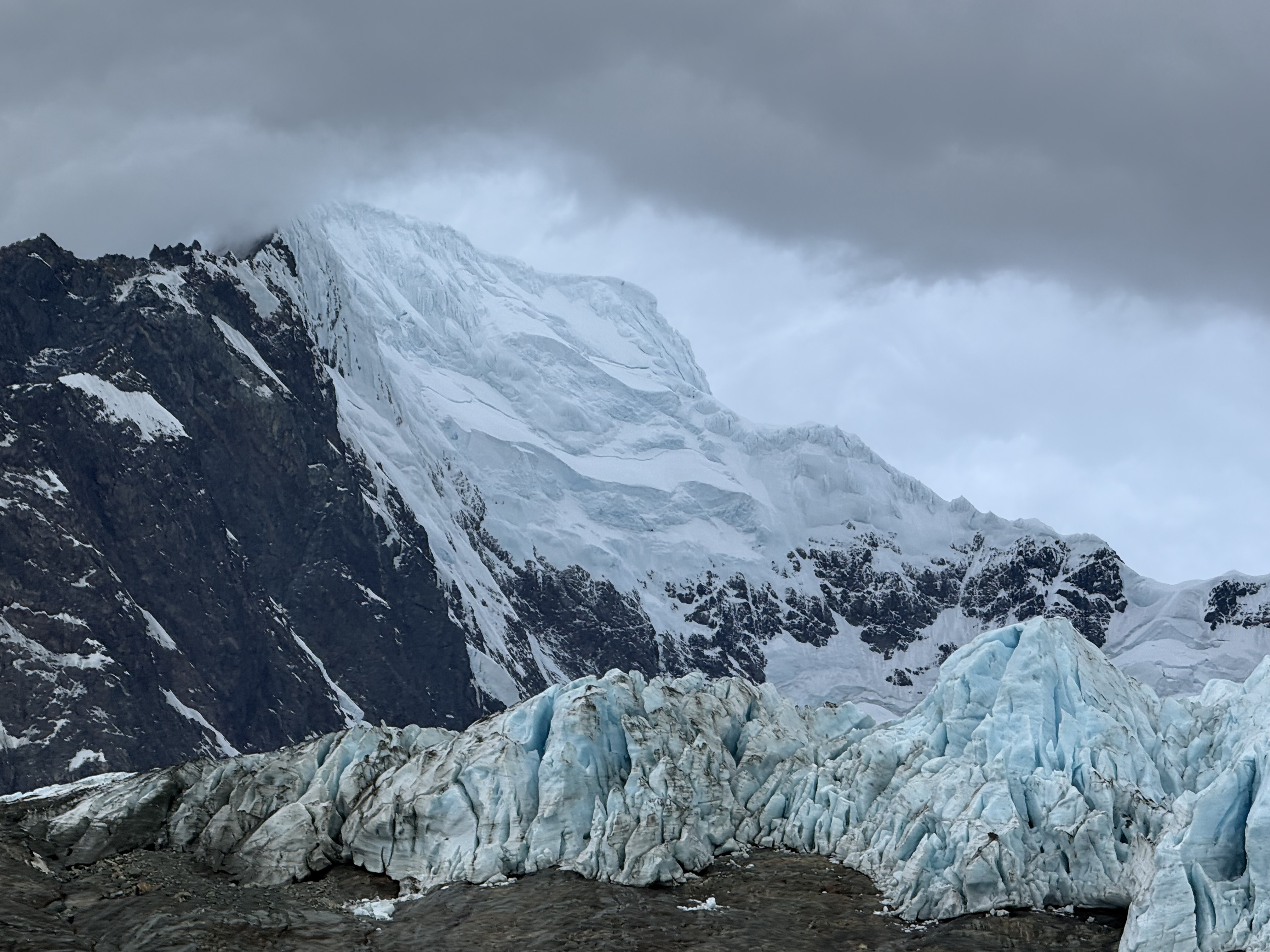
Sailing South to the Peninsula and Elephant Island Thursday-Saturday 1/29-1/31 Days 11-13
The trip from SGI to Elephant Island takes about three days and is 800 miles over open seas with very unpredictable weather. We experienced some rough seas on this journey, so again you will need to be prepared with Scopolamine patches or remedies that work for you. We had winds upwards of 40 mph with lots of pitching…for three days. We were happy to have the front to back movement of the pitching over the side to side movement of the rolling we experienced on the way to the Falklands. Our bed was aligned with the feet facing the stern of the ship, so with the rolling, we found ourselves not being able to sleep on our sides, as it would roll us over onto our backs. I have trouble sleeping on vacation regardless, so found myself taking some sleep aids and propping myself up with some strategically placed pillows. You may want to come prepared if you are a light sleeper.
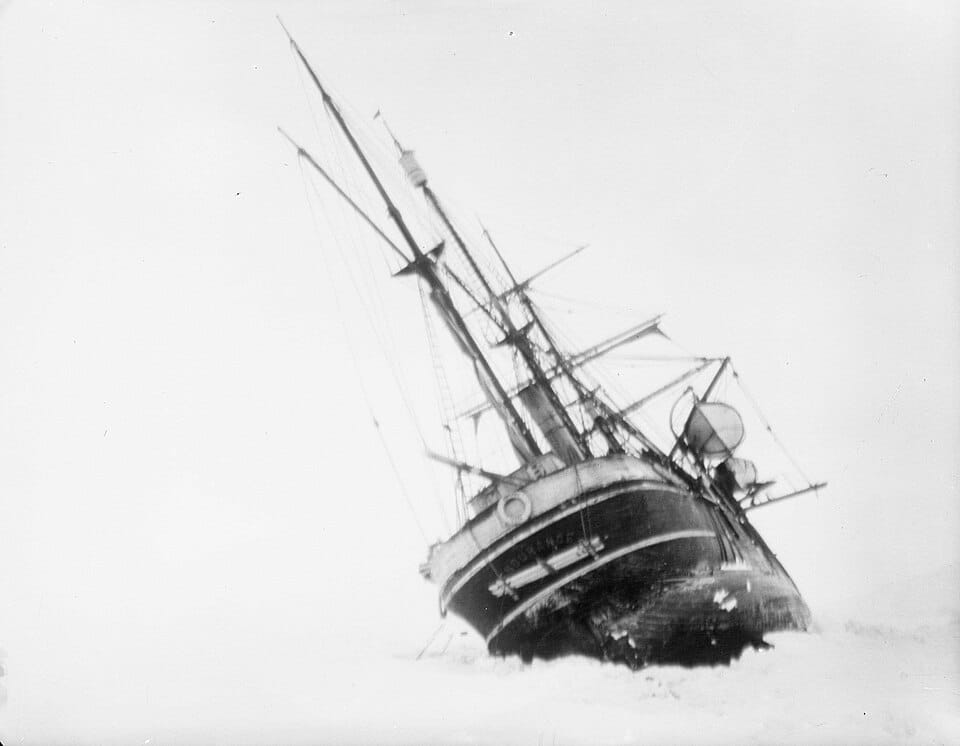
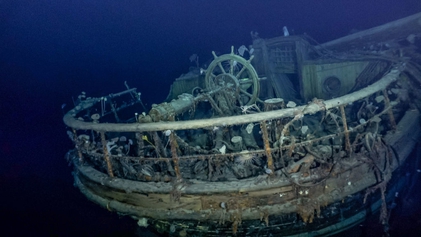
The highly educated and experienced expedition guides will keep you well informed and educated while in route. We attended another lecture on the Shackleton expedition, as well as a lecture on the Amundsen and Scott race for the South Pole. Lots of fascinating, joyous, and sad history in these stories. We also attended lectures on glaciers (one of our guides was a glaciologist), plate tectonics (one of our guides majored in geography and public policy), and lectures on whales and krill. We watched a documentary on Shackleton, and a documentary about finding his ill-fated ship the Endurance, which was discovered in 2022, 107 years after she sank, perfectly preserved and resting on the sea floor at a depth of 9869 feet in the Weddle Sea.
We enjoyed the presentation from our Head Chef Ralf on the rigors and logistics of planning, ordering, loading, storing, and preparing the food on board the ship. He had a seven member team, with one cook solely responsible for feeding the staff. (The expedition team ate their meals with us, but we never saw the rest of the crew eating at our meal times.) There were 24 different nationalities on our ship, so keeping everyone satisfied with a varied menu was a challenge. We took on all of our supplies in Ushuaia for the entire 18 day voyage, with the exception of tomatoes, which were not available and had to be procured in Stanley.
In the evening on our third sea day, we reached Point Wild on Elephant Island. This is the site where Shackleton’s crew spent over four months hoping to be rescued, but not knowing whether Shackleton and his five men had perished on their journey to South Georgia Island. The seas and shore can make landing very difficult here, and our Expedition Leader Ali said she had only ever been able to make a landing once. We were just happy to have been that close and to have seen what is left of the beach. With the seas we experienced, we were in awe of Shackleton and his five man crew doing this same 800 mile journey (in the opposite direction) in basically a small rowboat with a homemade sail. To understand what they went through is simply mind boggling. You can read more about our three day voyage to Elephant Island on today’s blog post.
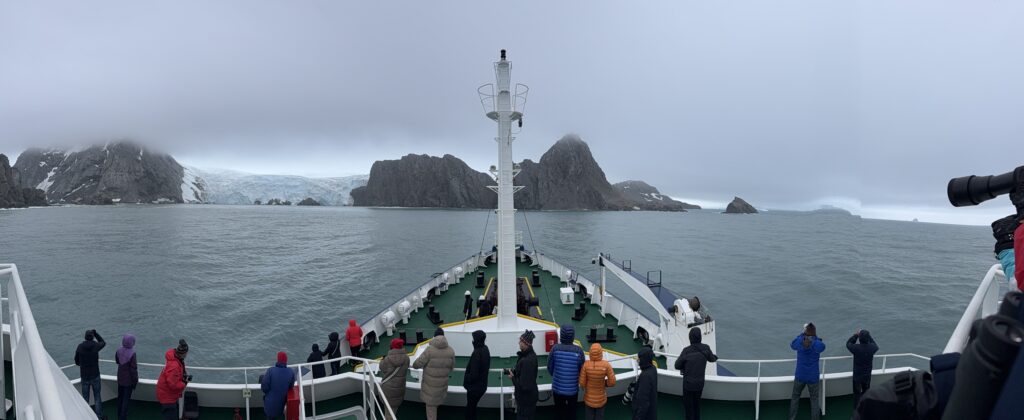
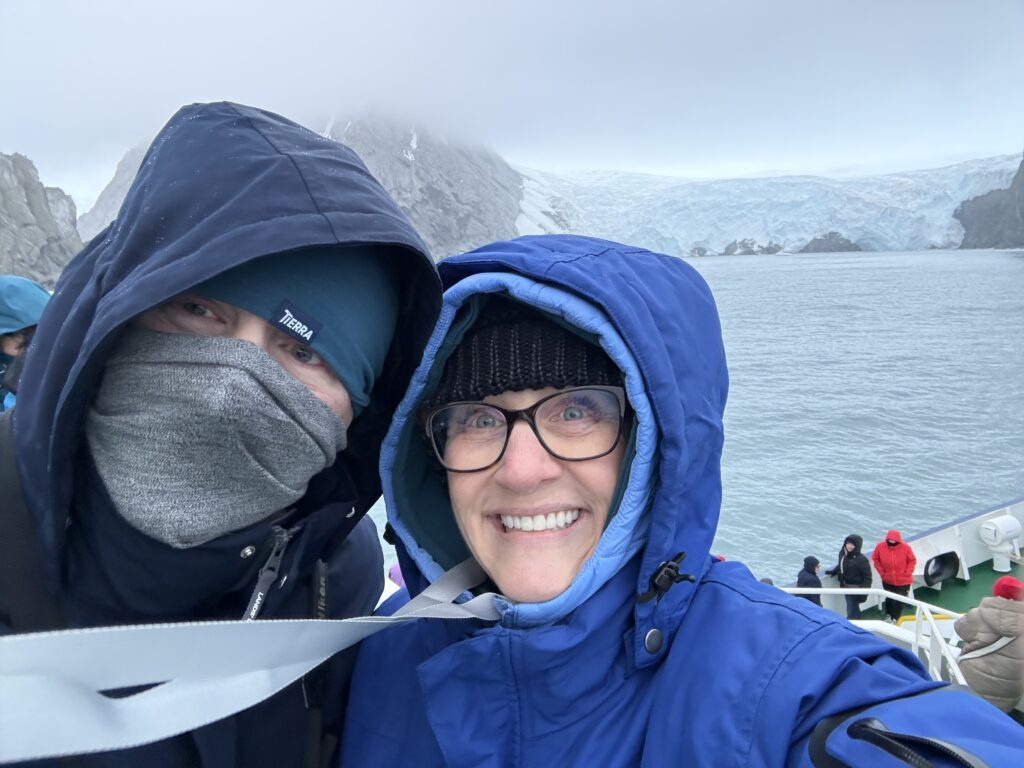
Continental Landings 2/1-2/2 Sunday/Monday Days 14/15
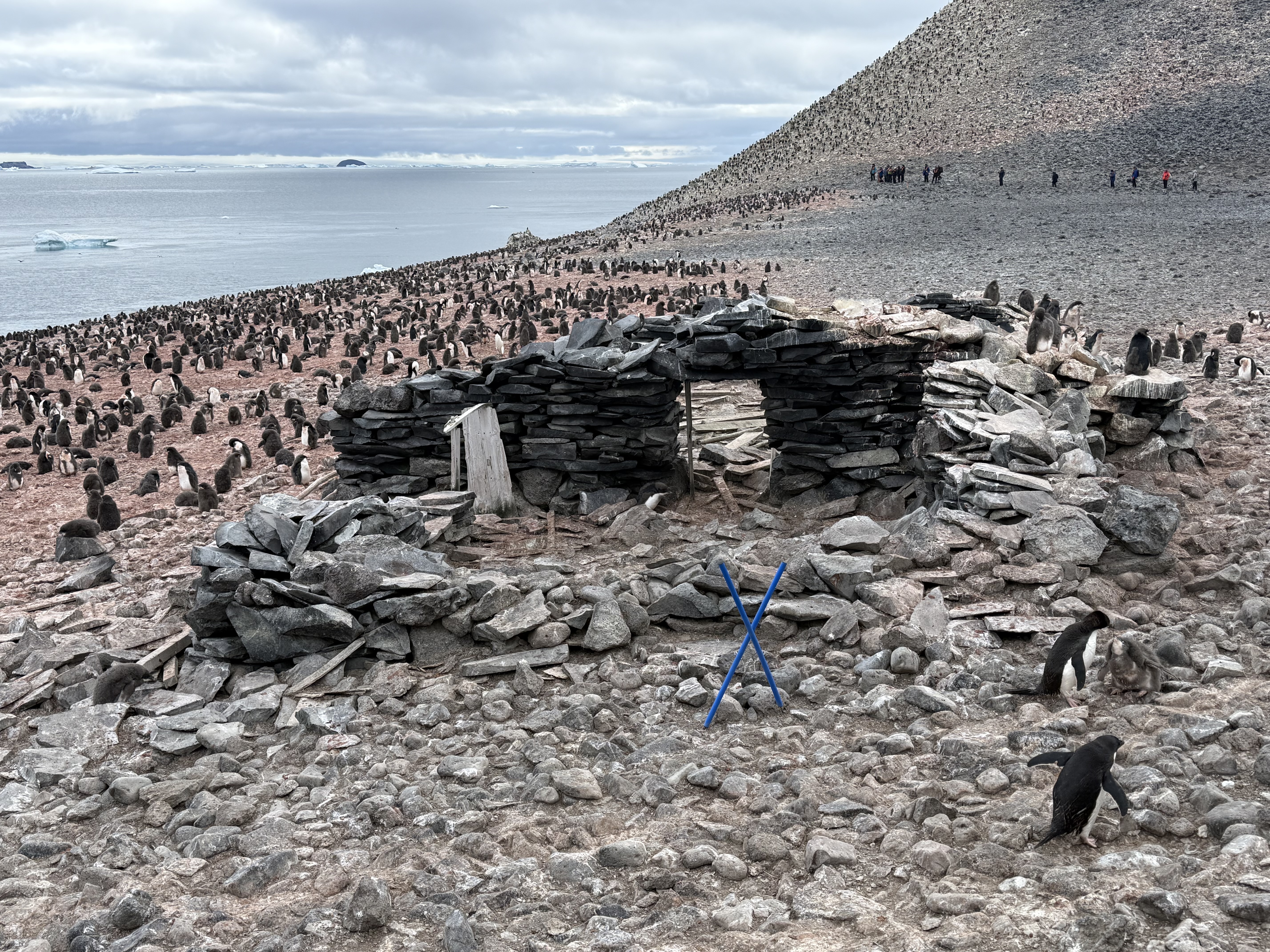
After breakfast on Sunday, Expedition Leader Ali presented our IAATO briefing, which is mandatory for all passengers going ashore on the Antarctic continent. It was basically a recap of all the biosecurity practices we had already been doing. Our guide Marcelo gave a presentation about a Norwegian Antarctic expedition team who had overwintered in a stone cabin on Paulet Island, which we would be visiting on Monday.
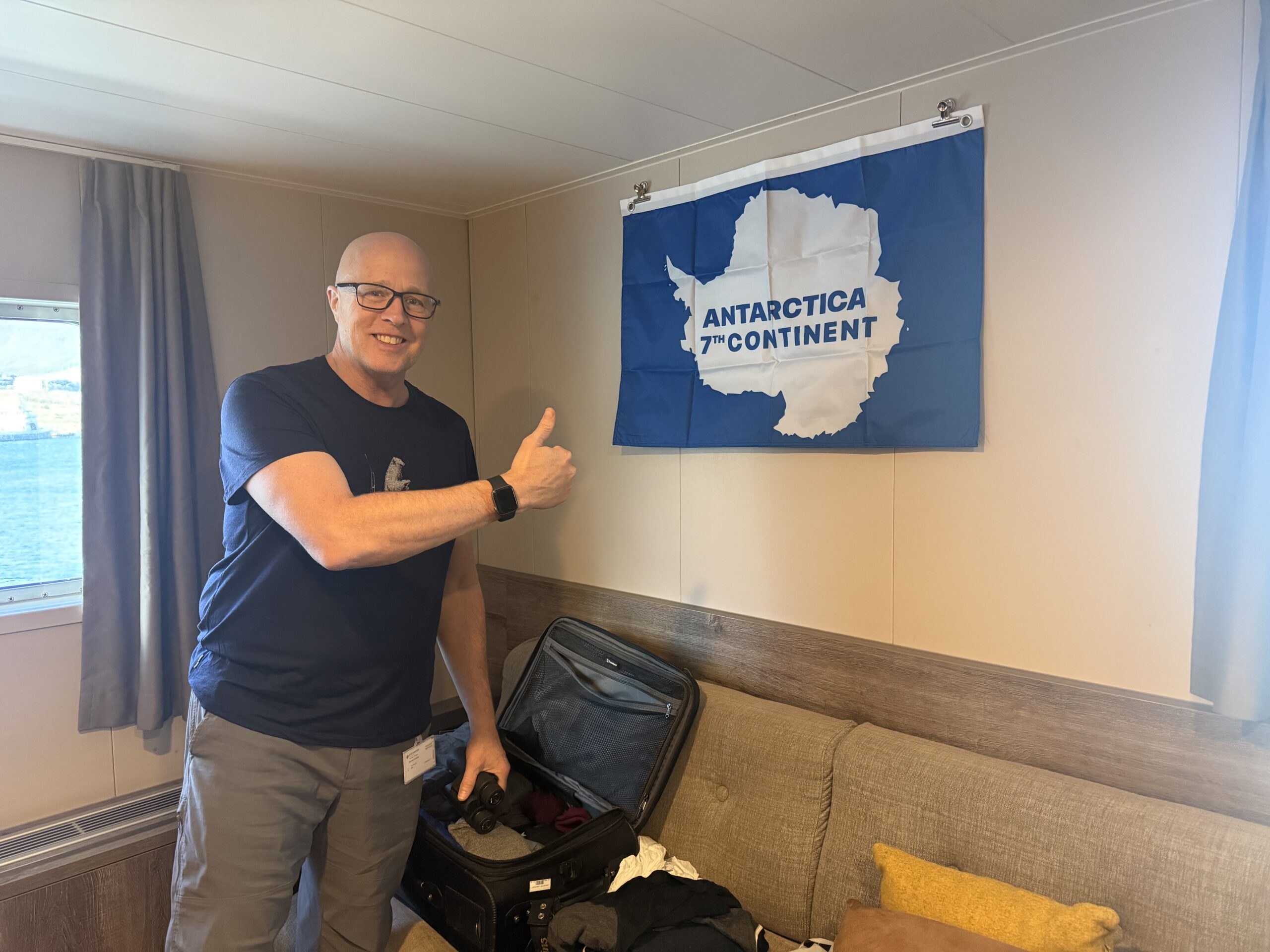
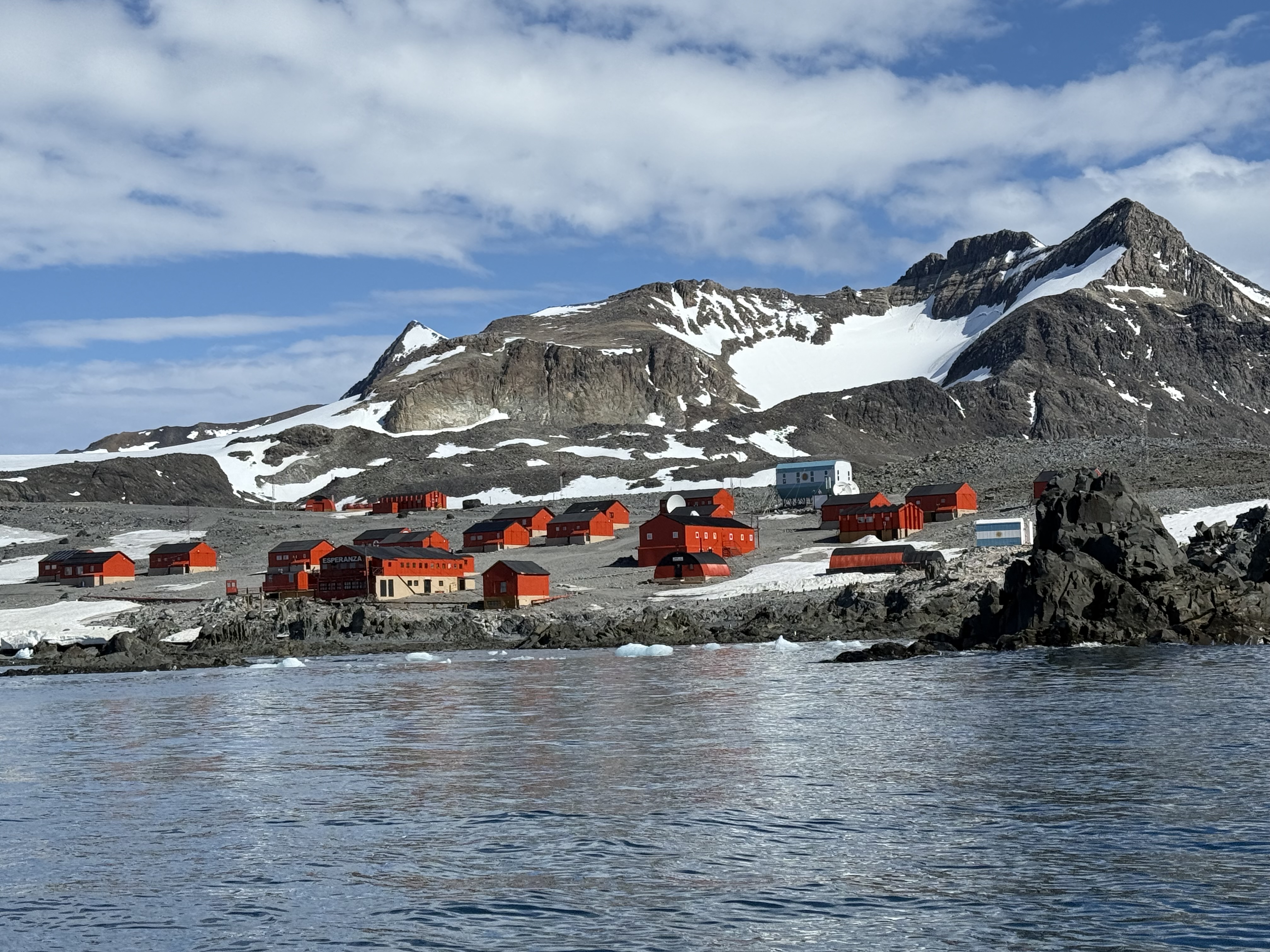
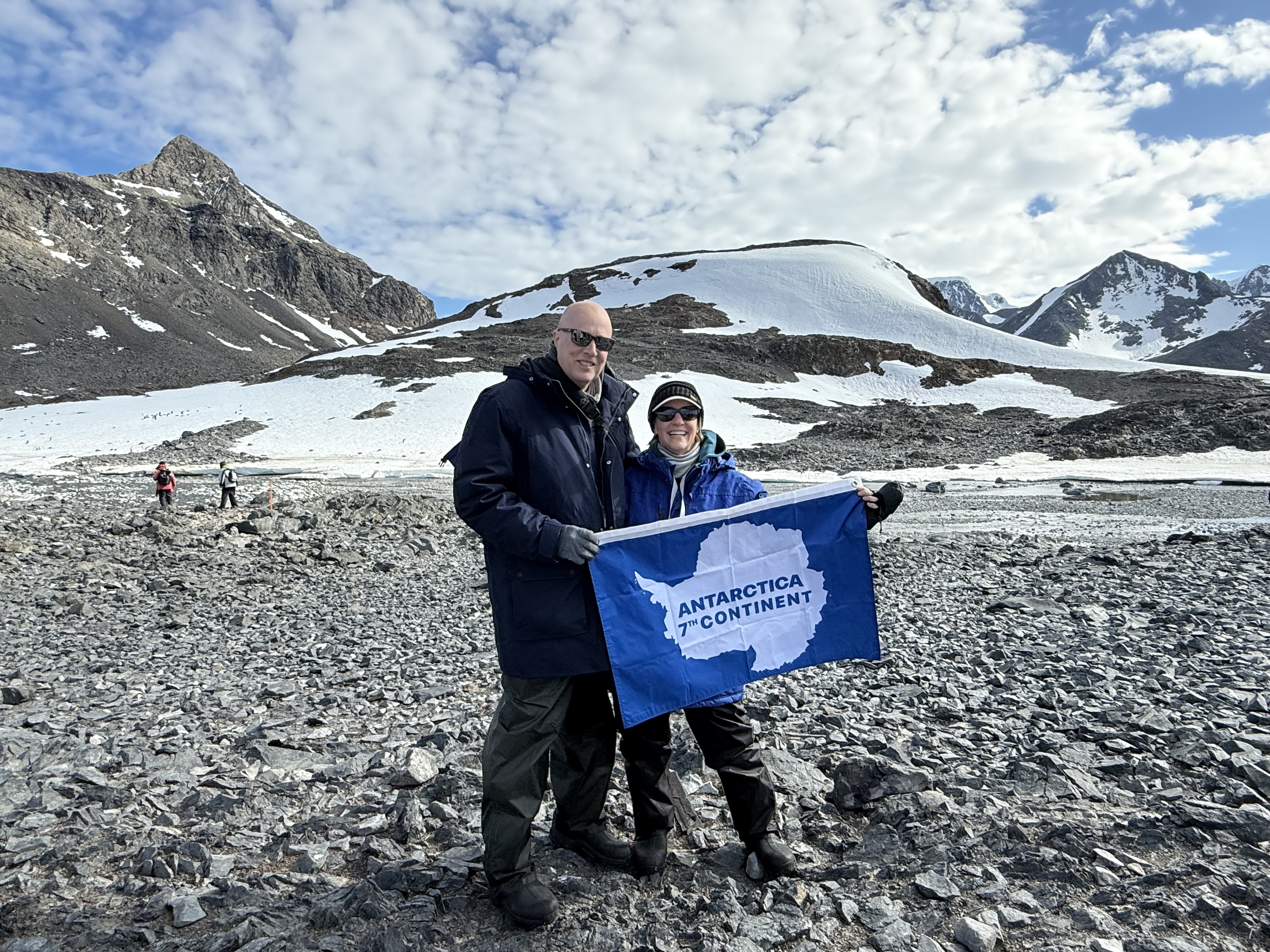
In the afternoon, we made our first continental landing at Hope Bay. While we were super happy to finally be setting foot on the continent itself, we found ourselves wishing for a bit more snow so it would be little more “Antarctica-y” but alas, in February, you get a little snow and a little mud. It did not stop us from enjoying the hike to the Adélie Penguin colony, watching a Weddle Seal basking in the sun, and taking fun photos with our Antarctica 7th Continent flag we had purchased from Etsy. It also did not stop us from enjoying the Zodiac ride to see the Esperanza Argentine Military Base, where our fabulous guide and retired Argentine Admiral Marcelo had once been the “boss of the boss of the boss” of the Base Commander. Wowsa! We are lucky to have him on our ship! We discovered later that Marcelo had made some calls so we would be permitted to take the Zodiacs close to the base. Yet another example of why we feel we lucked out getting on the Plancius, when it was not the ship we originally booked.
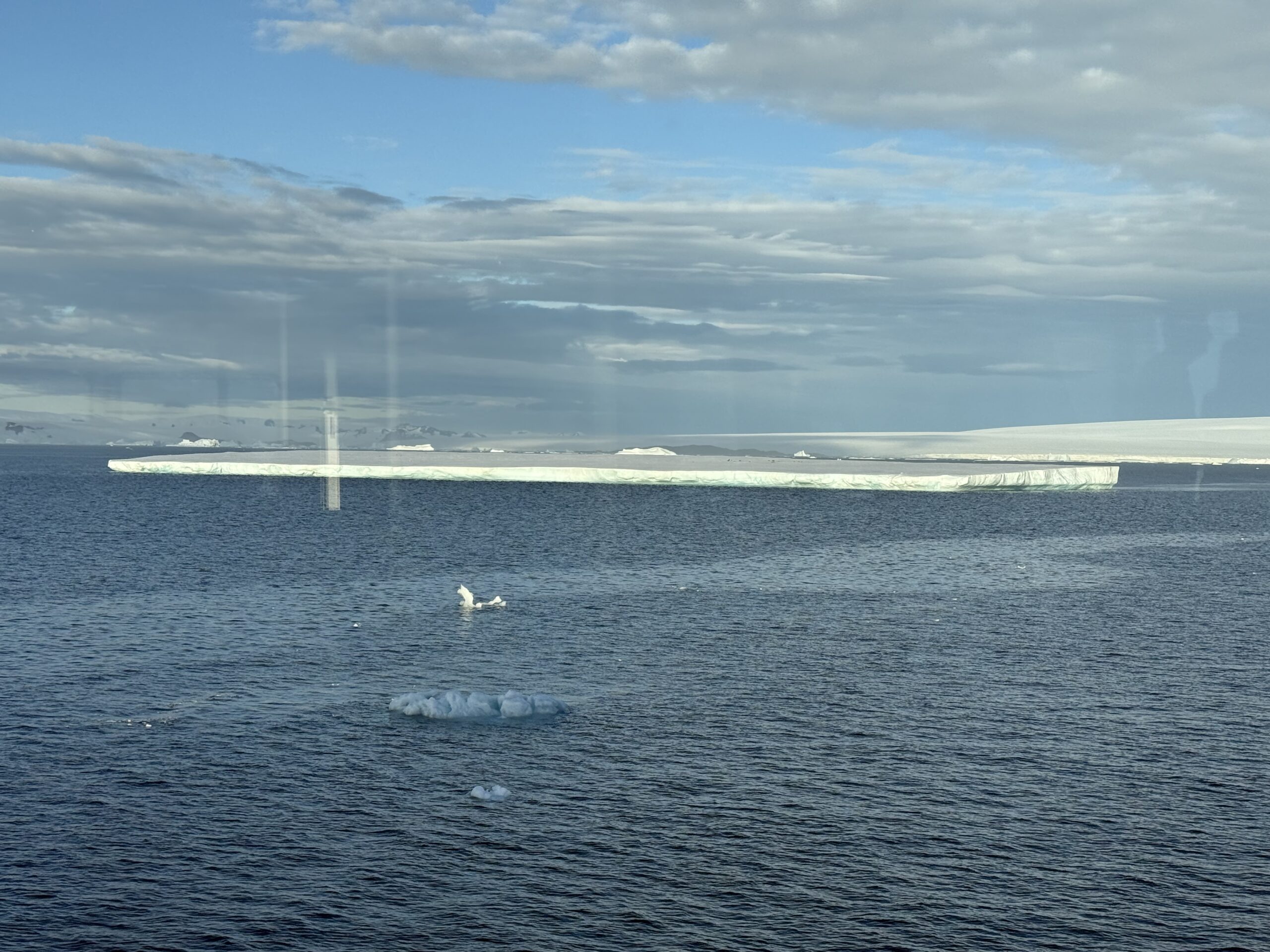
After dinner, we were treated to a sunset Zodiac cruise among the icebergs and bergy bits. The weather was beautiful and being up close and personal (at a safe distance) to the icebergs was a real highlight of this trip. We were lucky enough to encounter a pod of Orca on this cruise, but we were not very successful at getting any good photographs. Here is today’s blog post.
On Monday morning, we landed at Paulet Island, located near the Antarctic peninsula. We were able to see the remnants of the Norwegian expedition cabin, and Marcelo was there to answer any questions. Paulet Island is an active volcano which keeps part of the island ice free, and it is inhabited by over 100,000 pairs of Adélie Penguins, which are year round residents. By the time it has warmed up in February, and the penguins have been spending a lot of time on land raising their chicks, the remaining snow will be orange with penguin guano (their diet is strictly krill), and it can get quite smelly. This was the only place we noticed the smell, and it was pretty powerful. You will acclimate to it while on land, but we found that the smell permeated our coats. (As I mentioned, you will keep your coats and boots in your room on the Plancius, as opposed to a boot room on other ships.) When we returned to our room after lunch, the smell was pretty overpowering. We propped the door open and got some air freshener from our cabin steward. So, our advice is to bring an air freshener. Smelly penguins and sometimes dirty Zodiacs are also the reasons we recommend renting your waterproof parkas in Ushuaia.
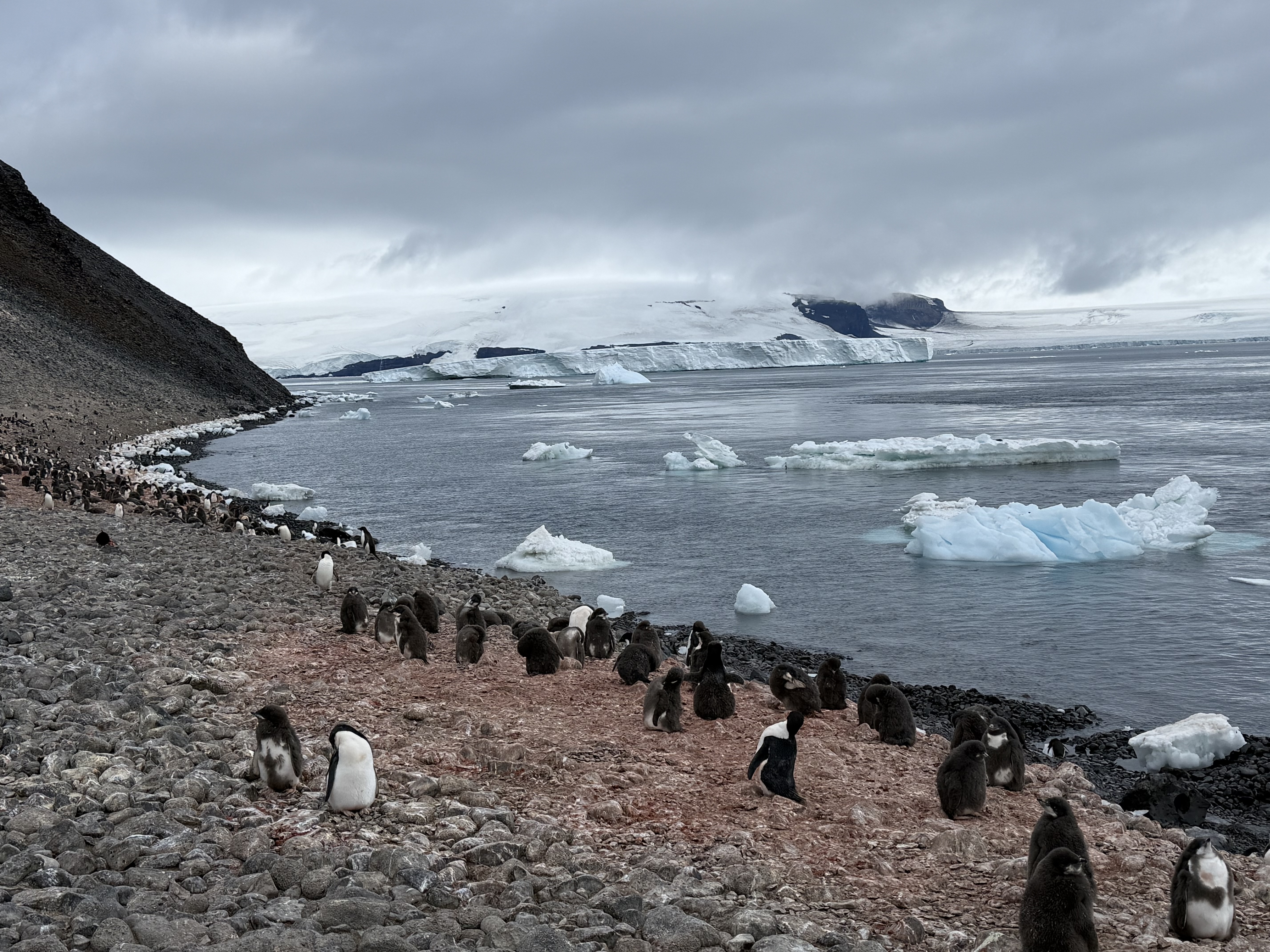
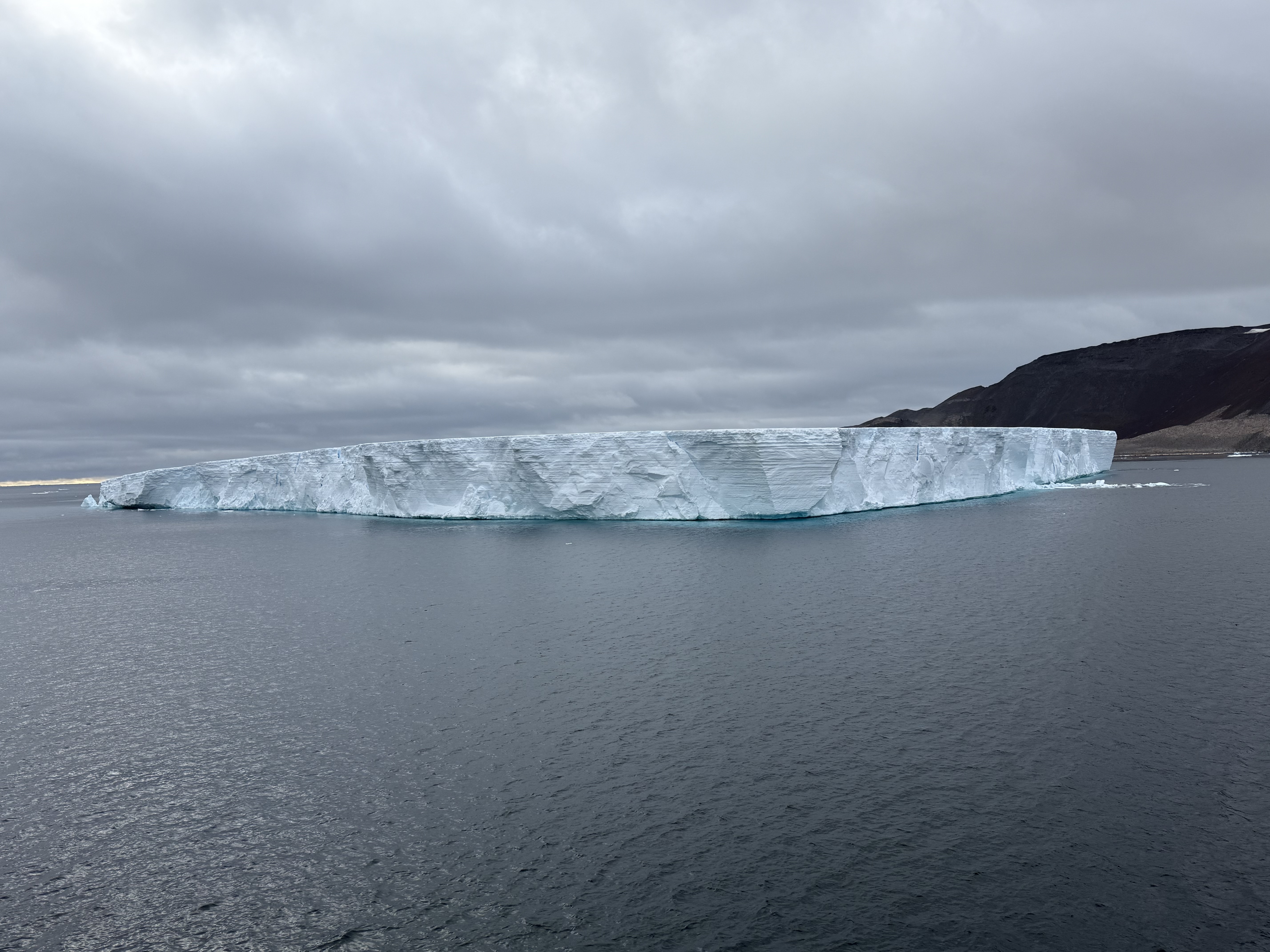
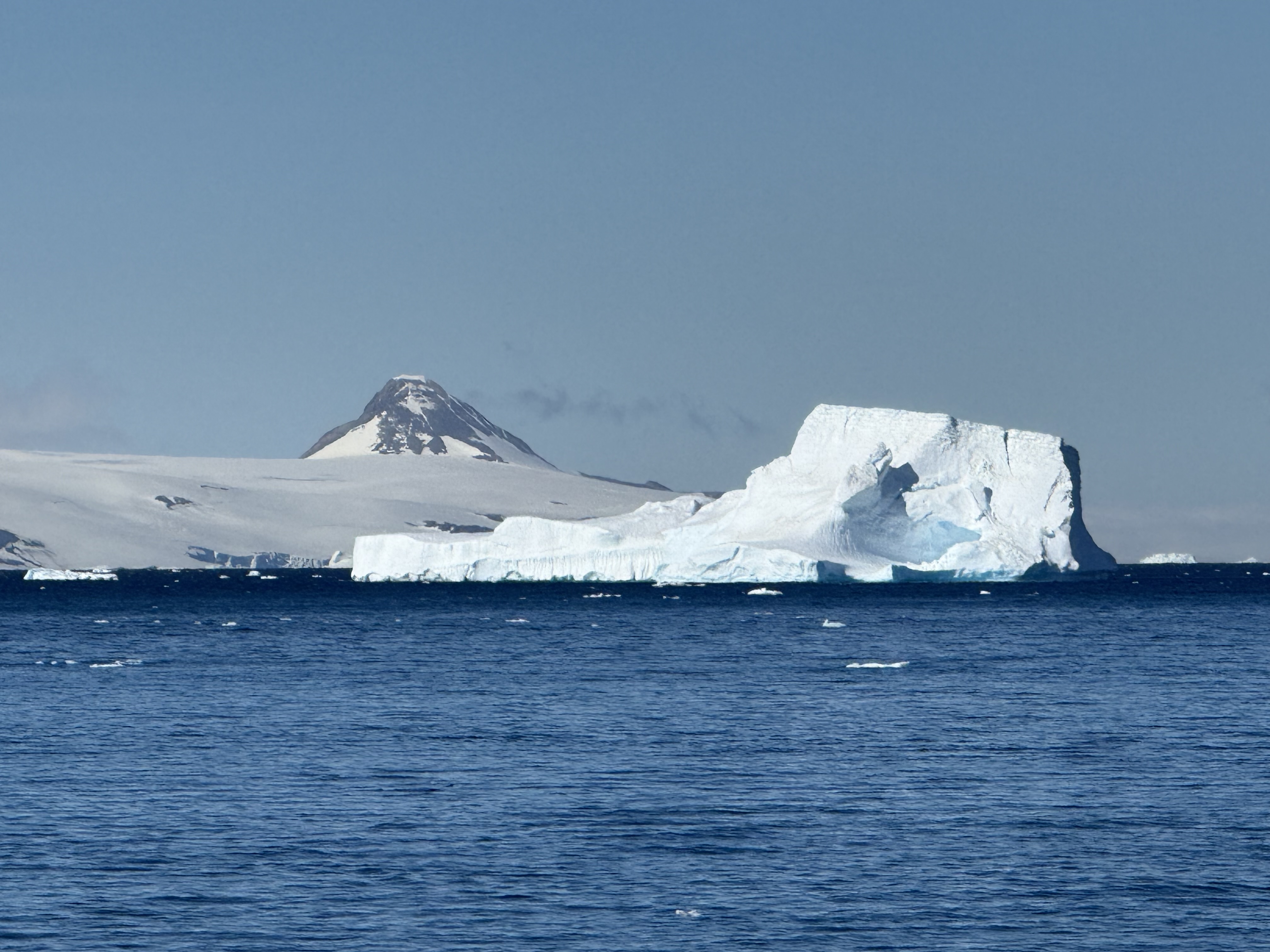
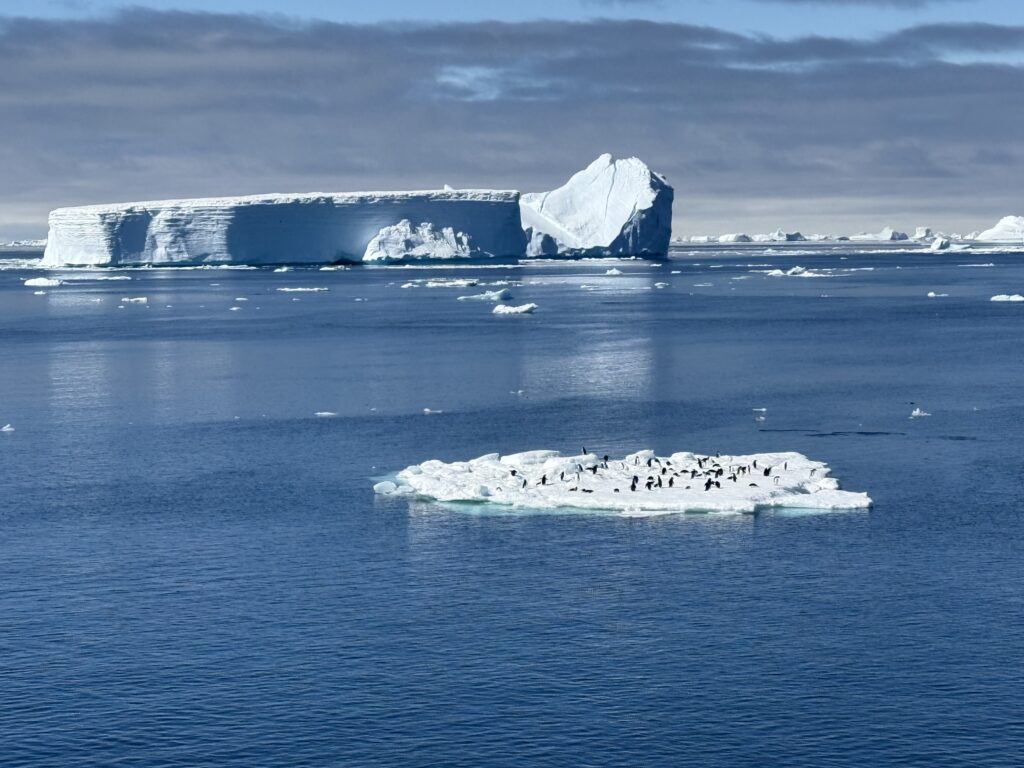
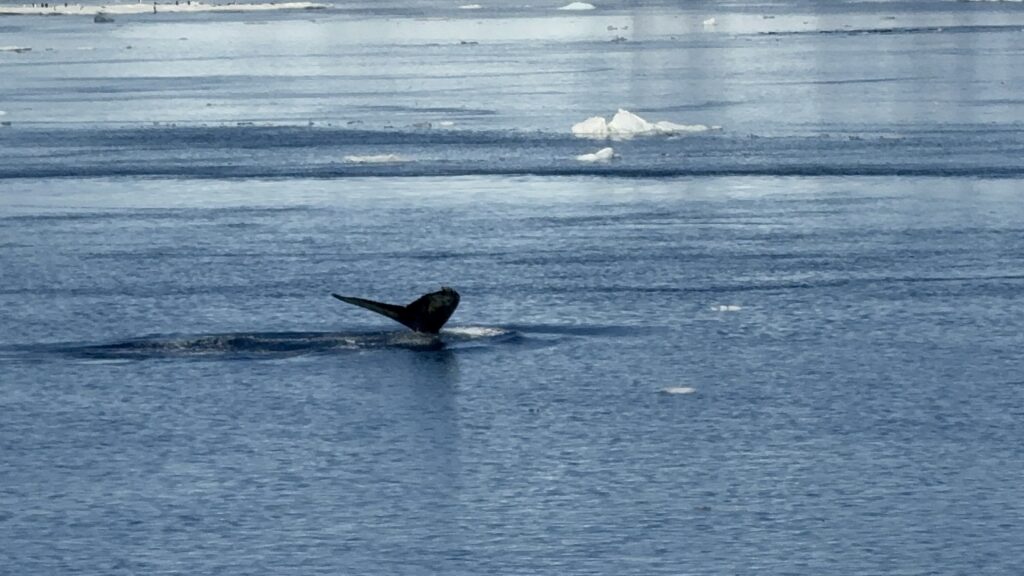
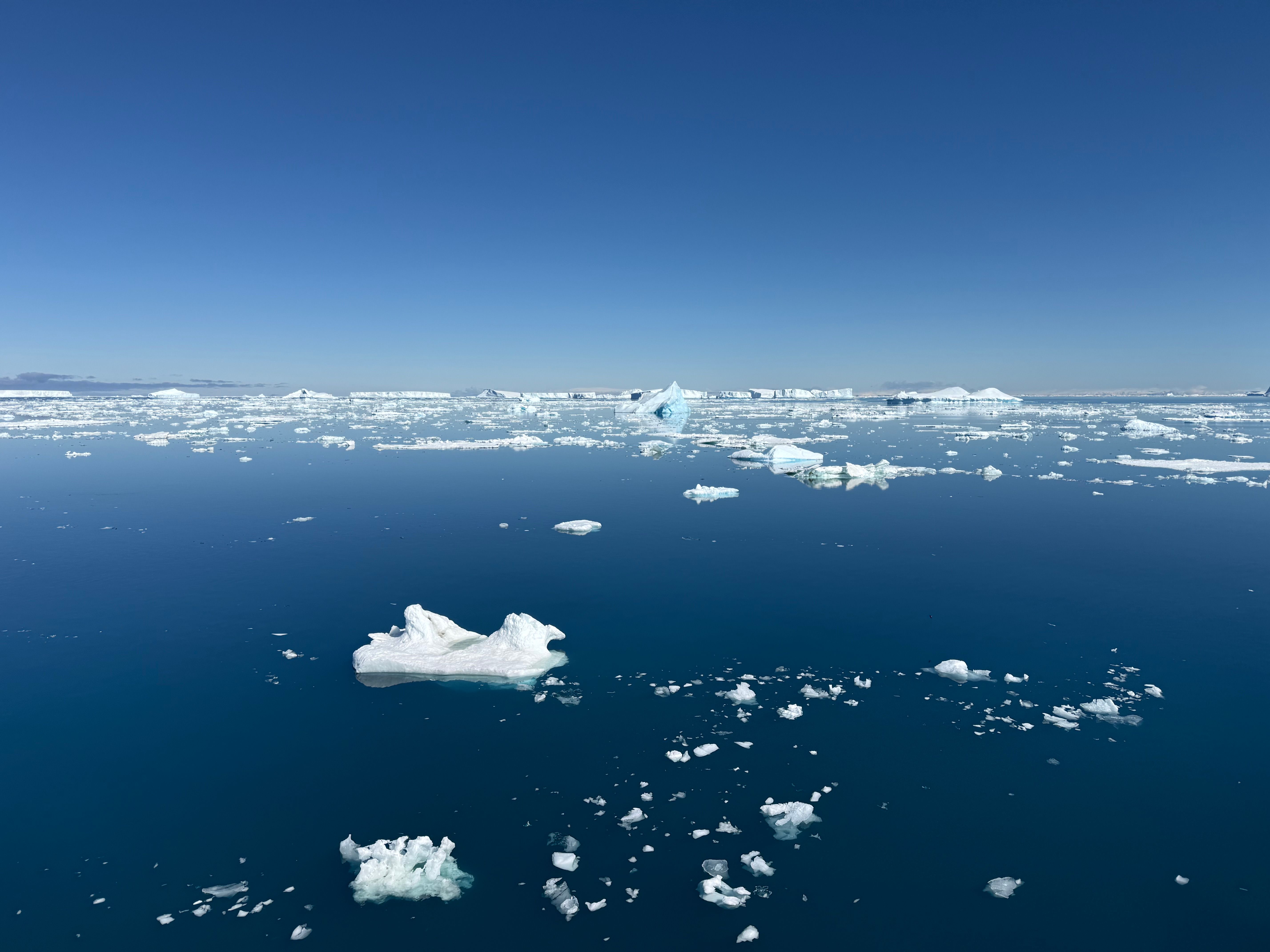
In the afternoon, we sailed through some very light ice pack, and past tons of beautiful icebergs, bergy bits, and growlers. The water was incredibly clear and you could clearly see that 90% of all icebergs are under the water. That’s difficult to imagine on the giant icebergs. We also stopped for a large pod of Humpback Whales. They shut off the engines so we could hear their blows in the quiet sunshine. It was lovely being surrounded by these magnificent beauties, albeit difficult to get a good photo of a whale tail.
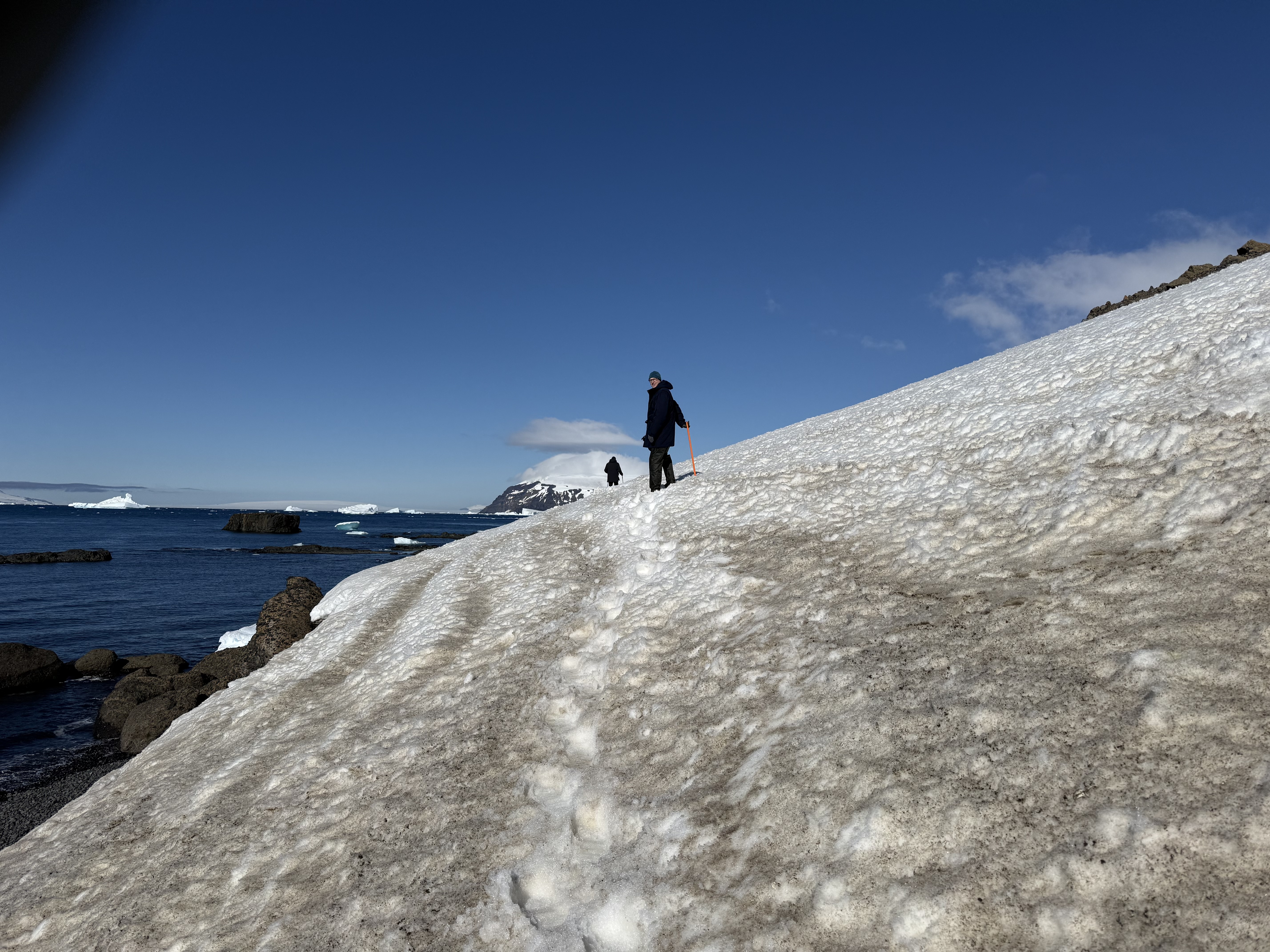
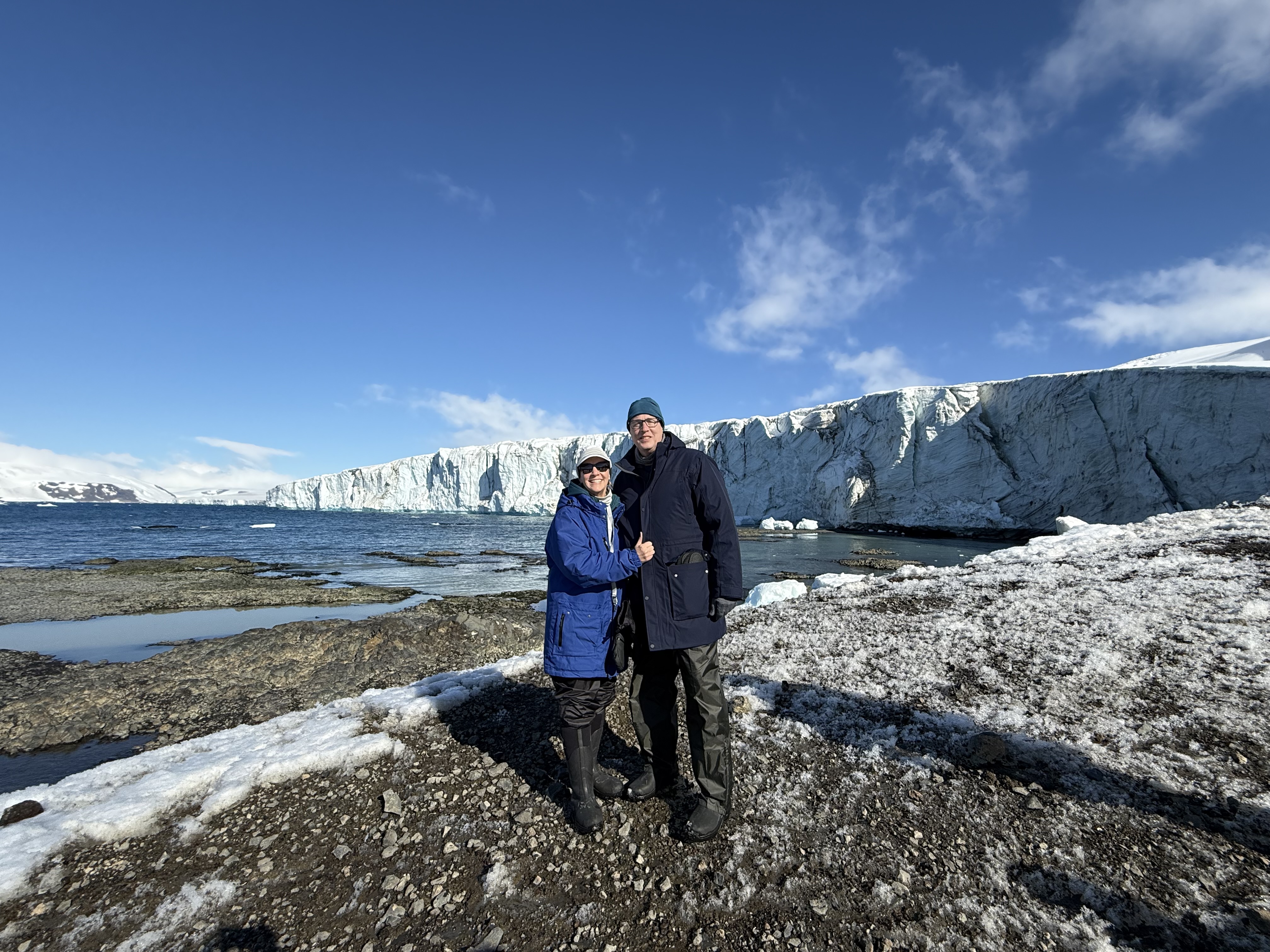
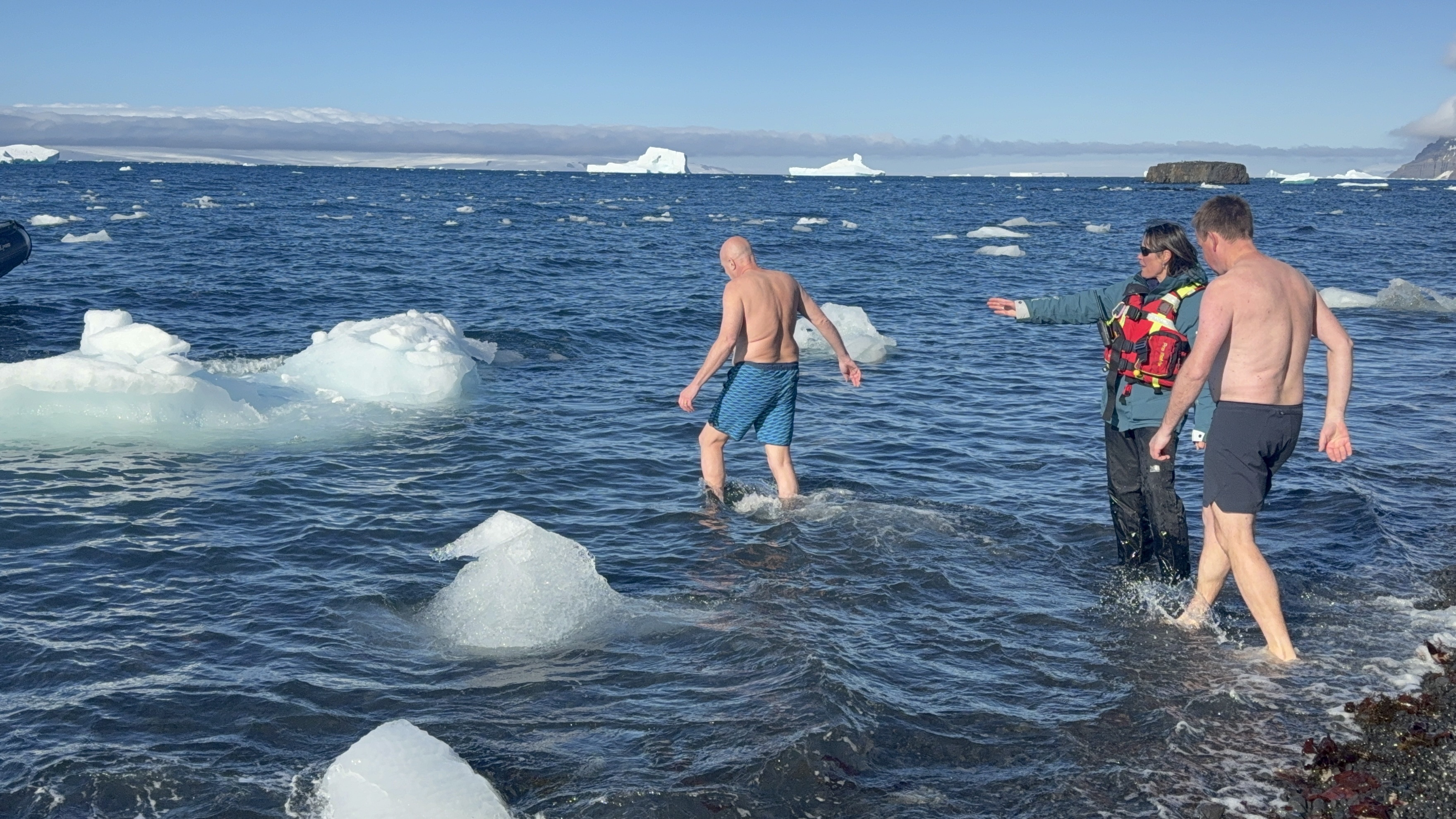
We then made our second continental landing at Brown Bluff, where we took a hike to a very large glacier, and saw Gentoo and Adélie Penguins. This is another landing where we would recommend hiking poles. The hike was along a snow covered hill, and some of the footing was tricky. Steve also did the polar plunge here. Oceanwide Expeditions offers the polar plunge from the shore, and not by jumping off the ship. We were aware of this before we went, but were just a bit disappointed in it, as we felt we missed the quintessential experience of the plunge into the cold Antarctic water. Instead, passengers were advised to wear swim attire under their clothing, and to strip down and walk into the water from the beach. Steve said the water was super cold (about 36 deg F), but when he got out, it didn’t feel nearly as cold as he expected. It was fun and he was glad that he got the chance to do it. I was the designated photographer. Steve wore swim trunks, but based on others who participated, jumping in naked or with only a bra and underwear was the preferred method. Who knew??? I’ll spare you any images, because I did not take any photos of naked people. :) You can read more about Paulet Island and Brown Bluff in today’s blog post.
Half Moon Island/Enter the Drake Passage Tuesday 2/3 Day 16
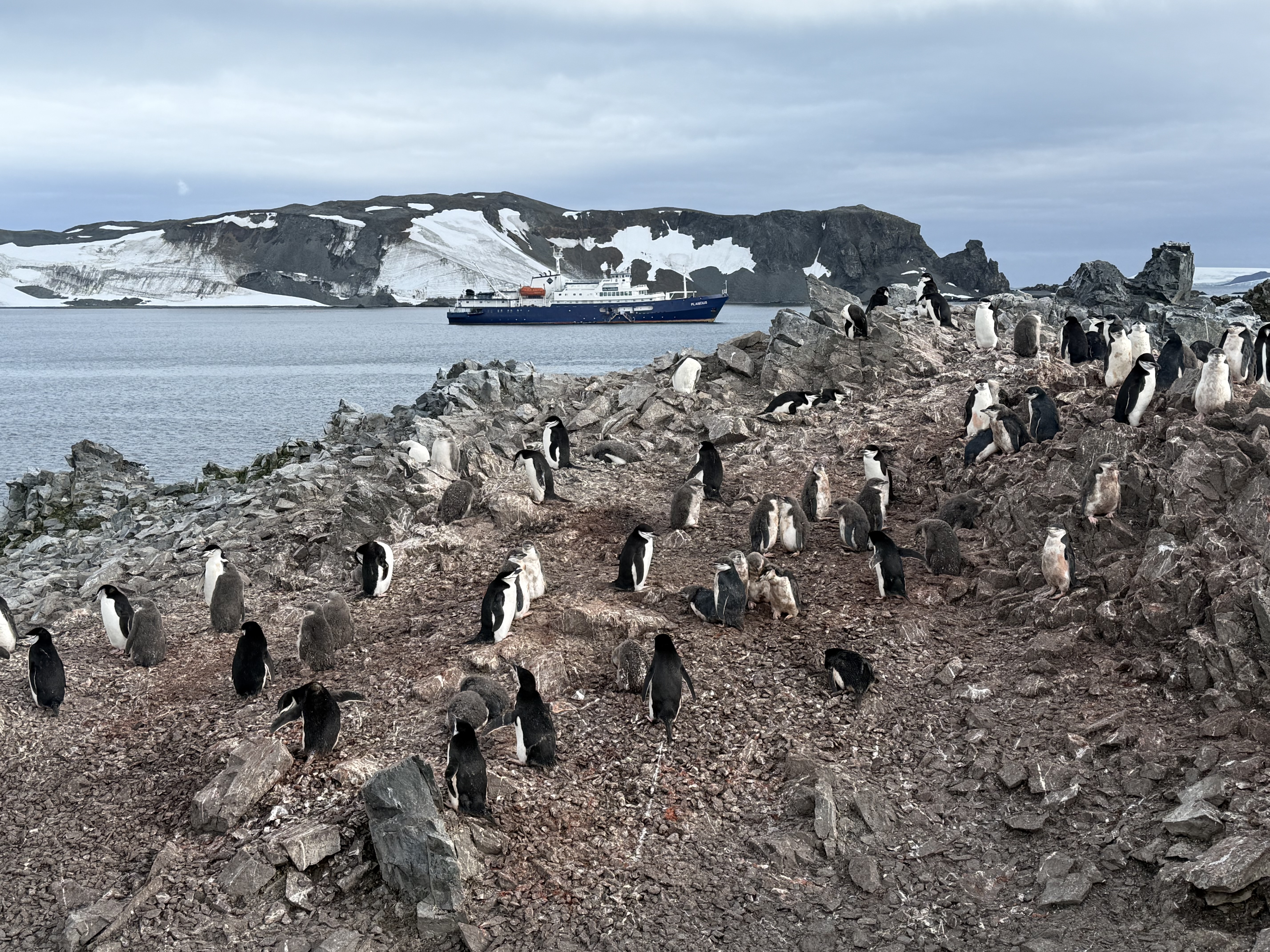
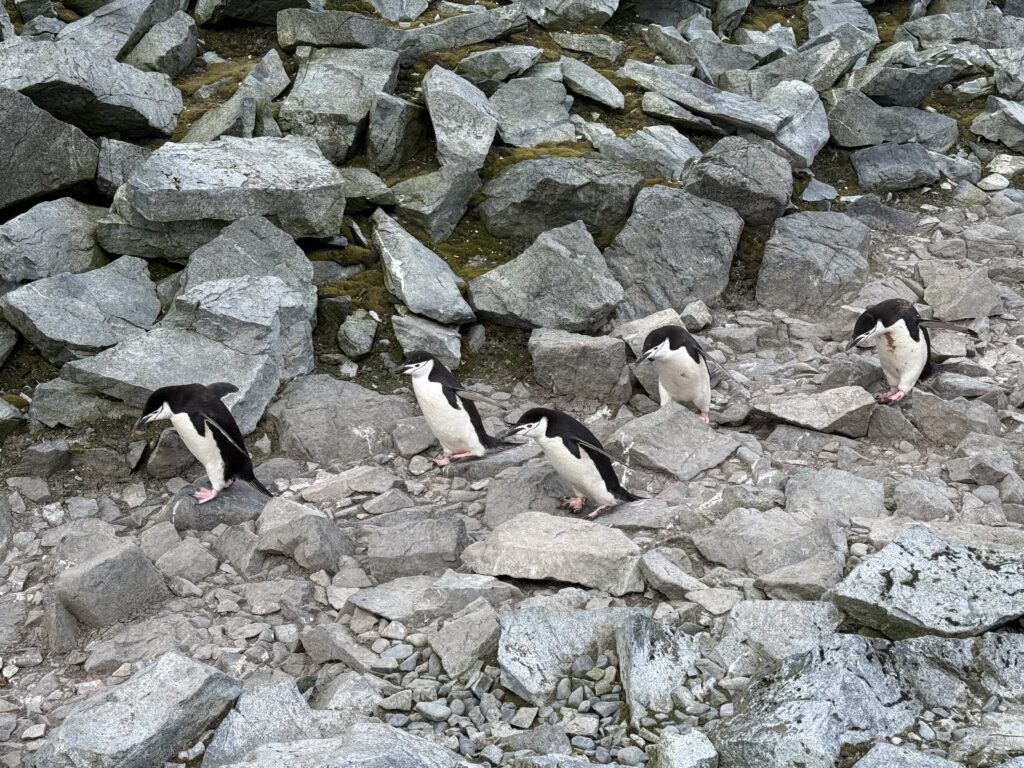
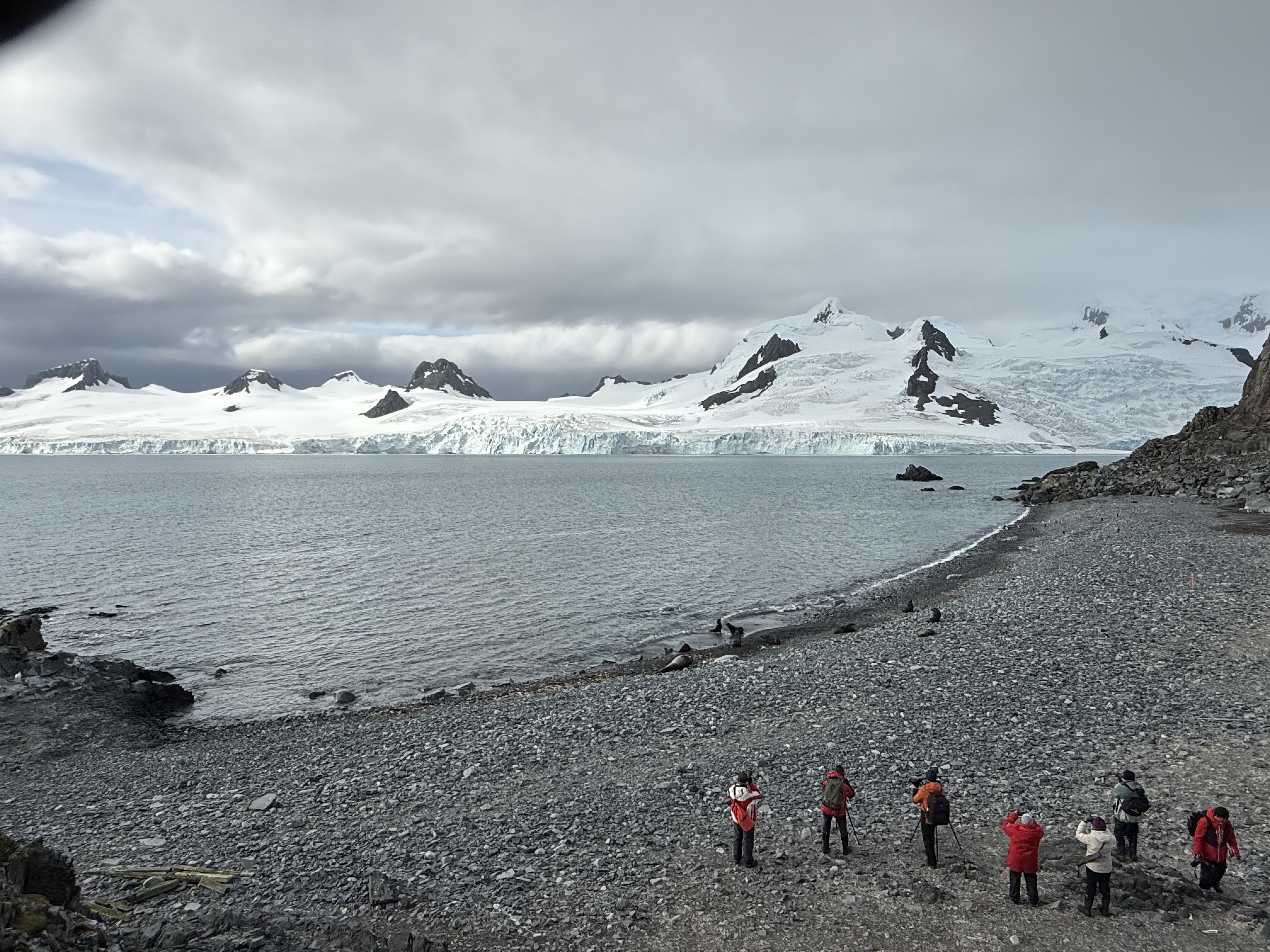
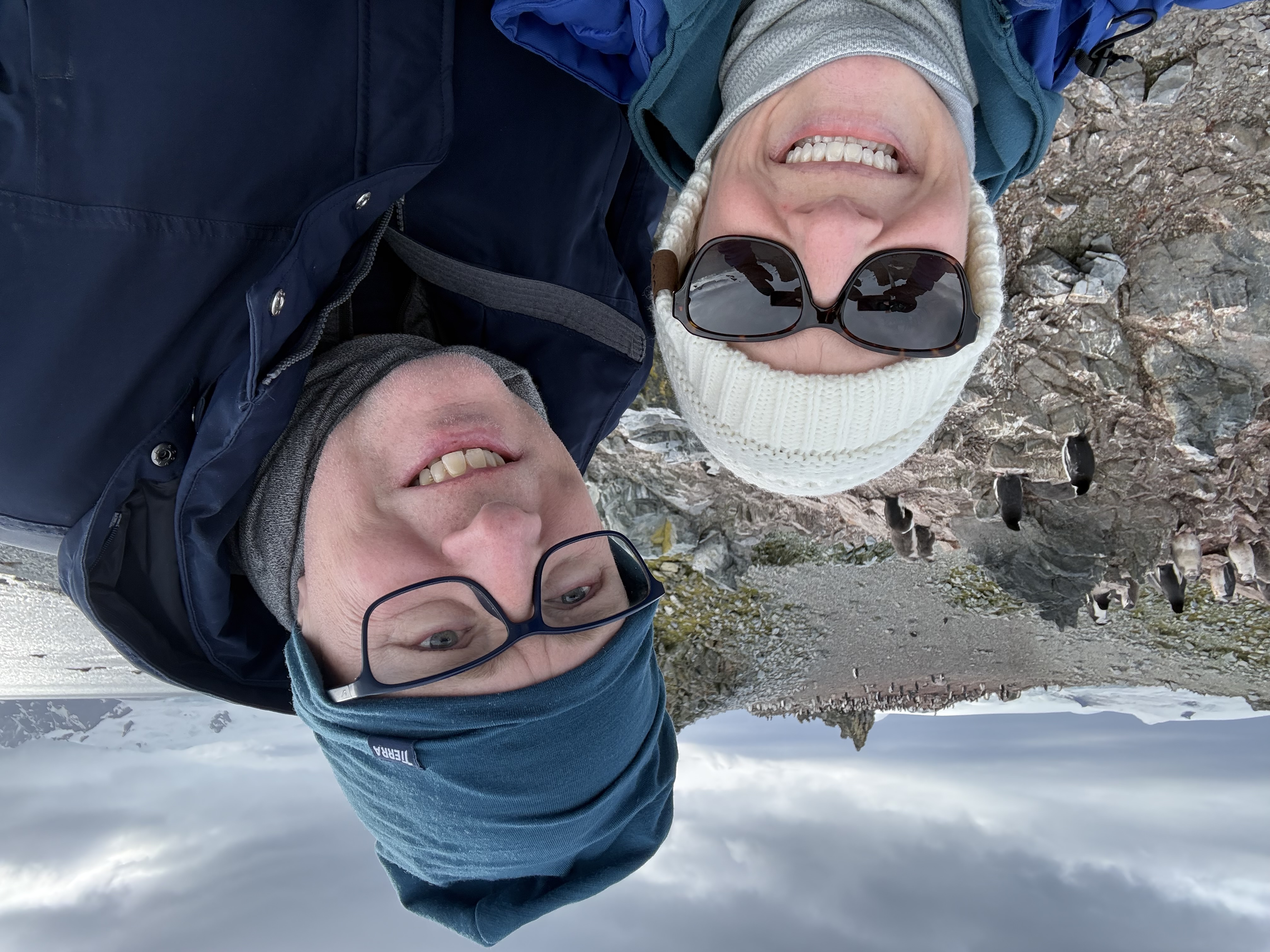
Today we landed at Half Moon Island, part of the South Shetland Islands, just off the tip of the Antarctic peninsula. There is another small Argentine Military Base here called Camara, and we were lucky enough to meet some of the people. Of course, our guide Marcelo knew them. We also took a hike up to the Chinstrap Penguin colony. This is another hike where we would recommend hiking poles if you like to use them. The hike is uphill on rocky terrain with uneven footing. There is also a long stretch of beach located here, where there are many whale bones and several seals, both Weddle and Fur.
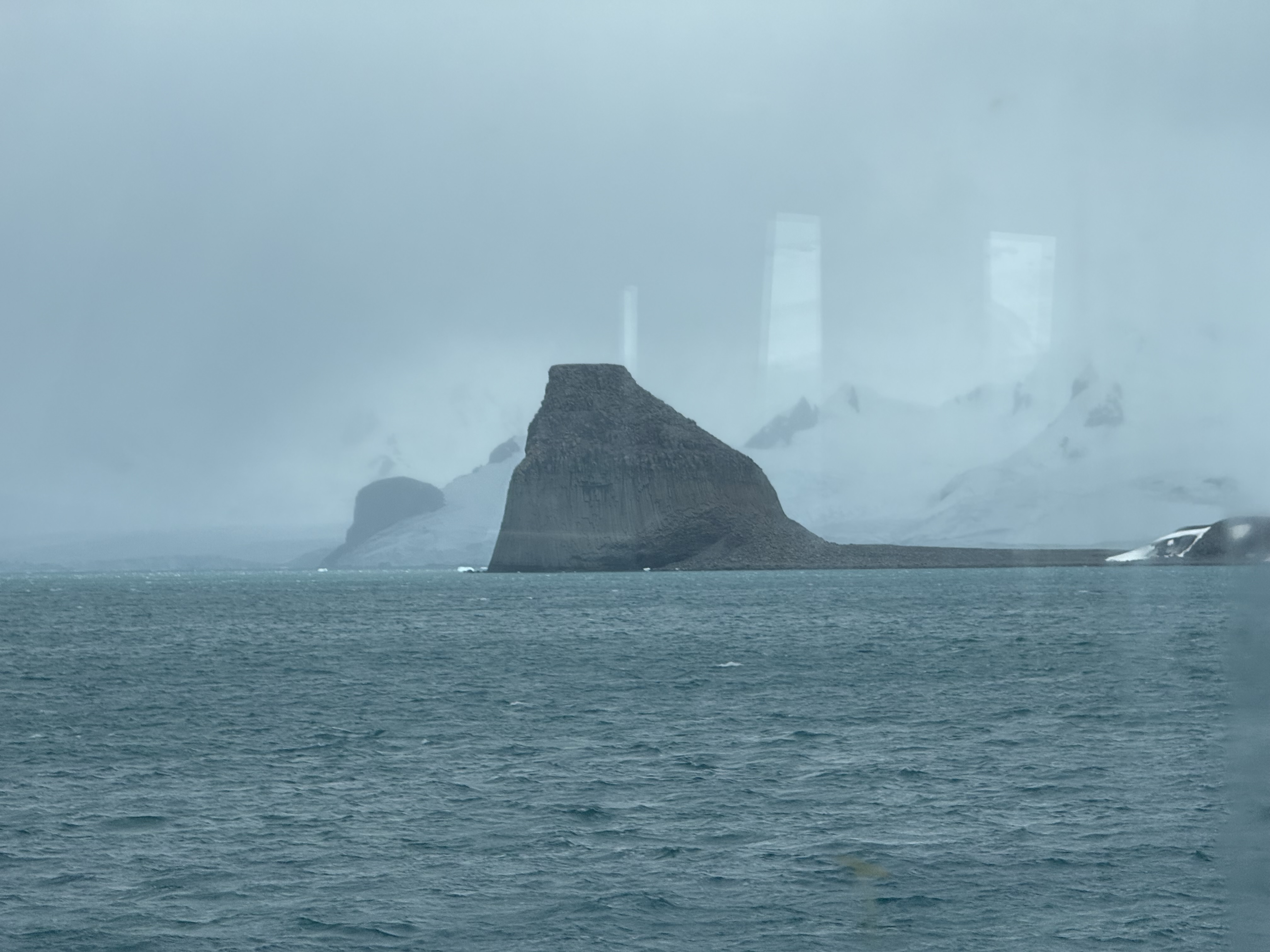
After lunch, we had a planned landing at Yankee Harbor, which is on Greenwich Island in the South Shetlands, but the winds had picked up and the swells were too big to safely land us. The ship’s Captain remarked that he didn’t like seeing the bottom of Ali’s Zodiac as she was assessing the water. Yikes! So we had a free afternoon and enjoyed the scenery as we sailed past Edinburgh Hill, an extinct volcano, and Livingston Island, the first land ever discovered below 60 deg south latitude.
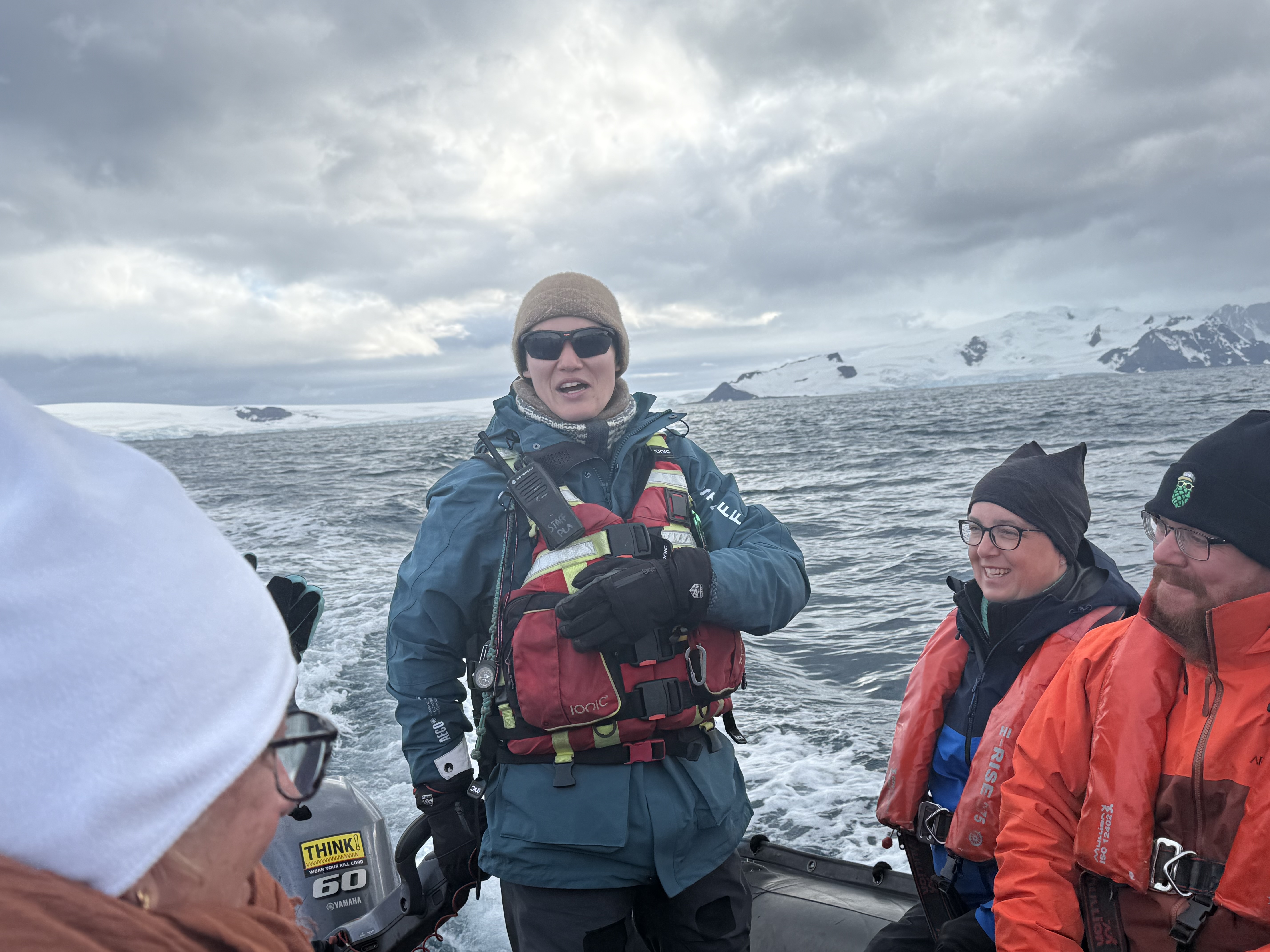
Leaving the South Shetland Islands marks the beginning of the Drake Passage. If you are considering booking this trip, I’m sure you’ve already read about the Drake Passage, so I won’t go into detail about it here. All voyages that go to Antarctica from Ushuaia will cross the Drake at least once, and some cross it in both directions, so it’s basically a rite of passage for folks who sail to Antarctica. It takes roughly 48 hours to cross the 500 mile Drake Passage. It is referred to as the Drake Lake when the passage is smooth, and the Drake Shake when the passage is rough. We began our crossing of the Drake under relatively “normal” conditions, with winds about 29 mph, lots of swells, and some rocking and rolling. None of this was any worse than what we had already experienced on the way to the Falkland Islands and South Georgia, and on our way south to Antarctic peninsula. As you already know, come prepared with your motion sickness medications and strategies, because the weather is unpredictable and the winds can change quickly. You can read more about today’s activities in the blog post.
Drake Passage/Return Home 2/4-2/6 Wed-Fri Days 17-19
We continued to have relatively normal Drake experience with winds gust around 45 mph and lots of movement. It was not nearly as bad as some people have experienced, but we think it qualified as a Drake Shake, as it definitely was not a Drake Lake. The staff kept us entertained again with a few lectures on giant Isopods (think big roly poly bugs), whale reproduction, and women in Antarctic history. We have been very pleased with the lectures and educational presentations on this trip. There has been a wide variety with topics for everyone. We especially enjoyed our guide Karoline’s presentation on living in a remote cabin in Svalbard, Norway.
In the afternoon, we had our Plancius Pub Quiz. We had four rounds of ten questions each, related to things we had learned about The Falklands, South Georgia, Antarctica, and the staff and ship. You definitely need to pay attention to the lectures if you want to win a bottle of wine. Our team came in 5th out of about 15 teams, which we thought was a respectable finish. And listen, we are all adults. Do we really need to pull out our phones and google the answers to a simple, fun trivia game? No, we absolutely do not need to cheat, yet we witnessed this happening. Grow up folks. Grrr, stepping off soapbox now.
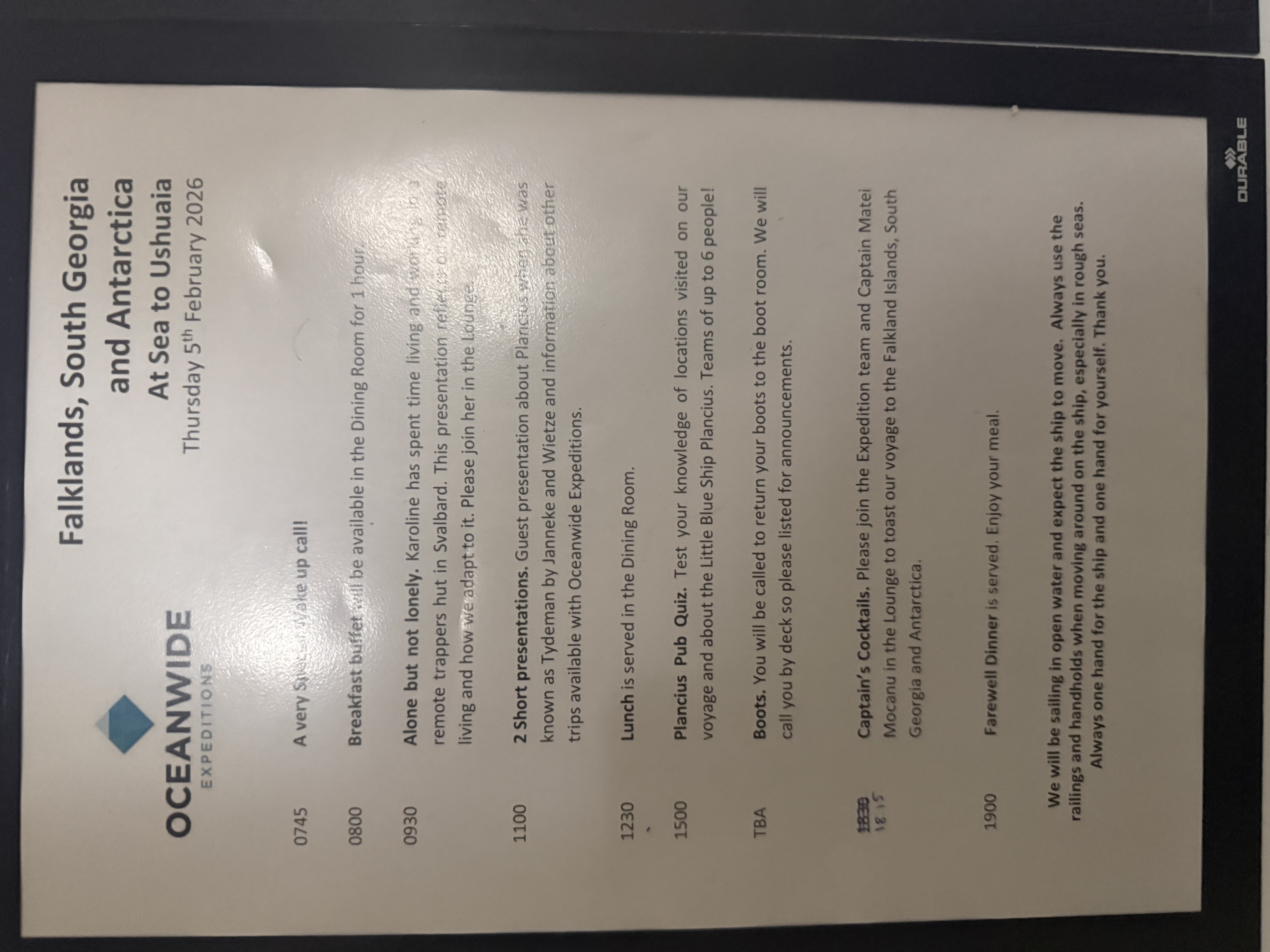
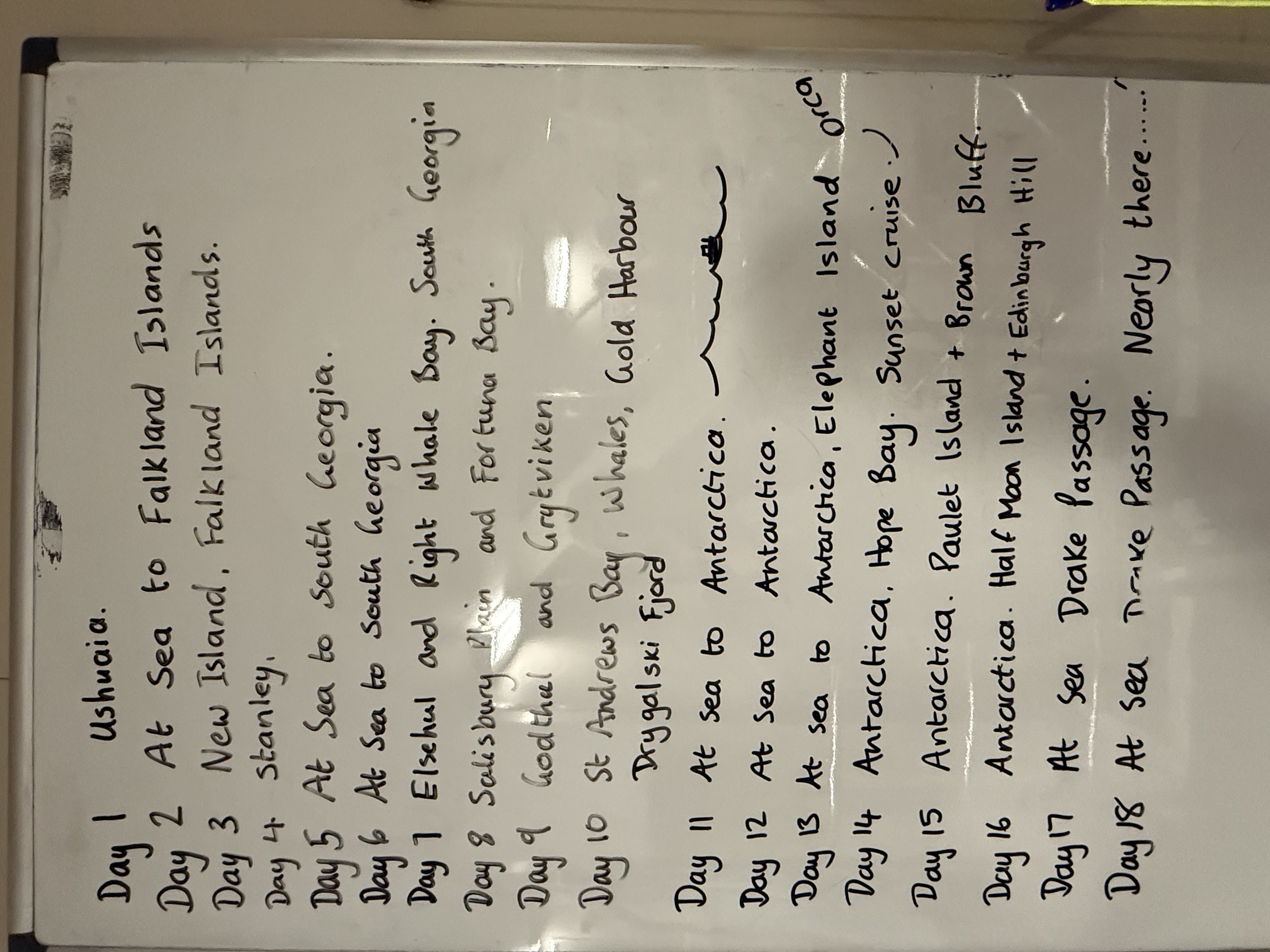
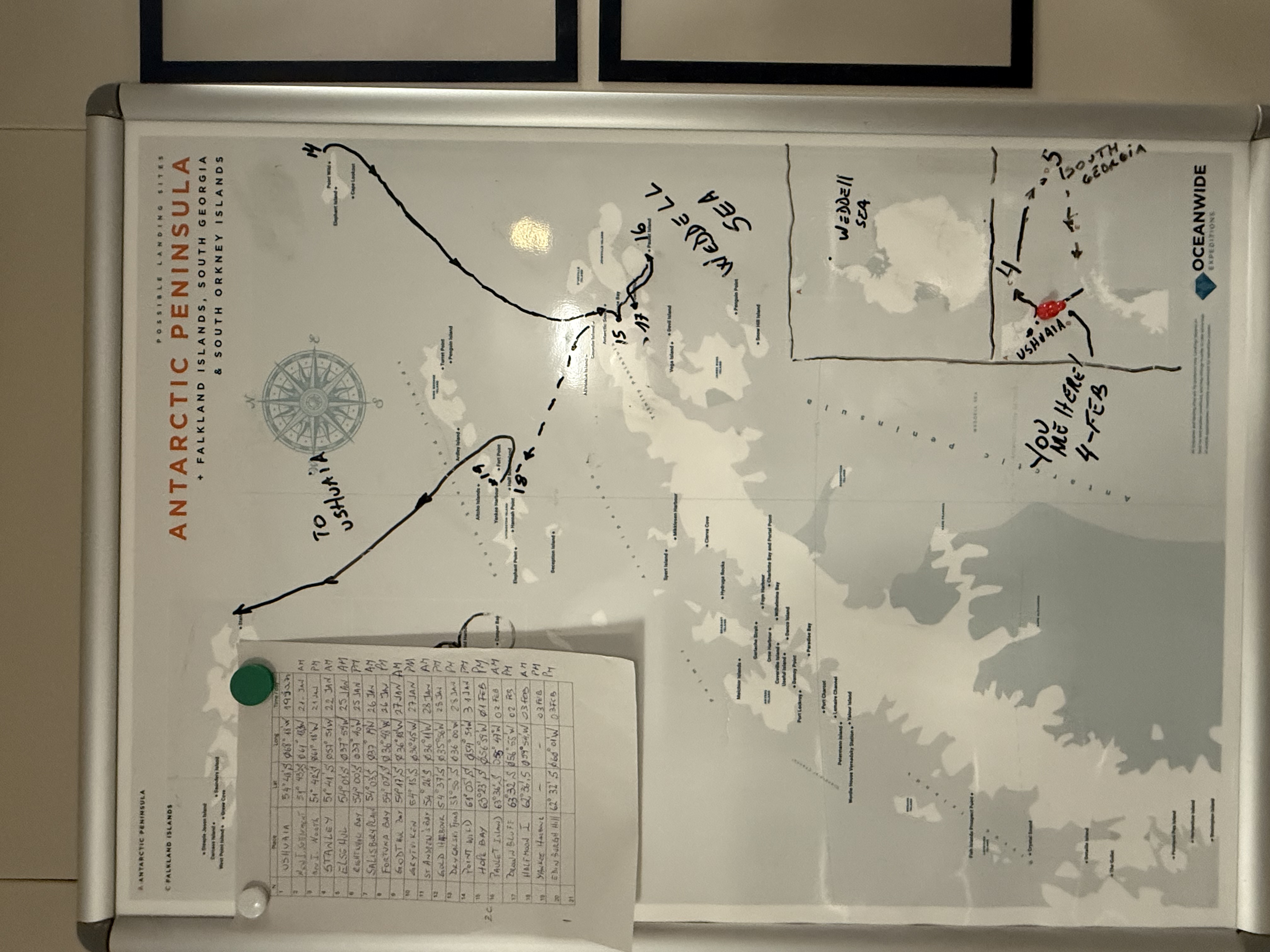
We had the Captain’s toast and a final gathering of the expedition team before dinner. Our last dinner was fun and we got to finally meet all the behind the scenes folks who had been taking care of us for the duration of the cruise. They are a hard working bunch, and definitely deserve the tips you give at the end of the voyage. Yes, tipping can be controversial, but the staff deserve them, regardless of any possible feelings that the company should pay them more, or that the company should include them in the price of the voyage. We came prepared with our tips in USD in a thank you card, and put them in the drop box at the reception desk on the last evening. Oceanwide recommends 10-15 USD or Euro per guest per day.
After dinner, we got packed up to come home. We hand washed our travel day outfits so they would be clean for the trip home, and not have any possible penguin smell lingering on them. Handwashing is our routine when we travel, as we pack in a carry on and do not check our bags on the way to our destination. We returned to Ushuaia about 1 am on the morning of Friday Feb 6th. After breakfast, we disembarked the ship and took the Oceanwide provided bus to Ushuaia Airport. Our Aerolineas Argentinas flight was delayed for about two hours, and we expected this based on what we had read. We left ourselves a five hour window in Buenos Aires when we booked our flight to Atlanta for this purpose. You can read today’s blog post for more information.
Summary
A trip to Antarctica is often considered a bucket list trip or a once in a lifetime trip, due to the remote location and the expense of an expedition trip. We were so very happy to have booked this trip with Oceanwide through Polar Tracks Expeditions. We felt we were very informed, we knew what to expect, and we were well prepared. We feel like we made the best choice for us by choosing a small ship over a larger ship, but this is a highly personal decision. We were extremely happy with the expedition staff and ship crew. They worked night and day to give us a good experience. Overall, it was an amazing trip that we would highly recommend. We would love to go back and do the itinerary that takes passengers to the Weddle Sea and across the Antarctic Circle to see Emperor Penguins and Leopard Seals, and do some kayaking and maybe an overnight camping experience. I don’t think you can get too much of the fabulous scenery that is Antarctica.
If you are interested in any more detailed information about this trip, you can read our packing list article, in addition to checking out our daily blog posts. Please feel free to contact us if you have specific questions and we will do our best to answer them. We are by no means experts, but are happy to offer any of our honest personal experiences to help you plan a trip.
Like what you read? Hate it? Please leave us a comment below, but don’t be bitchy. Happy Travels!